
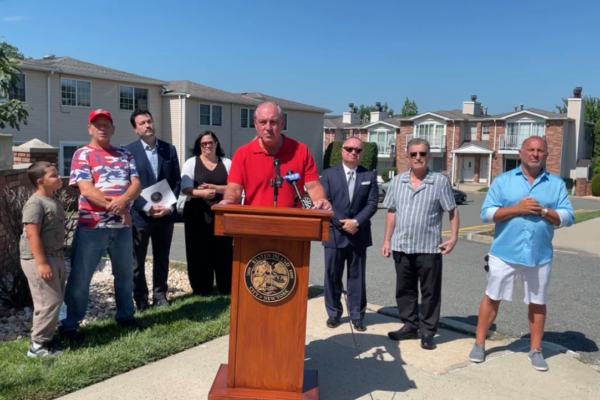
New York, August 22, 2026 – On Friday, August 21, Vito Fossella, the Borough President of Staten Island, along with representatives from the community board and local civic groups, held a press conference to oppose the proposed plan by the New York City government to add approximately 17,675 housing units in Staten Island. They requested the city government to first improve the local infrastructure such as transportation, healthcare, schools, parking, and sewage systems.
According to the city’s housing plan, within the next five years, 17,675 new housing units will be constructed in Staten Island, increasing the housing stock by about 9.5%, with approximately 4,420 units meeting the affordability criteria.
“Fostering a surge of 18,000 new housing units in the next five years is entirely unacceptable and shows great disrespect to the residents of Staten Island,” Fossella said, expressing his disappointment that the city government did not communicate with the residents, who only found out about the plan through newspapers.
Fossella pointed out that the population of Staten Island has grown from around 50,000 in the 19th century to approximately 500,000 today, yet the public transportation capacity has not grown in tandem. The island still lacks a subway system, forcing people to rely solely on driving. He raised concerns about the recent St. George residential project which added 117 housing units but only had four ground-level parking spots. With a shortage of parking facilities and essential amenities like hospitals, adding tens of thousands of residents would place even greater stress on the existing community.
Therefore, Fossella urged the city government to “hit the pause button” and engage in dialogue with the residents of Staten Island first.
Representatives from the first and second community boards, as well as the North Shore, South Shore, and Mid-Island, and a representative of State Senator Andrew Lanza, all voiced their support for the Borough President’s stance at the press conference. One community board manager, Joan Cusack, emphasized that Staten Island attracts young residents because it is like a “suburb within the city” with good schools. She urged residents to continue writing letters to the city government to make their voices heard and not treat Staten Island as a dumping ground.
Fossella concluded by stating that Staten Island is not against development or housing, but rather seeks answers from the city government to a fundamental question: are the necessary infrastructure improvements in place before increasing the population? He emphasized the importance of government collaboration with residents to address deficiencies in transportation, healthcare, schools, and then discuss the addition of new housing units.