
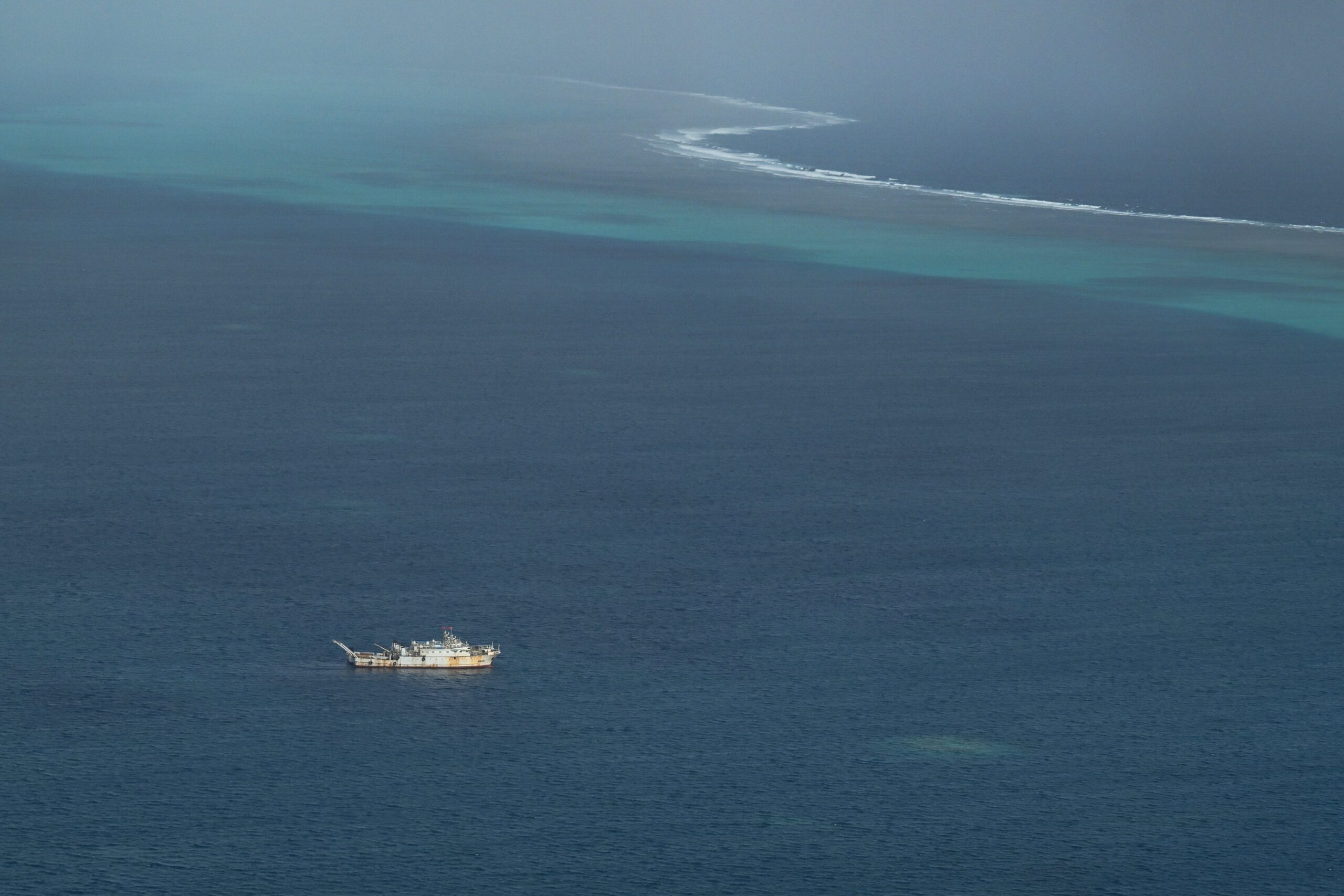
In satellite images from August, the Chinese Communist Party (CCP) has completed the first phase of land reclamation at Antelope Reef in the Xisha Islands. Antelope Reef is strategically located between mainland China, Vietnam, and major shipping routes in the South China Sea. Analysts believe that it will become one of the CCP’s largest military bases in the South China Sea.
The Center for Strategic and International Studies (CSIS) in Washington, D.C., released a report titled “Is a new Chinese runway taking flight at Antelope Reef?” on August 14. The report indicates that satellite images from August show excavation work on the artificial island at Antelope Reef, likely for the construction of a new airstrip. The cleared area on the island matches the width of existing runways at other CCP bases in the South China Sea, such as Fiery Cross Reef, Subi Reef, Mischief Reef in the Spratly Islands, and Woody Island in the Xisha Islands, at 180 feet (approximately 55 meters) wide.
The runway project is located on the northwest edge of Antelope Reef, capable of accommodating a runway similar to those found at other CCP bases in the South China Sea. The existing runways at CCP bases are 10,000 feet long (approximately 3.05 kilometers), while the current construction area at Antelope Reef is about 4,300 feet long (approximately 1.31 kilometers).
In the northern part of the island, additional earthworks are underway to likely extend the runway to the planned length of 10,000 feet. Adjacent to the runway, at least one building foundation is being excavated, matching the dimensions of large hangars found at other CCP airports in the South China Sea, with a plan size of approximately 200×200 feet.
Compared to previous satellite images, significant changes have been observed at Antelope Reef. Land reclamation and dredging works have been completed, with no visible dredging vessels in the latest imagery, resulting in an artificial land area of approximately 1,458 acres.
During the dredging phase, a specific area at Antelope Reef has been continuously under construction, possibly serving as the administrative headquarters of the reef. In recent months, new buildings have been constructed, along with green areas and a paved parking lot, transforming Antelope Reef from a remote outpost into an administrative center similar to those built by the CCP on other islands.
CCP state media claims that Antelope Reef will be used for civilian purposes such as weather forecasting and scientific research. However, according to a report by Reuters on August 19, the South China Sea is increasingly becoming a competitive arena for military buildup between China and the United States and its allies. Both sides are vying for advantages that could play a crucial role in any future conflict in the Taiwan Strait. Ben Lewis, founder of the PLATracker open-source data platform, stated, “If a conflict occurs in the Taiwan Strait, the northern South China Sea will be particularly important, making the location of Antelope Reef ideal for the CCP.”
The Asia Maritime Transparency Initiative (AMTI) under CSIS has been monitoring and analyzing CCP’s activities at Antelope Reef. This represents the first large-scale artificial island construction in the South China Sea by the CCP since 2017.
AMTI’s analysis from March indicated that Antelope Reef could become one of the most important strategic bases built by the CCP in the South China Sea.
Located within the Crescent Group in the southwestern part of the Xisha Islands, Antelope Reef is approximately 162 nautical miles from Sanya Port in Hainan Province, China, and about 216 nautical miles from Hai Phong, Vietnam.
If developed into a military base comparable in scale to other major CCP outposts, Antelope Reef would enhance China’s reconnaissance and surveillance capabilities closer to the Vietnamese coast, offer more deployment space for CCP forces in the northern South China Sea, and provide additional backup bases.
The proximity of Antelope Reef to Hainan may facilitate the expansion of CCP’s civilian and administrative activities in the Xisha Islands, such as meteorology, scientific research, navigation services, and related facilities.
While this may not dramatically shift the current strategic landscape in the South China Sea, the CCP is demonstrating its ability to expand its controlled island outposts continuously.
CCP’s largest outpost in the Xisha Islands is Woody Island, with an area of around 890 acres, housing air and naval bases and serving as the administrative center of Sansha City, responsible for managing the entire South China Sea. Sansha City is a prefecture-level city established by the CCP in 2012, administratively under Hainan Province, overseeing the Xisha, Zhongsha, and Nansha island groups.
The most extensive CCP outpost in the South China Sea is found at Mischief Reef, with a total land area of approximately 1,504 acres. The current land area of Antelope Reef is approaching that of Mischief Reef, ample space to accommodate various large infrastructure projects similar to those on Woody Island and the “Three Big Bases” in the Spratly Islands – Mischief Reef, Subi Reef, and Fiery Cross Reef. These facilities include diesel power plants, underground storage facilities, coastal defense positions, surface-to-air missile facilities, anti-ship missile systems, and extensive surveillance and electronic warfare equipment.
Another notable feature is the lagoon at Antelope Reef, which exceeds the existing port size within the Crescent Group. Originally a coral reef encircling the reef, the lower middle section forms a relatively calm water area known as a lagoon. Preservation of the lagoon during land reclamation projects, along with the excavation of a channel to the open sea, could result in a significantly large natural inner harbor at the center of the artificial island, partially shielded by the reef.
From a military perspective, a large inner harbor can accommodate coast guard vessels, allowing maritime militia ships to stay long-term, providing support such as supply, maintenance, and personnel and material transportation. This positioning enables the CCP to maintain a long-term presence and maritime control in the southern Xisha Islands.