
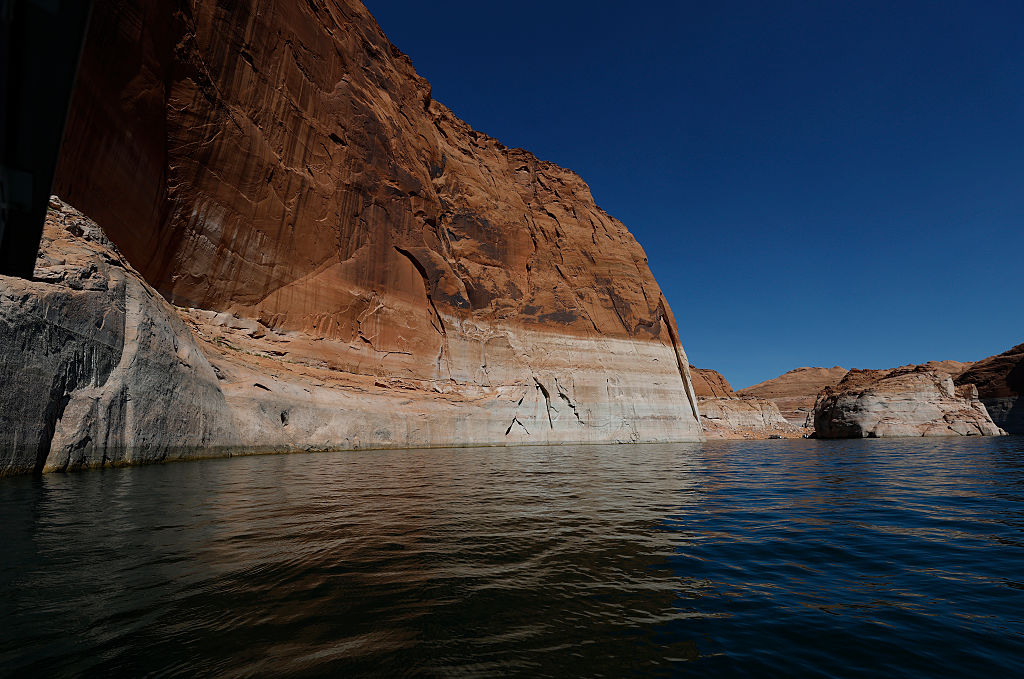
Lake Powell, the second largest reservoir in the United States, has reached its lowest water level on record, posing a severe water crisis in some southwestern regions of the country.
According to the Bureau of Reclamation’s automatic measurement system, on Saturday, August 15, the water level at Lake Powell dropped to 3519.91 feet (about 1072.87 meters) above sea level, breaking the previous record set in April 2023 at 3519.92 feet. If the water level falls below 3490 feet, it could jeopardize the reservoir’s power generation capacity.
Less than two weeks ago, the largest reservoir in the US, Lake Mead, faced a similar situation. Data released by the Bureau of Reclamation showed that Lake Mead’s water level had dropped to a historic low of 1040.46 feet (about 317.13 meters) above sea level on August 7, lower than the previous record set in July 2022 by 0.13 feet (about 0.04 meters), marking the lowest level since the lake was first filled in 1937.
Lake Powell and Lake Mead store the majority of the water from the Colorado River, which is used to support agriculture, irrigation, drinking water, hydropower generation, water recreation, as well as habitat for fish and wildlife in seven states in the southwest United States, western Native American tribes, and two northern Mexican states.
The purpose of establishing these two reservoir systems was to store water in wet years and release water in dry years. However, long-term trends indicate a reduction in winter snowfall in the Rockies of Colorado in recent years, while rapid development in the western region has further increased the demand for water from these reservoirs.
Lake Powell, located at the Utah-Arizona border, currently holds just over 20% of its capacity, with the last time it was full being in 1983. If the water level continues to decline, the Colorado River may no longer flow through the Grand Canyon, leading to an ecological disaster known as “dead pool.” This crisis could trigger chain reactions nationwide. According to data from the California Department of Food and Agriculture, nearly half of the vegetables and over three-quarters of fruits and nuts produced in the US come from California, with much of the state’s crops irrigated with water from the Colorado River.
The fluctuation in Lake Powell’s water level is unlikely to affect drinking water supply at the moment. Jack Schmidt, director of the Center for Colorado River Studies at Utah State University, stated in an interview with ABC News, “Of all the water in the Colorado River Basin, 55% is used for livestock feed production, including alfalfa and grass cultivation. When you account for all agricultural activities in the basin, approximately 70% of the total water usage in the Colorado River is used for some form of agricultural activity.”
While water conservation efforts have mainly impacted agriculture rather than urban residents so far, some cities in the southwestern US are taking proactive measures to save water, including water recycling, limiting residential lawn watering, and desalinating seawater.
Climate scientists predict that the flow of the Colorado River will continue to decline in the coming decades, making it challenging for Lake Mead and Lake Powell to increase their water storage. The strong El Niño phenomenon observed in the Pacific region this summer may lead to increased rainfall in the fall, but it may not reverse the long-term trend of declining water levels.
(The article was referenced from ABC News.)