
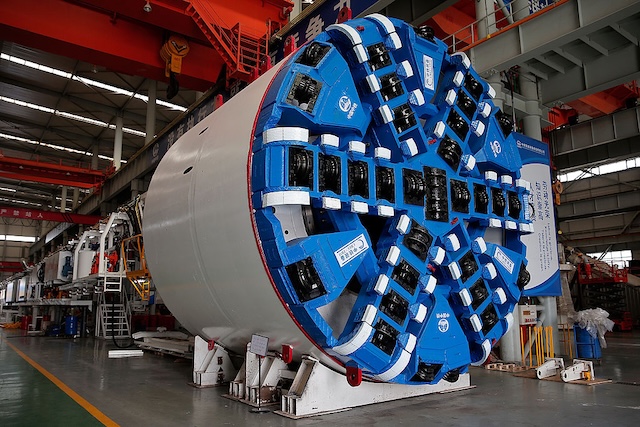
On Monday, October 19th, the Chinese Ministry of Commerce and the General Administration of Customs announced that they will implement export controls on heavy construction equipment such as shield tunneling machines (full cross-section tunnel boring machines) and crawler excavators, and adjust the export restrictions on drones and dredgers. The new measures will take effect on November 18th. Analysts believe that German, Dutch, and other European equipment manufacturers may gain new market opportunities as a result.
The Ministry of Commerce of China’s announcement stated that newly controlled items include full cross-section tunnel boring machines, as well as key components such as disc cutters, spiral conveyors, segmental lining trolleys, and main drive systems specifically designed for related equipment. In addition, crawler excavators meeting specific technical specifications and high-altitude wet spraying machines are also within the scope of control.
The announcement specifically stipulates that export of relevant equipment to “sensitive countries and regions in dispute with China” requires an export license application. However, the announcement did not disclose the specific list of these countries and regions, nor did it clearly explain their identification criteria.
China tightening export controls on some engineering equipment may also change the international market competition landscape.
According to Bloomberg, Germany’s Herrenknecht is a significant shield tunneling machine manufacturer and a major competitor to Chinese manufacturers. Shield tunneling machines can be used to construct underground tunnels needed for robust military infrastructure. Royal IHC of the Netherlands focuses on dredgers and dredging equipment, also competing with Chinese enterprises. Dredgers can be used to build naval facilities.
The report states that China accounts for about 70% of the global shield tunneling machine market. The expansion of export controls by the Chinese government may lead overseas customers to be concerned about the uncertainty of Chinese equipment exports, thereby turning to European suppliers to seek alternative equipment to diversify supply chain risks.
Royal IHC of the Netherlands has already partnered with an Indian enterprise.
In an announcement last October, the company stated that it will build a Beagle 8 trailing suction hopper dredger for India’s Vishwa Samudra Group, with the vessel to be constructed at the Kinderdijk shipyard in the Netherlands and expected to be delivered in the summer of 2027. Additionally, according to the company’s official website, Royal IHC has regional offices, production facilities, and service centers in India.
An article in the Indian newspaper “The Economic Times” on Monday pointed out that China’s shield tunneling machine export restrictions could affect several infrastructure projects in India, including metro systems, high-speed railways, and tunnel projects in border areas.
The report revealed that as early as 2024, India’s Minister of Commerce and Industry, Piyush Goyal, had informed the then German Deputy Prime Minister, Robert Habeck, that Beijing prohibited German company Herrenknecht, which produces shield tunneling machines in China, from exporting products to India.
Data from Reuters shows that India’s imports of tunneling and excavation equipment from China decreased from around $18 million in the 2022-2023 fiscal year to $3 million in the 2023-2024 fiscal year, dropping further to $500,000 in the 2024-2025 fiscal year, and slightly rising to $800,000 in the 2025-2026 fiscal year.
Shield tunneling machines are crucial equipment for large-scale underground projects, and India is actively seeking to reduce its reliance on Chinese shield tunneling machines and high-end engineering equipment. The tightening of export controls by China may accelerate this process.
A report released by the Confederation of Indian Industry and Boston Consulting Group in July 2026 indicated that the domestic demand for mining and construction equipment in India exceeded $17 billion in 2025, with an annual growth rate of approximately 10% to 12%.
The report projected that with continued investments in areas such as highways, railways, ports, airports, and mining, industry capital expenditure related to these sectors could increase to 9 to 10 trillion rupees by 2030. The report suggested that India strengthen its domestic production of components, research and development, and export capabilities.
According to a report by Reuters on August 21st, India is pushing forward a roughly $1.2 billion engineering equipment manufacturing incentive plan aimed at attracting about $1.8 billion in new investments over seven years to develop high-tech equipment manufacturing including shield tunneling machines to reduce dependence on imports from China. Indian state-owned company BEML, as well as engineering and manufacturing companies such as Larsen & Toubro, may benefit from this initiative.