
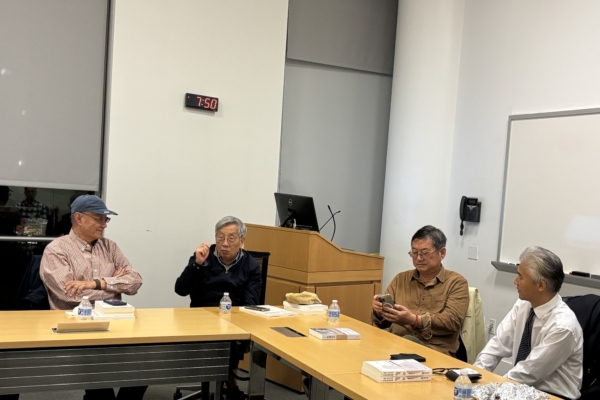
New York Think Tank (NY SAGE) and Bouden House hosted a symposium titled “Defenders in China” at the Fordham University School of Law in Manhattan on the evening of October 16. The event aimed to discuss the plight of human rights lawyers in China under political pressure. Participants praised these legal professionals who tirelessly advocate for citizens’ rights as the “backbone of China.” Commentators including Hu Ping, legal scholar Yu Ping, human rights lawyer Wu Shaoping, and others attended the discussion.
Bouden House President Rong Wei opened the event by citing the South Korean film “The Attorney” and the history of the “Formosa Incident” in Taiwan.
“The Attorney” is based on the early years of former South Korean President Roh Moo-hyun and depicts his defense of students persecuted under authoritarian rule, leading him to engage in democratic movements and eventually win the presidency in 2002.
After the “Formosa Incident” in Taiwan in 1979, lawyers like Chen Shui-bian, Hsieh Chang-ting, and Su Tseng-chang defended non-party democratic individuals, subsequently getting involved in political reforms. Chen Shui-bian was elected president in 2000, marking the first peaceful transfer of power; Hsieh Chang-ting, Su Tseng-chang, and others served as prime minister subsequently.
Rong Wei contrasted this with the situation of human rights lawyers in China: in South Korea and Taiwan, lawyers advocating for human rights have propelled democratic progress and even ascended to national leadership roles. In contrast, in China, human rights lawyers face arrests, convictions, and even disbarment for fulfilling their defense duties.
From Gao Zhisheng’s disappearance since 2017 after enduring torture, to Wang Quanzhang facing continued harassment post-“709 Crackdown,” and Xie Yang being sentenced to five years in March this year, the arduous journey of Chinese human rights lawyers is clear.
Wu Shaoping, a human rights lawyer who handled sensitive cases in China before leaving in 2019, described the unique situation of human rights lawyers in China as a chain of defending the defenders.
He mentioned that when a lawyer is arrested for taking on a case, other lawyers step in to defend them; if those who take over face pressure, new lawyers step up. Those who initially sought legal protection for others become the ones needing defense. Wu Shaoping believed that this relay experience is even more brutal than what “The Attorney” depicted.
Wei Shiping recalled a Chinese lawyer’s experience from a personal perspective, highlighting the challenges faced by human rights lawyers under political pressure.
According to the US Congressional-Executive Commission on China, since the “709 Crackdown” in 2015, over 300 lawyers and human rights activists have been questioned, detained, or secretly imprisoned. The crackdown continues: after lawyer Yu Wensheng, who defended 709 victims, was released in April, he and his family are still under tight surveillance. In the Beijing Zion Church case at the end of 2025, up to 40 lawyers joined the defense team. However, lawyer Zhang Kai had his license revoked in January, and six defense lawyers had their practices suspended in March.
In July this year, the New York City Bar Association warned in a statement on the 11th anniversary of the 709 incident that such repression seriously undermines the independence of lawyers and the rule of law.
Hu Ping, Honorary Editor of “Beijing Spring,” astutely pointed out during the meeting: “In China, there is only power, not law.”
Hu Ping analyzed a unique political phenomenon: in highly sensitive political cases, lawyers are sometimes relatively safe. Since these cases are heavily controlled by political power, authorities rarely let the defendants win, making it challenging for lawyers’ defense to truly challenge the interests of those in power.
On the other hand, seemingly ordinary cases not involving politics can be treacherous. If a case affects local officials or those in power, lawyers with solid evidence have a chance to win the lawsuit but are more susceptible to retaliation from colluding officials and businessmen. Therefore, the risk for lawyers lies not in the sensitivity of the case, but in whether their defense truly impacts power and interests.
Legal scholar Yu Ping further pointed out that under the authoritarian rule of the Chinese Communist Party, political power always overrides the law. Once a case touches the political bottom line, the judicial system is entirely politically controlled, and independent professional judgment cannot be exercised.
Despite the harsh reality, Yu Ping sees hope in the long-term development. He noted that through decades of legal exchanges and education, China has nurtured a group of judges, prosecutors, and lawyers with modern legal literacy and shared professional cognizance. The talents cultivated will not be in vain; if there are changes in the political environment in the future, they will be essential in promoting the reconstruction of the rule of law in China.
The actions of Chinese human rights lawyers, from relay defenses since the 709 incident to the legal resistance in the case of the Zion Church, demonstrate their commitment to upholding positions amidst continuous repression. They use each specific case to expose judicial injustices, defend the rights of the parties involved, and continually accumulate strength for future institutional reforms in China.