
Audience friends, hello everyone! Welcome to watch “Century Truth”.
If a country has experienced a major historical event, and over thirty years later, people still cannot openly discuss it, cannot investigate the truth, and even mentioning the date of the incident has become an official taboo, what does it mean? It means that this matter has not truly passed.
In China, “June Fourth” is such an event. In the spring of 1989, university students took to the streets in what initially started as a movement against corruption, in favor of reforms, and against the government. However, it eventually turned into a massacre by the military. Tanks, machine guns, and students lying in pools of blood became frozen images in history.
In fact, that storm also impacted the leadership in Zhongnanhai. Among the top leaders of the Chinese Communist Party, there were those who opposed martial law, advocated for dialogue, attempted to ease tensions, and those who refused to carry out orders. Each choice reshaped their lives thereafter.
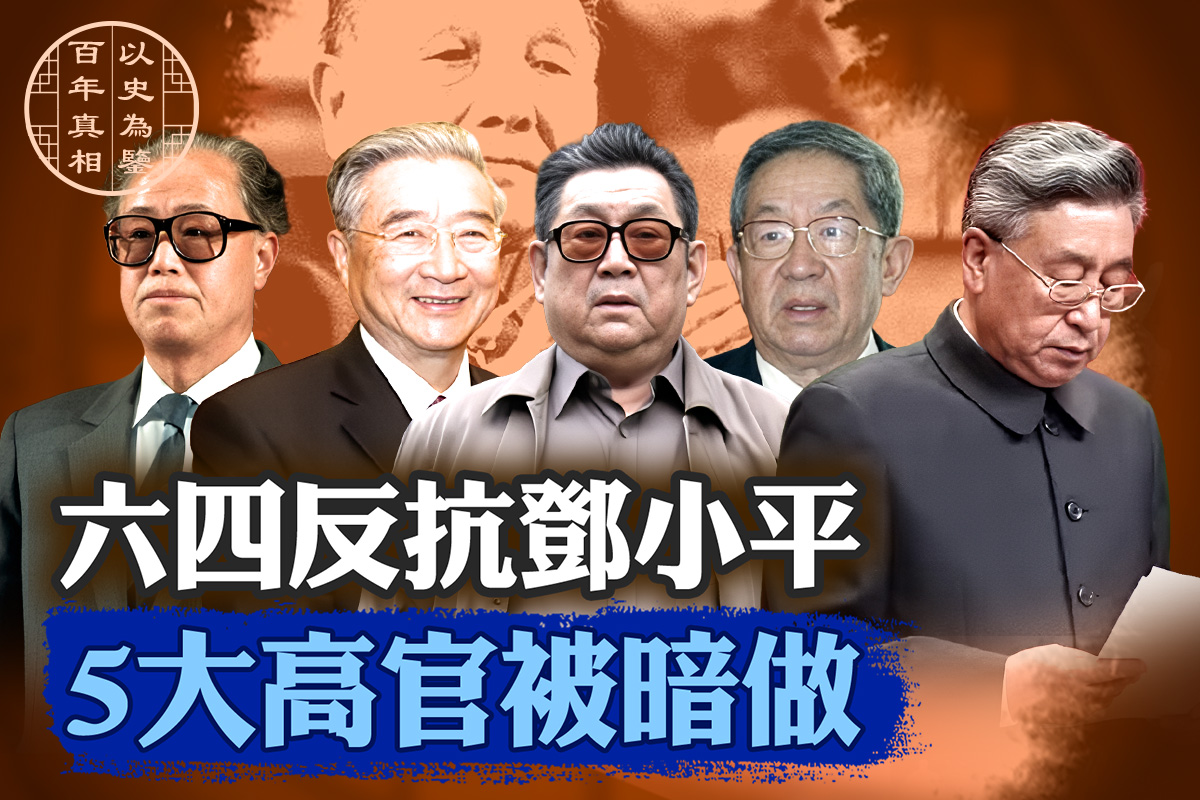
Today, let’s go back to 1989 and look at five high-ranking Chinese Communist Party officials who were purged due to the June Fourth incident.
The first and most closely watched figure is Zhao Ziyang.
In 1989, Zhao Ziyang held a special position. He was the General Secretary of the Chinese Communist Party, as well as the First Vice Chairman of the Central Military Commission, the de facto top leader of the CCP.
However, within the CCP, the one who controlled the military power was the true top leader. At that time, the Chairman of the Central Military Commission was Deng Xiaoping, and his word was final.
After the student movement erupted, there were disagreements among the senior CCP officials. Some believed that the students’ demands deserved attention and could be resolved through dialogue, while others thought the situation had spiraled out of control and required a firm hand.
Zhao Ziyang belonged to the former group. He opposed martial law, advocated for handling the student issue through democracy and rule of law, and hoped to de-escalate through dialogue rather than deploying the military.
In the early hours of May 19, 1989, Zhao Ziyang went to Tiananmen Square, holding a megaphone, and said to the students who had been on a hunger strike for many days, “Fellow students, we have come too late.”
In just a few words, a precious moment in history was created. Some believed that this statement conveyed an apology to the students, while others saw it as Zhao Ziyang’s sense of powerlessness in not being able to control the situation. Just before this, the senior leadership had already decided to deploy the military to enforce martial law and clear the square.
After “June Fourth,” Zhao Ziyang immediately became a target of purge.
On June 24, 1989, it was decided during the Fourth Plenary Session of the Thirteenth Central Committee of the CCP to remove Zhao Ziyang from the positions of General Secretary and First Vice Chairman of the Central Military Commission, leaving only his Party membership intact. From then on, this man who once stood at the heart of Chinese power was under long-term house arrest until his death in 2005.
According to later released recordings and memoirs, Zhao Ziyang always believed that his opposition to martial law and suppression was the right choice.
If Zhao Ziyang represented the stance of openly opposing crackdowns, then the next figure, faced a more complex situation. Because he did not directly oppose martial law, but he sympathized with the students and tried his best to avoid bloodshed through his efforts. This person is Hu Qili.
Hu Qili was one of the five members of the Politburo Standing Committee at the time, ranked first in the Central Secretariat, in charge of propaganda and ideology.
Regarding the student democratic movement, Hu Qili’s overall attitude was to sympathize with the students and lean towards resolving the issue through democracy and rule of law.
On April 27, 1989, Hu Qili held a symposium with the heads of several major news agencies including Xinhua News Agency, People’s Daily, and Guangming Daily. He explicitly stated that given the strong demands from various sides regarding the reporting of the student movement, the Central Committee had decided to relax the standards of news reporting. On the issue of the student movement, the chief editors of news agencies had the right to decide what to report or not report, without the need for constant consultation.
At that time, there was a brief period of relaxation in the Chinese news media, which was directly related to Hu Qili, who was in charge of propaganda work.
On May 17, the Politburo Standing Committee held a meeting at Deng Xiaoping’s residence. Deng proposed martial law, Zhao Ziyang opposed it, and while Hu Qili did not object, he still suggested, “Is there a better method than military control.”
On May 20, the same day martial law was implemented, Hu Qili wrote a letter to the Politburo Standing Committee, expressing his agreement with a statement made earlier by Yang Shangkun, who was the State Chairman and Vice Chairman of the Central Military Commission at the time. It said, “The People’s Liberation Army is absolutely not targeting the students.” Hu Qili earnestly hoped in his letter that during the imposition of martial law, there would be no bloodshed.
However, this letter was questioned by another member of the Politburo Standing Committee, Yao Yilin. In his comments, Yao said, “We should try our best not to shed blood, but it should not be expected to be completely bloodless. If the military does not use force, it will tie our hands.”
At the Fourth Plenary Session of the Thirteenth Central Committee on June 24, 1989, Hu Qili was removed from his positions as a member of the Politburo Standing Committee and Secretary of the Central Secretariat because he did not fully align with Deng on the issue of martial law.
After discussing Hu Qili, let’s take a look at the third person—Rui Xingwen.
To some viewers, the name Rui Xingwen may be unfamiliar. However, in the late 1980s, he, like Zhao Ziyang and Hu Qili, was an important figure among the reformist faction of the high-ranking CCP officials.
At that time, Rui Xingwen served as Secretary of the Central Secretariat, assisting Hu Qili in overseeing propaganda and ideological work. If Zhao Ziyang represented the direction of reform and Hu Qili was in charge of propaganda, then Rui Xingwen was more of an implementer.
Before the imposition of martial law in Beijing, there was a noticeable relaxation in the standards of news reporting in China, influenced not only by Zhao Ziyang and Hu Qili but also by Rui Xingwen’s actions.
After “June Fourth,” Rui Xingwen recalled that he had conveyed the high-level opinion to major news units about loosening the criteria for news reporting.
His exact words implied that by loosening the restrictions, news and propaganda channels became increasingly uncontrolled, eventually leading to a complete lack of control. This “loosening” was Rui Xingwen’s political charge. At the Fourth Plenary Session of the Thirteenth Central Committee, Rui Xingwen was removed from his position as Secretary of the Central Secretariat.
Following these individuals, this next person, much like Zhao Ziyang, engaged in dialogue with the students at Tiananmen Square. That person is Yan Mingfu.
Yan Mingfu served as Secretary of the Central Secretariat and Minister of the United Front Work Department, as well as the Vice Chairman of the National Committee of the Chinese People’s Political Consultative Conference. Within the highest echelons of the CCP, he was often thought of as having a more moderate and open-minded image.
In May 1989, as the student hunger strike intensified, tensions in Beijing escalated. The issue of whether to retract the “April 26 Editorial” became a focal point of debate among the top CCP leaders. This editorial had characterized the student movement as a “turmoil,” directly exacerbating the situation.
The then-Premier Li Peng recorded a detail in his “June Fourth Diary.”
On May 15, Yan Mingfu and Hu Qili went to Li Peng’s office, proposing to admit the problems in the “April 26 Editorial” and acknowledge the patriotic nature of the student movement to potentially ease the situation. However, Li Peng did not accept their suggestions.
The next day, Yan Mingfu received a task to visit Tiananmen Square and see the students on hunger strike. A rare occurrence, even the People’s Daily featured a photo of him on the front page—a high-ranking CCP official directly engaging with the students.
Years later, Yan Mingfu’s daughter Yan Lan mentioned the situation in her memoir “Yan Family.” According to a friend of hers who was studying at Peking University at the time, Yan Mingfu sat among the students and sincerely said, “Your spirit has moved the whole country. Your demands for reform, freedom, and anti-corruption will be taken seriously by the central government. But these demands are not worth exchanging for life.”
To reassure the students, Yan Mingfu pledged that the party central would take their reform demands seriously and expressed willingness to return to school with them as a hostage to ensure everyone’s safety.
He further promised that as long as the students stopped hunger striking and left the square, there would be no retaliation against them.
Looking back on these words today, they still evoke a sense of regret. Because the subsequent course of history did not unfold in that direction.
After “June Fourth,” Yan Mingfu was first removed from his position as Secretary of the Central Secretariat. The following year, he was stripped of his positions as Minister of the United Front Work Department and Vice Chairman of the National Committee of the Chinese People’s Political Consultative Conference.
The stories of these four individuals we mentioned earlier showcase high-ranking officials within the CCP. The next person we’ll discuss is a military figure. The dilemma he faced at the time was more direct than those of the previous individuals— the military order had been issued, would he execute it or not? This person is Xu Qinxian.
In 1989, Xu Qinxian was the Commander of the 38th Group Army in the Beijing Military Region, holding the rank of Major General. Those familiar with the Chinese Communist military would know that the 38th Army was no ordinary unit. It had long been regarded as one of the most elite and core fighting forces of the CCP, earning the moniker “Wansui Army.” If Beijing were truly to declare martial law, it was almost inconceivable for the 38th Army to be absent.
However, this time, Xu Qinxian faced not just a regular military task but a political choice.
According to the indictment of the CCP Military Procuratorate: around 4:00 pm on May 18, 1989, Liu Zhenhua, the Political Commissar of the Beijing Military Region, and Commander Zhou Yibing, among other leaders, told Xu Qinxian that the Central Military Commission had ordered the 38th Group Army to enforce martial law.
Upon hearing the deployment orders, Xu Qinxian immediately expressed his refusal. He said, “For such a major operation involving the deployment of the military, I suggest that it should be discussed by the Standing Committee of the National People’s Congress and a full meeting of the State Council, to determine whether this is right or wrong. Such an order should be issued by the state, not in the name of the party.”
He further added, “This action must withstand the test of history.” “The Central Military Commission can appoint me as the army commander or remove me from my post. I cannot carry out such orders, please find someone else to lead.”
In 2025, a complete video recording of the court proceedings from the 1990 military tribunal was first exposed overseas, showing many people for the first time Xu Qinxian’s statements in court.
He said, “This mission, unlike frontline combat and emergency relief work, where the enemy’s front and our defense are relatively clear, and the mission is more defined. But for this kind of mission taking weapons and equipment into Beijing to confront the situation, I said good people and bad people are mixed together, soldiers and civilians are mixed together, how can I carry out this mission, whom should I fight?”
Xu Qinxian’s decision to disobey orders came at a great cost. He was first relieved of his military position. In 1990, he was secretly sentenced to five years in prison by the CCP Military Court on the charge of “disobeying martial law orders.” Thus, his military career came to an end.
Today, we have shared the stories of these five individuals.
Zhao Ziyang opposed violence and was under house arrest until his last day. Hu Qili advocated for dialogue and was removed from office. Rui Xingwen implemented news relaxation policies, which were deemed to cause a loss of control over public opinion. Yan Mingfu walked into the square and was cleared from the centers of power. Xu Qinxian refused to lead the troops to Beijing and ended up in a military court.
For many years, discussions about “June Fourth” have mainly focused on the suffering of the students and the images of guns and tanks in the square. Yet, another storyline also holds significance. It is worth remembering that within the framework of the CCP, there were individuals who tried to prevent the situation from deteriorating to the worst possible outcome. However, in the end, they all failed.
After “June Fourth,” political reform within the CCP nearly completely stalled. This period of history has left an eternal question for people: If there had been a choice for dialogue instead of violence back then, would China be a different country today?
Alright, that’s the end of today’s “Century Truth”. If you enjoyed our program, please subscribe, like, and share. See you in the next episode.
Production Team of “Century Truth”