
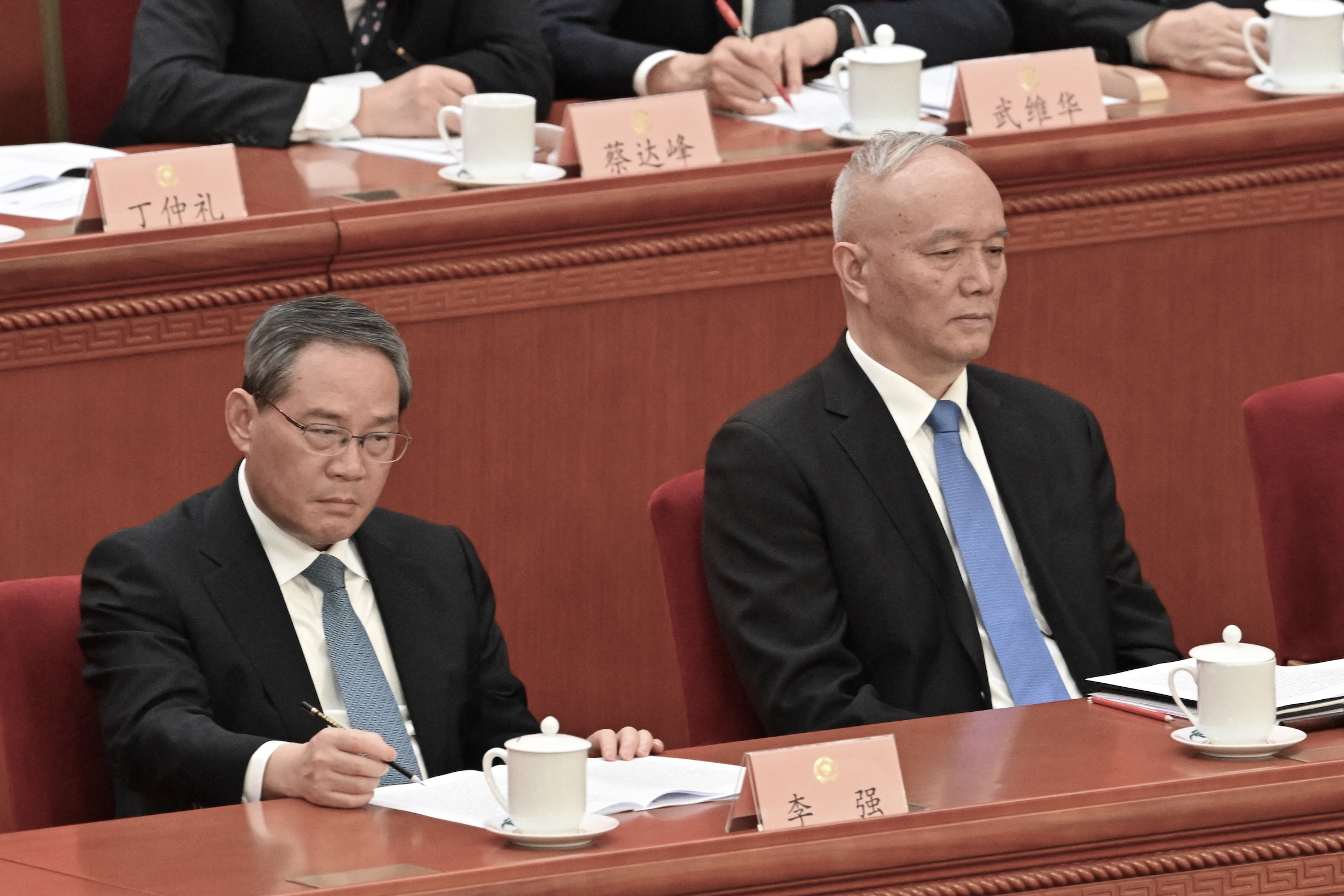
The 20th plenary session of the 20th Central Committee of the Chinese Communist Party (CCP) is set to be held before the end of this month. Despite the official theme being party rectification, there are speculations that it may involve personnel changes. There have been rumors circulating online that Premier Li Keqiang may potentially take on some of Xi Jinping’s duties, but analysts believe that it’s unlikely for Li Keqiang to succeed Xi Jinping, who may be the last CCP leader. The critical factors affecting Xi’s power stability are currently under close scrutiny.
Leading up to the 20th plenary session, there have been constant media reports suggesting that the meeting may involve personnel changes, with possibilities of additional members in the Central Political Bureau and Military Commission.
However, Chinese affairs expert Wang He told Epoch Times that the likelihood of additions to the Political Bureau during the 20th plenary session is slim, as well as the chances of new appointments to the Military Commission. It’s anticipated that Xi Jinping will be re-elected during the 21st National Congress, prompting a reshuffle of personnel.
There have been online rumors suggesting different scenarios for Xi Jinping during the 20th plenum, such as retaining the position of Chairman of the Military Commission while assigning the General Secretary and President roles to Li Keqiang, among others.
Independent commentator Cai Shenkun expressed on social media platform X that Li Keqiang is only a few years younger than Xi Jinping, with negligible age difference between them. It’s absurd to consider baseless speculations that Li Keqiang would succeed Xi Jinping, a prediction made five years ago now treated as a “prophetic utterance”, which is simply ridiculous.
Wang He further mentioned to Epoch Times that it’s highly unlikely for Xi Jinping to delegate power, as he aims to tightly control the situation, ensuring that the 21st National Congress unfolds according to his will and maintaining overall control of the personnel arrangement at the congress. However, whether Xi can exert the same level of hand-on influence over personnel decisions as in the 20th Congress remains uncertain.
The CCP’s official magazine, “Qiushi,” recently published a speech by Xi Jinping at the fifth plenary session of the 20th Central Commission for Discipline Inspection on January 12th. Xi emphasized that the anti-corruption struggle remains severe and complex, with the ongoing arduous task of eliminating the breeding ground and conditions for corruption. He also cautioned against the presence of “two-faced individuals” who harbor conflicting intentions and actions.
Since the beginning of 2026, the political scene has been rather peculiar. Xi Jinping abruptly dismissed high-ranking officials Zhang Yuxia and Liu Zhenli from the Military Commission, causing significant political repercussions. This has led to current authorities being overly cautious and vigilant, with a sense of constant uncertainty, indicating Xi Jinping’s heightened sense of insecurity compared to before.
Wang He believes that at present, the two key figures securing Xi’s power are Cai Qi, Director of the Central Office, who oversees the Central Guard Bureau, and Wang Xiaohong, Minister of Public Security. These individuals respectively hold the “swords” that safeguard Xi’s power. If these two figures remain stable, Xi Jinping’s authority will remain unchallenged. However, any changes in these positions could potentially disrupt Xi’s power grip.
Both Cai Qi and Wang Xiaohong are former associates of Xi from the Fujian faction early in his career, with Wang Xiaohong in charge of Xi’s security during his time in Fujian.
Chinese affairs expert Li Linyi expressed that Cai Qi’s position as head of the Central Office and Wang Xiaohong’s role as Minister of Public Security are unlikely to be easily replaced. However, given that both individuals are over 70 years old by the time of the 21st Congress, and rumors of Wang Xiaohong’s ill health circulate, Xi may heavily depend on these two figures to retain power, thereby raising potential uncertainties.
Li Linyi pointed out that compared to the “swords,” the “guns and cannons” are of greater significance. The current Vice Chairman of the Central Military Commission, Zhang Shenmin’s loyalty to Xi is uncertain. Additionally, the removal of Zhang Yuxia, Liu Zhenli, and the secretly tried Liu Yazhou in the military carries significant influence, with many current generals still being their former subordinates. Should new members be added to the Central Military Commission during the 20th plenum or a new commission established at the 21st Congress, Xi will face challenges ensuring the loyalty of these new inductees.
The 21st National Congress of the CCP next year will determine the power structure until 2032. The Economist recently published an article stating that Xi Jinping’s continuity in the top position is almost certain, yet hundreds of high-level positions remain to be arranged. Over the upcoming months, a series of closed-door meetings will decide who fills these roles, including during the October 20th plenary session.
Historical figures from the “Seventh Generation” of officials, who grew up during the reform and opening-up era, may enter the core of power over the next decade. Former CIA analyst Qin Jiangnan pointed out that by the time of the 22nd Congress, when Xi Jinping is 79 years old, he may consider handing over to the fifth and sixth decade officials of the “Seventh Generation” as successors. However, this could lead to turmoil as Xi would have to select individuals he does not have much established trust with.
Independent commentator Du Zheng previously mentioned in Taiwanese media that while Xi Jinping favored “acquaintances” due to past connections and positive interactions, the recent wave of purges demonstrated the failure of this “crony politics.” In the personnel arrangement of the 21st Congress, Xi has no choice but to include “strangers.”
Du Zheng believes that younger senior officials who did not undergo the brainwashing of the Cultural Revolution era, have some knowledge of the truths behind the Tiananmen Square incident, experienced the influences of the reform and opening-up policies, are tech-savvy, and even adept at bypassing internet censorship. There is a growing number of officials who openly express dissent, implying that Xi is losing control. Many officials have been found privately reading what the CCP deems as “reactionary political publications,” and more who have not been caught simply keep a low profile. Regardless of who takes over the regime in the future, the evil and rotten Communist Party must be eradicated. Xi Jinping may very well be the “last generation” of the CCP.
Retired US Air Force General Blaine Holt wrote in Newsweek last year that the CCP is facing collapse, and Xi Jinping could be its last ruler.
Chinese affairs expert Li Linyi stated that political landscapes can swiftly change, and China’s current economic and social crises have accelerated political transformations, intensifying CCP infighting. It’s likely that there may not even be a need for a 22nd Congress, as the CCP regime could collapse before then. The notion of a “Seventh Generation” of leaders is merely a fantastical hypothesis.