
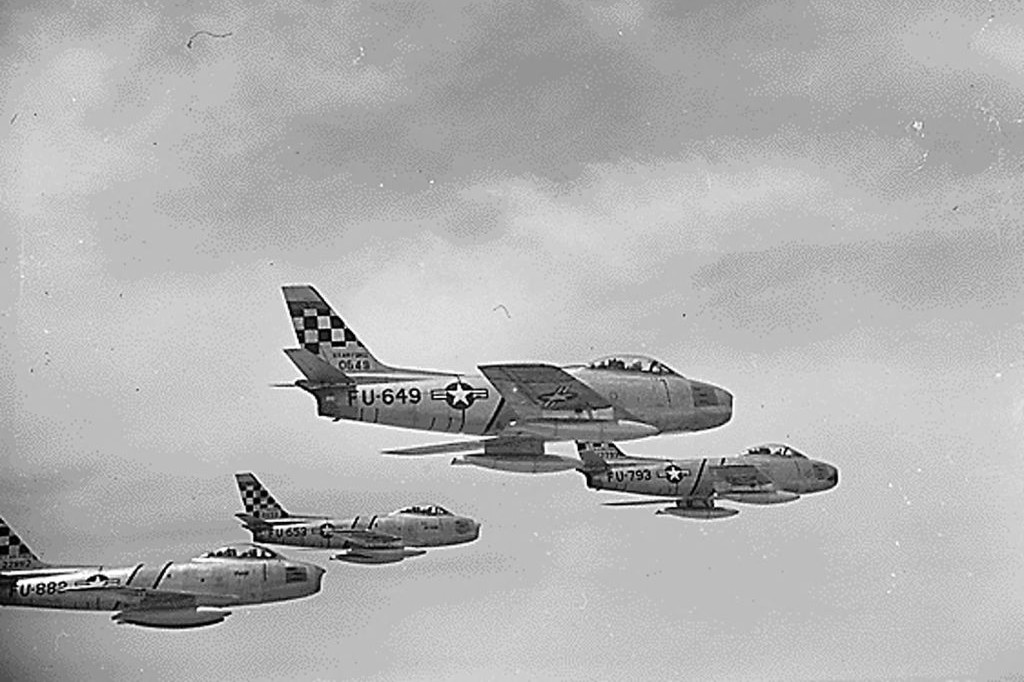
After World War II, the United States and the Soviet Union engaged in fierce competition in the development of jet fighters. Ultimately, US jet fighters gained a slight advantage in the Korean War, laying the foundation for long-term air superiority in the future.
Following the previous part:
How did the US military gain air superiority in the Korean War – How US jet fighters won the initial battle (Part 2)
The Mig-15 was a supersonic jet fighter developed by the Soviet Union, featuring a swept wing design and a maximum speed of 1,151 kilometers per hour. In the early stages of the Korean War, the Mig-15 outperformed the fighter jets of the United Nations until the US Air Force quickly deployed the F-86 fighter jet.
The predecessor of the Mig-15 was the Mig-9, which was the first generation jet fighter developed by the Soviet Union after World War II. It used reverse-engineered German engines, but had many flaws such as insufficient engine power, poor reliability, and poor handling characteristics. At that time, Soviet engine technology lagged far behind the West, and they could only rely on captured German products and data.
Soviet designers went to the UK to request engines and unexpectedly obtained a production license for the advanced Rolls-Royce engines, which were then mass-produced and fitted onto the Mig-15 fighters. The swept wing technology from the captured German jet fighter was also directly applied to the Mig-15. The prototype of the Mig-15 made its first flight on December 30, 1947, several months after the US F-86.
In 1949, the Mig-15 entered service in the Soviet Air Force. Early models were prone to rolling, and later versions were equipped with aerodynamic trim devices adjusted by ground personnel. If the speed of the Mig-15 approached Mach 1 (1,225 kilometers per hour), the aircraft’s control capabilities significantly decreased, and pilots were instructed not to exceed 0.92 Mach.
The initial design goal of the Mig-15 was to intercept US bombers. It was equipped with 2 23mm machine guns and 1 37mm cannon, boasting powerful firepower but lower firing rates, making it difficult to engage small, highly maneuverable enemy jet fighters in aerial combat.
The improved Mig-15bis, introduced in early 1950, was capable of carrying rockets or bombs weighing from 50 to 250 kilograms. With a total weight of 5,044 kilograms, the Mig-15 continued the Soviet design philosophy of light fighter jets, mainly used for air defense interception.
The upgraded model of the Mig-15, the Mig-17, faced off against multiple supersonic US fighter jets in the Vietnam War in the 1960s, with a total production exceeding 13,000 units.
In early 1950, aircraft from the Republic of China took off from Taiwan to conduct air raids on military targets of the Chinese Communist forces located in Shanghai and other areas. In February 1950, at the request of the Chinese Communist Party, Soviet Air Force pilots equipped with Mig-15 fighters were deployed to southern China and began training Chinese Communist pilots.
On April 28, 1950, a Soviet pilot flying a Mig-15 shot down a Republic of China Air Force P-38 fighter, marking the first aerial combat victory of the Mig-15. On May 11, 1950, a Soviet Mig-15 possibly also shot down a Republic of China Air Force B-25 bomber.
The Korean War broke out in June 1950, and the propeller-driven fighters provided by the Soviet Union to North Korea quickly succumbed to the United Nations forces. American bombers and attack aircraft aggressively targeted North Korean objectives.
In August 1950, a detachment of the Soviet 50th Fighter Aviation Regiment was moved from southern China to the northeast. In October 1950, Chinese troops entered combat in Korea; in November, three Soviet fighter aviation regiments were stationed in northeastern China. Due to the limited range of the Mig-15, it could not engage in combat in more distant airspace. Safety restrictions also prohibited its crossing over Pyongyang and prevented it from flying over the sea. The Mig-15 primarily operated in the airspace near the Yalu River in northwest Korea to intercept American bombers.
Mig-15 pilots waited on the Chinese side of the Yalu River border, ready to launch high-altitude diving attacks when UN aircraft were spotted. If encountering trouble, they could cross the border to escape back to the Chinese side.
The early-use US Air Force aircraft, F-80, F-84, Navy carrier-based fighters F9F, F4U, and the British Meteor fighter, were unable to match the Soviet Mig-15. In December 1950, the US deployed the F-86 jet fighter, gradually regaining air superiority.
The Soviet Union claimed that Mig-15 fighters shot down 1,106 UN aircraft. According to US Air Force statistics, 139 American aircraft were shot down by Mig-15s, 68 were lost for unknown reasons, 237 went missing for unknown reasons, and 472 aircraft were classified as other losses.
On November 1, 1950, a Soviet pilot flying a Mig-15 shot down one US Air Force P-51D fighter; on November 8, a Soviet pilot claimed to have shot down one US Air Force F-80C fighter, marking the first jet-to-jet aerial combat in history. On November 9, 1950, an F9F fighter launched from the US Navy aircraft carrier “USS Philippine Sea” shot down a Mig-15.
In December 1950, the US rapidly deployed three squadrons of F-86 fighters to Korea. On December 17, one F-86 fighter hit a Mig-15, forcing the Soviet pilot to eject from the burning aircraft. On December 22, a Mig-15 shot down an F-86A fighter. That month, American F-86 fighter pilots claimed to have shot down 8 Mig-15 fighters, while the Soviets claimed to have shot down 12 F-86 fighters. Actual losses were likely 3 Mig-15 fighters and at least 4 F-86 fighters.
By the end of 1950, the Soviet Union increased the number of aviation regiments in northeastern China. A regiment typically consisted of three squadrons, each having 35 to 40 aircraft. Communist Chinese and Korean pilots were also trained together.
The main mission of the Mig-15 was not to engage in air combat with the F-86 but to intercept American B-29 bombers.
On April 12, 1951, 44 Mig-15 fighters entered the airspace of northwest Korea, intercepting a US aircraft formation, including 48 B-29 bombers and 18 F-86, 54 F-84, and 20 F-80 fighters. The Soviet Union claimed to have shot down or severely damaged 10 B-29s, 1 F-86A, and 3 F-80Cs, while losing only one Mig-15. That month, the Soviets also claimed to have shot down 11 US F-80s, 7 B-29s, and 9 F-51 fighters. The US acknowledged that only one B-29 was directly shot down, with 3 forced to make emergency landings and the rest primarily lost due to anti-aircraft fire or accidents.
From October 22 to 27, 1951, US bombers launched a massive attack, destroying three airfields in Korea and encountering Mig-15 interceptions. On October 23, 1951, 56 Mig-15 fighters intercepted 9 B-29 bombers escorted by 34 US F-86 and 55 F-84E fighters. Soviet pilots claimed to have shot down or severely damaged 8 B-29As and 2 F-84Es while losing only one Mig-15. In the following days, Soviet ace pilots claimed to have shot down 2 F-86As, 1 B-29A, and 1 F-84E.
As a result, the US Air Force discontinued daytime bombing missions of B-29 bombers and switched to radar-guided nighttime raids.
From November 1951 to January 1952, both sides intensified their efforts to gain control of the airspace over northwest Korea, leading to unprecedented aerial combat intensity. At least 40 Soviet Mig-15 pilots were recognized as aces, each with five or more aerial victories. They could choose at their discretion whether to enter combat from the Chinese side into Korea. American aircraft were forbidden to cross the Yalu River into Chinese territory.
By the end of January 1952, the Soviet Air Force conducted a rotation, with new units having insufficient training. Many pilots had only operated the Mig-15 for 50-60 hours, resulting in heavy losses when facing well-trained American pilots. From February to July 1952, 81 Mig-15s were lost, with 34 pilots killed. 68 UN aircraft were shot down, including 36 F-86s.
On July 4, 1952, US F-86 fighters shot down 11 Mig-15s, mainly attributed to a secret “Operation Maple Leaf.” American planes crossed the Yalu River, approaching air bases in northeastern China, launching attacks during Mig-15 takeoffs and landings. However, most of the time, US pilots were prohibited from crossing the Yalu River, losing the initiative in aerial combat.
To avoid escalating the war, the US did not conduct air raids on Chinese air bases or supply lines in northeast China. Otherwise, the Chinese forces might have faced greater difficulty in engaging near the 38th parallel or maintaining the stalemate.
In May 1953, two Mig-15 regiments from the Soviet Union were deployed to Korea. By 1953, although they did not manage to take air superiority from the well-prepared US forces, they weakened the US air superiority.
Initially, the US F-94 fighters escorted B-29 bombers at night, later replaced by Marine Corps F3D night fighters, making it harder for Mig-15s attempting nighttime assaults.
From November 2 to 3, 1952, at night, US F3D fighters wounded one Mig-15 and shot down another five, without suffering any losses themselves. By then, B-29 bombers were also unharmed by enemy fire.
In the early hours of January 16, 1953, a US F3D fighter was nearly shot down by a Mig-15 at night, with the pilot managing to land the damaged aircraft back at the Korean base. On May 29, 1953, a Chinese pilot flying a Mig-15 shot down an American F3D-2 fighter.
On August 8, 1952, a “Sea Fury” fighter taking off from a British light aircraft carrier shot down a Mig-15, becoming one of the few piston-powered fighters to shoot down a jet fighter since World War II ended. On September 10, 1952, an F4U fighter launched from a US carrier shot down a Mig-15, only to be shot down by another Mig-15.
The Soviet Union claimed that the Mig-15 flew a total of 60,450 daytime missions and 2,779 nighttime missions, engaging in 1,683 daytime and 107 nighttime aerial combats with enemy forces, claiming to have shot down 1,097 UN aircraft, including 647 F-86s, 185 F-84s, 118 F-80s, 28 F-51s, 11 F-94s, 26 Meteors, 65 B-29 bombers, and 17 other aircraft types.
The US tallied 57 B-29 bombers and reconnaissance aircraft lost in combat, but the disparity with Soviet data, especially regarding F-86 losses, was significant. The US initially recorded a 10:1 ratio of F-86s shot down to Mig-15s, later adjusting to 5:1. The total F-86 losses for UN forces were 256.
US statistics showed that F-86 pilots shot down 792 Mig-15s. According to Soviet data, 335 Mig-15s were lost in the Korean War, while China claimed 224 losses and North Korea about 100. The acknowledged total Mig-15 losses in the Korean War should be around 659.
In September 1951, the number of participating Mig-15s increased significantly, and the Chinese Air Force officially engaged Mig-15s in combat, with the Korean Air Force joining a year later. China claimed to have shot down 211 F-86 fighters, 72 F-84 and F-80 fighters, 47 other aircraft, losing 231 aircraft, 116 pilots, which included 224 Mig-15s. According to Chinese data, the number of F-86 fighters claimed to be shot down by Chinese pilots exceeded 82% of the total losses of the UN forces. Similar to the Soviet claims, this appeared to be a significant exaggeration.
During the Korean War, the Mig-15 was mainly used to guard the supply lines of the Chinese forces in northwest Korea but was unable to effectively deter US air raids or support battles along the 38th parallel. American fighters, attack aircraft, and bombers maintained superiority on the front lines, to a considerable extent, offsetting the numerical advantage of the Chinese forces.
In the early hours of March 5, 1953, a Polish Air Force pilot defected while flying a Mig-15, coinciding with the day of Stalin’s death. Ultimately, four Polish pilots flying Mig-15s defected. On September 21, 1953, a North Korean pilot defected while flying a Mig-15. Upon studying the Mig-15 obtained by the US, it was confirmed that the aircraft’s performance was unstable. Defecting pilots revealed that the Mig-15 was challenging to control in the air, making it dangerous, especially for inexperienced pilots, likened to a “flying trap.” During the Korean War, several American pilots witnessed Mig-15s stalling and crashing.
In 1955, Egypt began to acquire Mig-15 and Mig-17 fighters. The Suez Crisis erupted in October 1956, with Egyptian Mig-15 fighters causing damage to a British reconnaissance aircraft on October 30. They also launched air raids on Israeli forces the same day, but were subsequently shot down by Israeli Air Force “Mystere” fighters. The next day, Mig-15s severely damaged two Israeli Air Force “Hurricane” fighters. Following these skirmishes, British and French aircraft carried out air raids on Egyptian air bases, destroying at least 8 Mig fighters and several other Egyptian aircraft, resulting in Egypt losing air superiority.
The Chinese Communist Party designated the Mig-15 as the J-2 and produced around several hundred units. The upgraded Mig-15, known as the J-5, had a production run exceeding 1,800 aircraft.
(To be continued)
This article was originally published by Dajiyuan.