
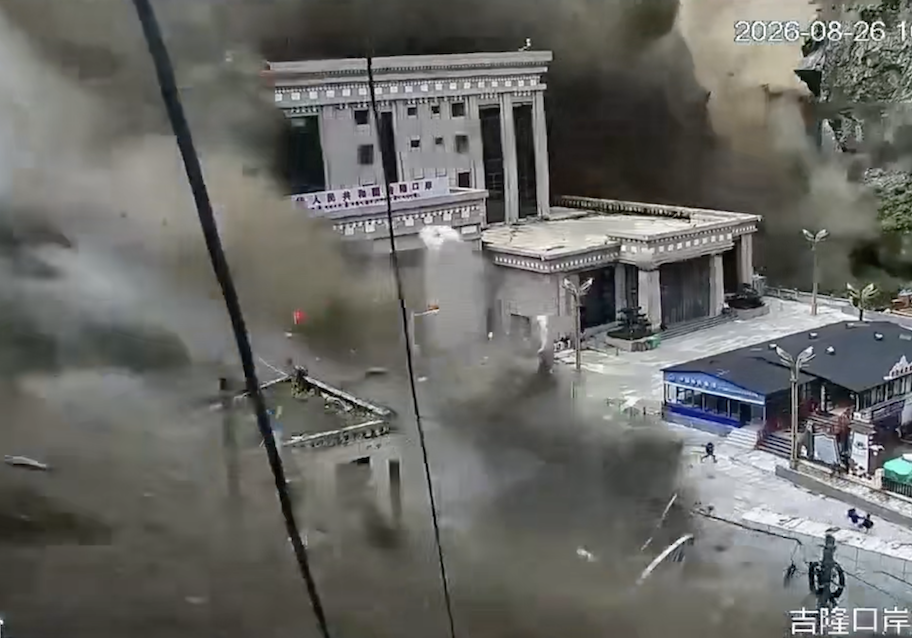
In simultaneous personnel changes, the Communist Party Secretaries of Tibet, Gansu, and Qinghai provinces have been replaced. Hu Changsheng has been transferred from Gansu to serve as the Party Secretary of the Tibet Autonomous Region, while Wu Xiaojun has moved from Qinghai to become the Party Secretary of Gansu Province, with Luo Dongchuan taking over as the Party Secretary of Qinghai Province. The former Party Secretary of Tibet, Wang Junzheng, has allegedly been relieved of his position due to the mudslides on the China-Nepal border.
According to a report by Xinhua News Agency on September 22nd, Hu Changsheng is appointed as the Party Secretary of the Tibet Autonomous Region, relieving his duties as the Party Secretary of Gansu Province. Wang Junzheng will no longer hold the position of Party Secretary of the Tibet Autonomous Region. Wu Xiaojun is now the Party Secretary of Gansu Province, relinquishing the post of Party Secretary of Qinghai Province. Luo Dongchuan has been appointed as the Party Secretary of Qinghai Province.
Wang Junzheng, born on May 17, 1963, in Linyi, Shandong Province, had worked in Yunnan earlier in his career. He also served as the Communist Party Secretary of Lijiang City and held various positions in Hubei, Jilin, and Xinjiang provinces before his recent tenure in Tibet. Wang Junzheng is a member of the 20th Central Committee of the Communist Party of China.
The reshuffle of the Party Secretary in Tibet was described in official reports as a decision made considering the overall situation with careful consideration. The report mentioned Wang Junzheng’s departure from his position due to “age considerations.”
However, Hu Changsheng, who is succeeding Wang Junzheng, is only about 7 months younger than him (born in December 1963).
Expert on China affairs, Li Linyi, commented that Wang Junzheng’s removal raises concerns, especially following the catastrophic mudslide disaster along the China-Nepal border in late August. The international community has criticized the Chinese authorities for lack of pre-warning and transparency in disaster response, while domestic grievances have been suppressed. Li Linyi suggested that Wang Junzheng’s quiet dismissal implies assigning blame to him, although such natural disasters are often caused by systemic failures within the Chinese regime from the top down. The discreet removal of implicated officials is a common practice in the Communist Party, allowing many to be indirectly protected.
On August 26, a devastating mudslide occurred in the border area between Nepal and China’s Tibet, submerging the Gyirong Port in Shigatse, Tibet. The Gyirong Port building has since been leveled to the ground. However, it was not until the fourth day of the incident on August 29 that the Chinese rescue teams reached the core area of the Gyirong Port for search and rescue operations, missing the critical “golden window” for rescue.
Just like previous incidents, the Chinese authorities heavily restricted information following the disaster, focusing on rescue efforts in official reports and downplaying the extent of the disaster in the affected area. Foreign journalists were not allowed free access to Tibet, contrasting sharply with Nepal’s openness. The US Embassy in China had openly requested Beijing to provide information on casualties, including American citizens, and related search and rescue efforts. The Chinese official response labeled the US request as “making things difficult even to the point of creating obstacles,” sparking questioning of the Chinese authorities’ actions.
Hu Changsheng, now stationed in Tibet, is 62 years old and from Gao’an, Jiangxi Province. He has held various positions in Sichuan, Qinghai, and Fujian provinces before his current appointment. Wu Xiaojun, the new Party Secretary of Gansu Province, is 60 years old and from Taihe, Jiangxi Province. He has had a long career in Jiangxi, serving in various government roles and eventually rising to his current position. Luo Dongchuan, the newly appointed Party Secretary of Qinghai Province, is 60 years old and from Chongqing. He has held positions in the judicial system before transitioning into provincial leadership roles.
In conclusion, the recent personnel changes at the Party Secretary level in Tibet, Gansu, and Qinghai provinces reflect a significant reorganization within the Chinese Communist Party. The circumstances surrounding Wang Junzheng’s removal and the subsequent appointments raise questions about transparency, accountability, and the handling of natural disasters within the Chinese regime.