
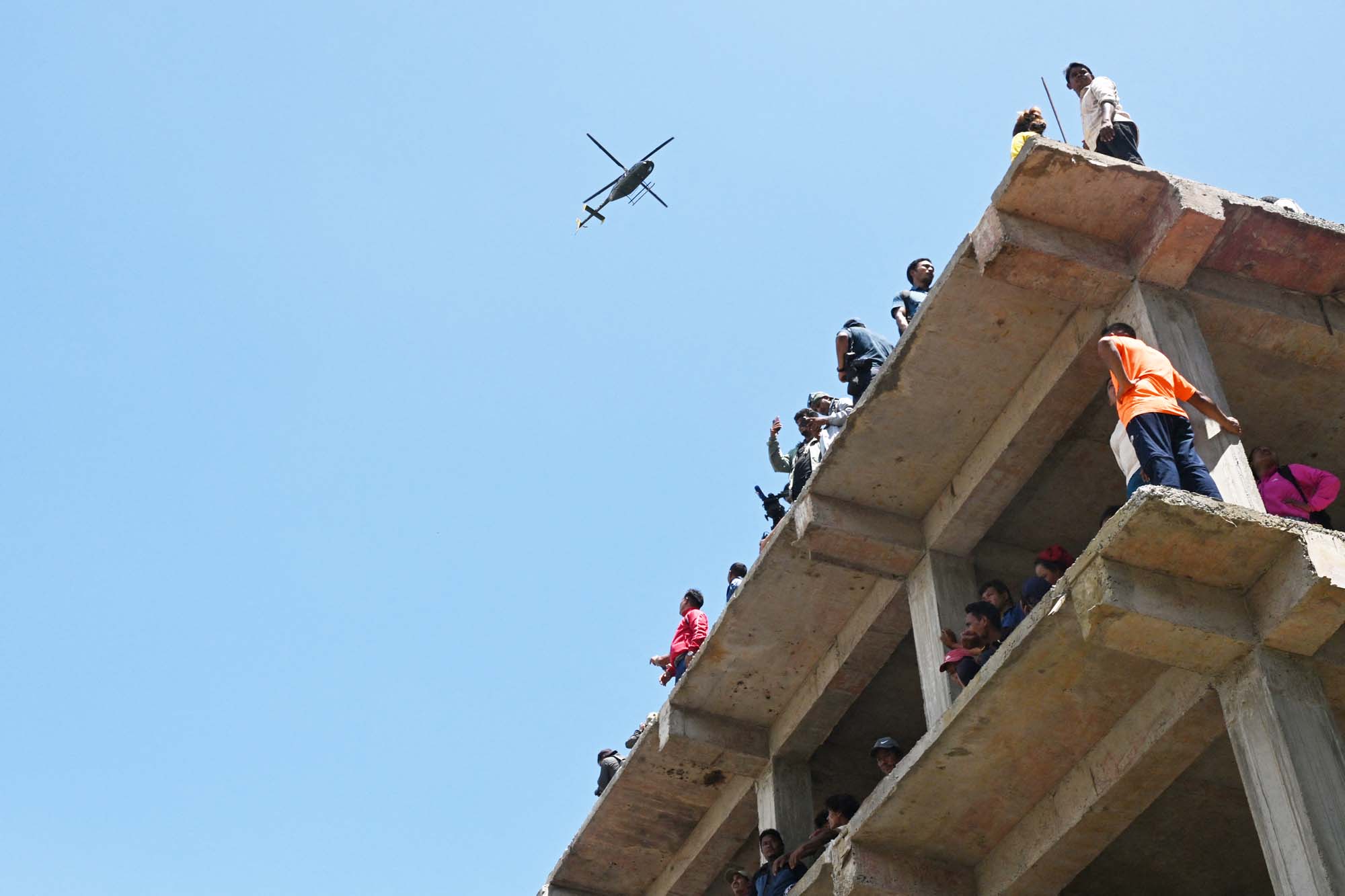
On August 26, a serious mudslide disaster occurred at the Gyirong Port on the border between China and Nepal, with the Gyirong Port building instantly being engulfed. On August 29, the Chinese Communist Party (CCP) media reported that 554 people were still missing. On the Nepalese side, there were also a large number of disaster victims, and the Nepalese army, with limited helicopter resources, almost fully mobilized to rescue people. In contrast, the CCP’s military only symbolically dispatched helicopters and did not see a large-scale mobilization to rescue people, highlighting many internal issues within the CCP’s military.
The Nepalese army has a total of less than 100,000 troops, with limited helicopters, including 3 purchased from the United States, 2 from France and Italy each, 3 light helicopters purchased from India, and 6 Mi-171 helicopters purchased from Russia, among others. According to Global Firepower, the Nepalese army has a total of 10 helicopters and 7 fixed-wing transport aircraft, with a helicopter combat readiness rate of about 50%.
After the disaster struck, the available helicopters of the Nepalese army immediately flew to the disaster area to search and rescue stranded civilians, including wounded individuals, elderly, children, students, and even transporting the bodies of the deceased to rear military camps.
In the face of the sudden disaster, the limited helicopters of the Nepalese army proved useful, actively participating in rescuing people in the disaster area and showcasing themselves as the people’s army. This is considered a normal performance for a country’s military during peacetime.
In contrast, how did the CCP’s military perform?
In recent years, the CCP’s military has amassed various types of helicopters, including Z-8, Z-9, Z-10, Z-11, Z-18, Z-19, Z-20, as well as Mi-8, Mi-17, Mi-171 purchased from the Soviet Union/Russia, and some helicopters purchased from France and the United States. The CCP claims to have established 15 army aviation brigades with 1,500 helicopters, second only to the US military.
With so many helicopters in their arsenal, the CCP’s military should have been able to mobilize extensively and systematically search and rescue the missing individuals in the disaster-stricken areas, even actively offering assistance to the Nepalese side. However, the actual situation was surprising.
On August 26, a CCP military report titled “PLA and Armed Police Forces Urgently Rescue Jiangkou County, Xigaze City, Tibet from Mudslide Disasters” was issued.
The article stated: “After the disaster, Xi Jinping attaches great importance and issues important directives… The Western Theater Command Party Committee resolutely implements… The theater joint command center activates the emergency response mechanism… The Tibet Military Region dispatched a forward command group to rush to the scene… The certain troops of the Xigaze Military Sub-district… rushed to the front line for rescue… The Western Theater Command Air Force… dispatched a drone to survey the disaster situation in the Gyirong Port area… Armed Police Tibet General Brigade Xigaze Detachment officers and soldiers… arrived in Gyirong County’s Gyirong Town, Sale Township, actively conducting personnel search and rescue, road clearance, and other work with the locals.
The Western Theater Command received the rescue order, but the Western Theater Command Air Force only dispatched a drone to survey the disaster situation in the Gyirong Port area swallowed by the mudslide, with no sign of helicopters being deployed. The Tibet Military Region only sent a so-called forward command group. The Xigaze Military Sub-district dispatched a team, claiming to rush to the front line. The Armed Police Tibet General Brigade Xigaze Detachment only reached Gyirong County’s Gyirong Town, Sale Township, which is essentially behind the front line of rescue.
The Western Theater Command, Tibet Military Region, and Armed Police Tibet General Brigade all seemed to be perfunctory or putting on a show in their rescue efforts. But the CCP military report claimed that the troops strongly implemented the directives, sparing no effort to search and rescue the missing individuals. While the Xigaze Military Sub-district claimed to have sent people to the front line, without helicopters, they had difficulty reaching the front lines.
On August 29, Xinhua News Agency published an article titled “72 Hours After the Jiulong Disaster in Tibet, Emergency Rescue Scene”. It mentioned that around 13:00 on August 29, after several days of continuous road clearing operations by various engineering rescue forces, a road of 2.6 kilometers was cleared, with 1.7 kilometers still remaining before reaching the Gyirong Port.
Three days after the disaster, CCP’s rescue team had not yet cleared the roads leading to the Gyirong Port, with ground rescue operations relying solely on arduous walking, resulting in very low efficiency.
The article stated that as of 1:00 on the 29th, 2 people from Heso Village had been rescued, and the Jiulong mudslide disaster had caused 7 deaths, with 554 people missing.
In mountainous regions, the crucial 72-hour rescue window necessitates helicopters. Yet the CCP military’s helicopters were still not extensively mobilized for rescue operations.
On August 28, a CCP military report was issued titled “PLA and Armed Police Officers and Soldiers Fighting on the Front Line to Rescue Jiulong in Tibet”. It mentioned that on August 27, a certain army aviation brigade from the Tibet Military Region dispatched helicopters to survey the disaster situation.
On the second day of the disaster, the Tibet Military Region of the CCP did dispatch helicopters, but they were only dispatched for surveying and not for actual rescue operations. Surveying the disaster could have been done with drones, and helicopters should have been primarily used for rescuing people.
The article mentioned that as of noon on the 27th, the CCP military had deployed more than 500 troops for rescue, with 4 helicopter sorties and several drone sorties. This article did not reiterate the strong implementation of directives and exhaustive efforts to search and rescue the missing individuals.
On August 29, the CCP military website reposted an article from Xinhua News Agency titled “PLA and Armed Police Officers Continue to Invest in Jiulong, Tibet for Disaster Rescue”. It stated that the rescue and evacuation of the mudslide disaster in Jiulong, Tibet entered the fourth day, with a certain brigade from the Tibet Military Region and the Xigaze Detachment of the Armed Police Tibet General Brigade continuing to advance towards the disaster-stricken area, persisting in opening up disaster evacuation passages, and creating conditions for personnel search and rescue and transporting the injured.
After the golden 72-hour rescue window had passed, the CCP military’s ground rescue personnel had still not reached the disaster-stricken area.
The article mentioned that on the afternoon of August 29, a certain army aviation brigade from the Tibet Military Region had urgently dispatched two helicopters to Jiulong Port to carry out disaster relief supply missions.
72 hours after the disaster, the CCP military once again dispatched two helicopters, but they only airdropped a small quantity of supplies without landing to rescue people.
On August 29, Xinhua News Agency published an article titled “Facing Disaster, We Should Charge Ahead – Exclusive Interview with Jiulong Mudslide Disaster Core Area Search and Rescue Strike Team”. It quoted Yin Wei, the political instructor of the Happiness Road Fire Rescue Station in Jiulong County, saying: “We were the first batch of fire rescue personnel to arrive about 5 kilometers from the national gate (Jiulong Port). At the beginning, we only saw the road covered with sand and mud, very soft to step on, personnel could not move forward at all. All buildings on the roadside, including utility poles, and roads were all washed away.”
He also said, “The road surface was deeply filled with sand and mud, making it difficult for personnel to move steadily. Additionally, the front section of the road had already been washed away, with swift water flow, making it difficult for personnel to reach the scene.”
This once again confirmed that the CCP military’s ground forces did not reach the frontline disaster area in time.
On August 29, CCTV claimed: “On August 29, in the core disaster area of Jiulong Port, about 70 firefighting and rescue personnel conducted a net-like search, continuously searching for missing individuals.”
Seventy firefighting and rescue personnel reached the core disaster area of Jiulong Port 72 hours after the disaster, claiming to conduct a comprehensive search for missing individuals. But how much area can 70 firefighters search, and how many people can they rescue?
The CCP media reported that as of 1:00 on the 29th, 554 people were still missing. At that time, the ground rescue troops sent by the CCP’s military had not yet reached the core disaster area of Jiulong Port. Many of the CCP’s helicopters still did not participate in the rescue efforts.
What issues did the CCP’s so-called “People’s Liberation Army” encounter?
On August 28, Xinhua News Agency reported a meeting of the CCP Central Political Bureau titled “CCP Central Political Bureau Convenes a Meeting to Study and Deploy Mudslide Disaster Rescue Work in Jiulong County, Xigaze City, Tibet”. The article stated that after the disaster, the Party Central Committee attached great importance, with Xi Jinping immediately issuing relief instructions, Premier Li Keqiang rushing to the disaster scene to guide relief efforts, various departments acting promptly, and military forces moving promptly to their designated positions.
According to the CCP media, the Chairman of the Military Commission and the “Party Central Committee” issued timely relief orders, and the CCP military promptly arrived as well. However, the reality was that 72 hours after the disaster, road clearing operations still had 1.7 kilometers to go before reaching Jiulong Port, with only about 70 firefighter and rescue personnel reaching the core disaster area of Jiulong Port, while the CCP military was still en route. The much-needed helicopters for rescue operations were only symbolically dispatched for assessment and airdrop of minimal supplies, without participating directly in the search and rescue of missing individuals.
The CCP military seemed not to be genuinely carrying out the Chairman of the Military Commission’s instructions to spare no effort to search for missing individuals. If this was indeed the case, then either the Chairman of the Military Commission and the “Party Central Committee” were ineffectively commanding the military, or the military was not following the party’s instructions.
On August 28, the Standing Committee of the CCP National People’s Congress issued an announcement, dismissing Zhang Yuxia from the position of Deputy Chairman of the Military Commission and removing Liu Zhenli from the military committee position; Zhang Yuxia, Liu Zhenli, Ju Qiansheng, and Zhong Shaojun, four generals, were stripped of their national delegate positions.
The turmoil in the CCP military continues, with uncertainty about whose command the troops should follow, indicating a breakdown in the command structure. In the event of the Jiulong Port disaster, the CCP’s military claimed to be rescuing, but the command structure was in shambles, and the western region’s command system was once again in disarray.
The Tibet Military Region of the CCP is not under the jurisdiction of the Western Theater Command but directly under the command of the Land Force Headquarters of the Military Commission. The command center of the Western Theater Command during peacetime has no authority to mobilize troops from the Tibet Military Region, making the so-called disaster relief in the western theater utterly impractical. The Xigaze Military Sub-district under the Tibet Military Region deployed ground troops, but without timely arrival at the disaster site; the helicopters were only symbolically dispatched, falling short of even a mere show.
The Armed Police Tibet General Brigade also does not heed the orders of the Western Theater Command but follows the commands of the Beijing Armed Police Headquarters. Therefore, even its Xigaze Detachment does not accept the Western Theater Command’s mobilization.
Both the CCP military and the Nepalese army participated in disaster relief efforts simultaneously. However, the rescue operation at the Jiulong Port disaster site exposed many of the CCP military’s problems to the world once again.