
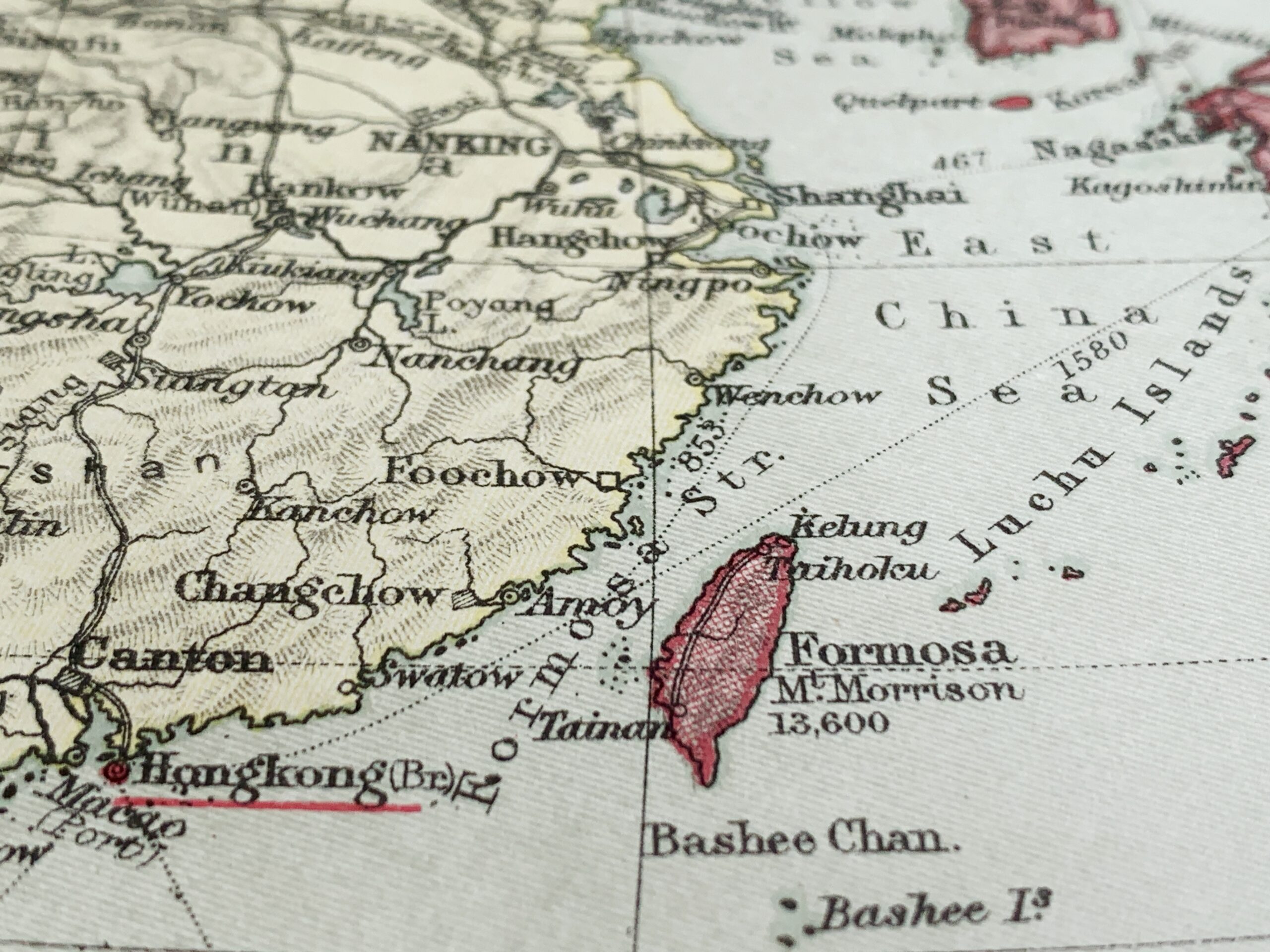
The United States Navy boasts 11 aircraft carrier strike groups, capable of swiftly projecting its firepower to any corner of the globe, making it the most powerful navy in the world. However, many people may not know or believe that the U.S. Navy has also faced setbacks in the past. As far back as the 19th century, this force embarked on an expedition to Taiwan, but due to reasons like being “unaccustomed to the local environment,” they were attacked by indigenous people and suffered a defeat.
The Naval History and Heritage Command (NHHC) of the United States disclosed this long-past event on its website. This story dates back to the March of 1867 (Qing Dynasty’s Tongzhi Year 6) involving the USS Rover incident.
The USS Rover was a merchant ship flying the American flag. This ship ran aground and sank in the waters south of Cape Eluanbi in Taiwan, with the captain, Joseph Hunt, his wife, and over ten crew members (some accounts mention over twenty) escaping ashore, only to be attacked by Paiwan warriors, the local indigenous people. The warriors killed them in retaliation for previous killings of their kinsmen by Europeans, with only one crew member of Cantonese descent surviving.
The Taiwan Kenting National Park Management Office noted on its website that this Chinese crew member later fled to Dagou (modern-day Kaohsiung) to report the incident to the authorities. Upon learning of this, the then American Consul in Xiamen, Charles W. Le Gendre, rushed to Taiwan in an attempt to establish direct contact with the Paiwan people, but his efforts were rebuffed.
Despite American officials engaging in negotiations with the Qing government, the Qing authorities declared that the Paiwan people were not under the jurisdiction of any legitimate government. This essentially meant that regardless of how the United States handled the situation, they would not intervene.
In June of the same year, Commodore Henry Bell, commanding the East India Squadron of the U.S. Navy, was ordered by Washington to lead the USS Hartford and USS Wyoming, two warships, on a punitive expedition from Shanghai, China, to Taiwan, known as the “Formosa Expedition.”
These two warships anchored near the USS Rover’s accident site. Under the command of Captain George E. Belknap of the USS Hartford, 181 officers, sailors, and marines were ferried ashore by ship’s boats and advanced into Paiwan territory, but they lacked intelligence on the terrain and the targets.
Due to the hot and humid jungle environment, the American soldiers’ heavy wool uniforms were ill-suited, leading to multiple cases of soldiers collapsing from heat exhaustion or heatstroke, and some displaying signs of confusion. In an ambush by Paiwan warriors, a Major named Alexander Slidell MacKenzie, the commanding officer, was killed, and Belknap also suffered greatly in the sweltering heat, eventually deciding to abandon the mission and order a retreat. Whether there were casualties among the Paiwan people remains unknown.
Data from the Kenting National Park Management Office indicates that following the failure of this mission, the U.S. government adopted a more aggressive stance. Concerned about antagonizing the Americans, the Qing government sent 500 troops under the leadership of General Liu Mingdeng to advance southward, but they were obstructed in Chaiyi (modern-day Checheng in Pingtung) and could not proceed.
With the Qing government unable to resolve the situation, Le Gendre, along with six interpreters, took matters into their own hands and, on October 10th, engaged directly with the overall leader of the Lang Jiao Eighteen Clans (a cross-tribal alliance then existing on the Hengchun Peninsula), Zuouqidu, reaching a verbal agreement to return the heads of Hunt and his wife as well as the looted items, and cease killing survivors of shipwrecks.
By February 28, 1869, Le Gendre met Zuouqidu again, and both parties signed an informal written agreement, bringing the USS Rover incident to a close.
However, even after this agreement was signed, the Paiwan indigenous people occasionally continued to kill survivors of maritime disasters, with the most severe incident being the killing of 54 Ryukyuan sailors in 1871. This prompted Japan to take military action against Taiwan in 1874. This marked the first time the Japanese Empire deployed troops overseas, known as the Mudan Incident.
The Naval History and Heritage Command (NHHC) stated that while Japan’s military action achieved the success that the American expedition could not, it also came at a heavy cost – 12 Japanese soldiers killed in battle, and 561 others died from illness.