
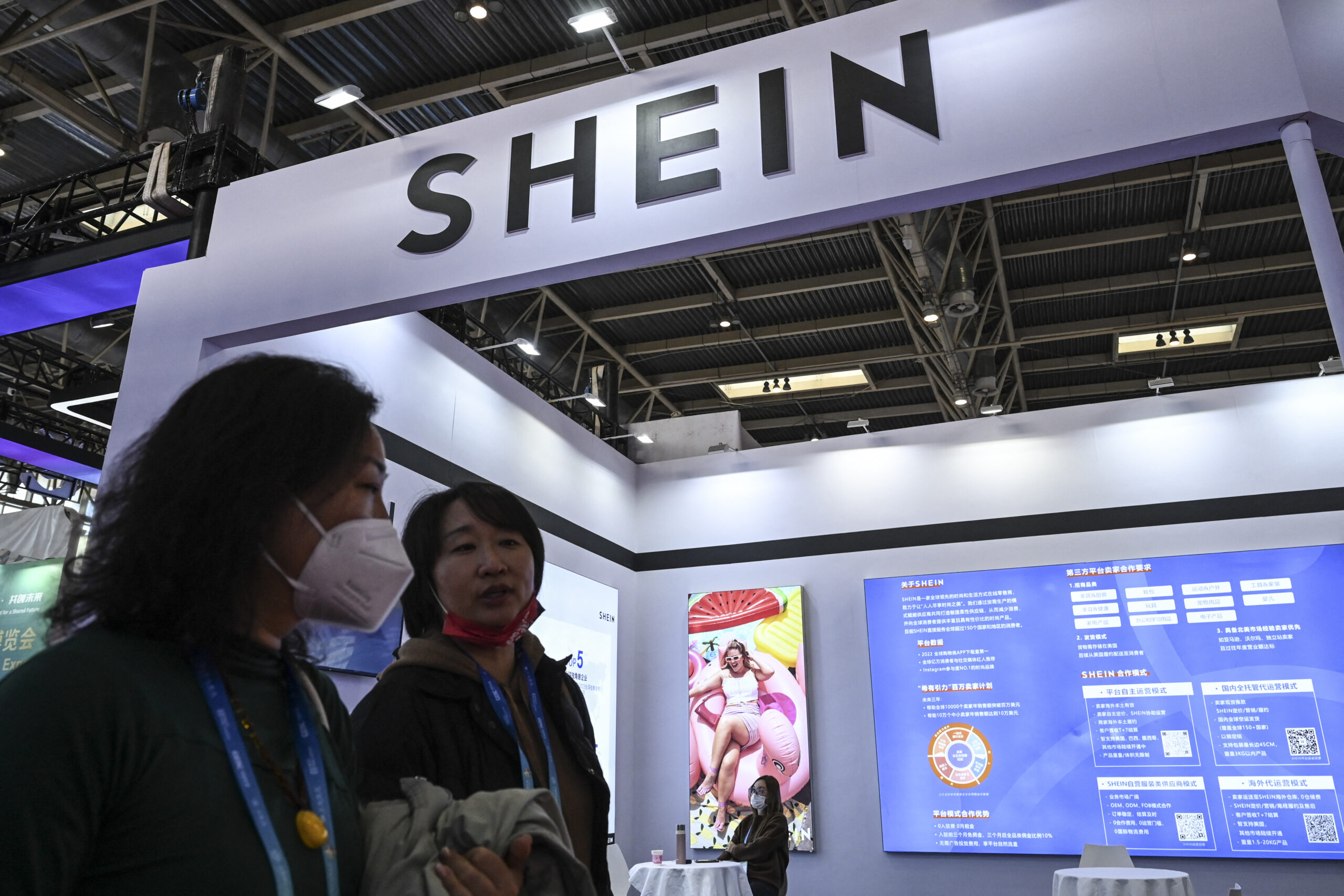
【Epoch Times News August 26, 2026】 China’s well-known fast-fashion online giant Shein is planning to list on the Hong Kong Stock Exchange on September 1. However, in recent years, Shein has been continuously causing environmental, social, and governance (ESG) issues, triggering investigations and hefty fines in Europe and the United States. Its previous listings in New York and London fell through due to these issues, casting a shadow over its upcoming listing in Hong Kong.
In 2022, Shein’s highest valuation was close to $100 billion, but now the upper limit of its Hong Kong IPO valuation is only $27 billion, shrinking by over 70%. The company plans to issue approximately 280 million shares, raising up to about $1.8 billion. According to Reuters, as of August 25, the IPO order book has received sufficient subscriptions.
However, tightening regulations in Europe and the US are increasingly impacting Shein’s low prices, fast turnover, and heavy reliance on the Chinese supply chain business model. The biggest question facing investors is whether Shein can sustain its rapid growth in Europe and the US after listing, and whether the post-listing regulatory and commercial risks can be resolved.
France is the country where Shein faces the greatest regulatory pressure. Last year, French regulatory agencies fined Shein €40 million for issues involving false discounts, misleading commercial promotions, and insufficient evidence to support environmental claims.
The French data protection authority (CNIL) later fined Shein’s European operation entity €150 million for violating French data protection rules related to cookie settings. In June this year, French regulatory agencies fined Shein approximately €22.5 million.
In February this year, the European Commission officially launched an investigation into Shein under the Digital Services Act (DSA), focusing on issues such as illegal product sales, platform addictive design, and algorithm transparency in recommendations. The most sensitive issue is the problem of illegal products, signifying the regulatory focus shifting to platform security issues.
The US market is also posing challenges. Shein disclosed in its Hong Kong IPO documents that its US business is under investigation by the Federal Trade Commission (FTC) for potential violations of consumer protection laws.
Shein stated it is cooperating with the investigation but warned that it could lead to “substantial monetary payments,” potentially having significant adverse effects on the company’s financial condition and business performance. With Shein not publicly disclosing the specific reasons for the FTC investigation, all these add up to significant uncertainty for investors.
In the past, due to tax-free policies on small packages in Europe and the US, Chinese cross-border e-commerce players like Shein were able to ship a large number of low-priced products directly from warehouses in China to Europe, avoiding some of the tariff costs borne by traditional importers.
The US and EU have since revoked tax exemptions on small packages, dealing a blow to Shein’s “Made in China + ultra-low prices + direct mail” model that propelled its rise.
In May last year, the US ended tax exemptions for packages below $800, after which Shein revealed that its profit of $395 million in the same period of the previous year turned into a loss of $99 million in the first quarter of this year, with a 14.3% drop in US revenue.
Europe is no longer a safe harbor either. The EU started levying a fixed tariff of €3 for each item category on certain small e-commerce goods meeting conditions, as of July 1 this year, for imports below €150.
This means Shein will have to raise prices, absorb costs itself, or change its supply chain to minimize the cost impact of tariffs. However, raising prices could weaken its low-price advantage, absorbing costs could compress profits, and shifting production and inventory in large quantities to Europe would increase warehousing, logistics, and compliance costs.
Both the US and Europe are core overseas markets for Shein, and the regulatory environments in these markets are among the strictest globally. Simultaneous actions from the US and Europe mean Shein cannot rely on “switching markets” to solve problems.
Shein employs a dual-class share structure where Class A shares have 10 votes per share and Class B shares have 1 vote per share. According to documents submitted to the stock exchange on Monday, Shein’s four co-founders hold 59.6% of total shares but will have 90% of voting rights after the IPO.
Kiran Aziz, head of responsible investments at Norway’s KLP pension fund, told Reuters that this ownership structure allows the co-founders to wield significant influence over shareholder decisions with no fixed expiration date.
Shein also combines the CEO and chairman positions. All four co-founders hold executive roles and concurrently serve as board members, with only three out of seven directors being independent. Aziz noted that such concentrated voting rights could weaken independent oversight, intensify potential conflicts of interest between management and controlling shareholders with minority shareholders.
Shein claims its model involves testing new products with small samples before increasing production as needed, resulting in minimal unsold inventory and less waste compared to competitors. However, critics point out that Shein’s low-price dumping and aggressive marketing model encourage consumers to engage in repetitive and impulsive consumption, fundamentally contradicting sustainable development goals.
The issue is that Shein introduces around 4,700 new designs daily on its website, offering over 2 million products, creating a bewildering array. This “ultra-fast launching + ultra-low prices” model is highly susceptible to scrutiny from environmental organizations and European regulatory authorities.
Last August, the Italian competition authority fined Shein €1 million, deeming some of its environmental claims to be misleading, with its recycling, sustainable production, and the “evolu Shein” series’ environmental claims being vague, exaggerated, and even misleading.
According to Reuters, on carbon intensity, Shein significantly surpasses Zara’s parent company, Inditex. In 2025, Shein’s sales were $41.8 billion, lower than Inditex’s $46.54 billion, but its reported greenhouse gas emissions were twice that of Inditex’s report.
Ken Pucker, a sustainable development practice professor at the Fletcher School at Tufts University, noted that Shein’s clothing materials are mostly chemical fibers, priced almost half that of H&M and Zara, making everything they produce seem more like disposable items.
An Asian investor focusing on ESG expressed concerns that fast fashion heavily reliant on high volume, short product cycles, resource consumption, and waste raises the core question for investors: can Shein’s growth strategy transition towards long-term sustainability? Given this, she has no intention to invest in Shein’s IPO this time.
To address investigations and improve public image, in 2024, Shein was forced to enhance its sustainable development measure disclosures, hire consultants, and establish an external ESG advisory committee, increasing its ESG report from a mere 28 pages in 2021 to a thick 118 pages last year.
While these efforts appear substantial, European and Asian investors still express worries regarding Shein’s labor conditions, corporate governance structure, regulatory scrutiny, and carbon emission reduction efforts.
Janina Bartkewitz, an ESG analyst at Union Investment in Frankfurt, stated that Shein continues to face serious ESG controversies, particularly concerning working conditions and labor rights, supply chain traceability, environmental impact, and sustainability implications.
Shein argues that the company’s governance, transparency, and accountability maintain high standards, complying with all applicable laws and listing requirements. Shein’s sustainability report last year claimed improvements in its supply chain.
However, ongoing investigations in Europe and the US increase the risk of hefty fines. The European Commission recently imposed fines of €550 million and €200 million on AliExpress, a subsidiary of Alibaba, and Temu, a subsidiary of Pinduoduo, respectively, for illegal products.
Bartkewitz noted that aside from financial impacts, the severity of regulatory scrutiny raises questions about Shein’s compliance, internal controls, and board oversight. Some investors have also pointed out issues in corporate governance.
Shein’s biggest challenge in its Hong Kong IPO is not whether there will be sufficient fund subscriptions but whether it can resolve its structural issues after listing and maintain its low-cost model.
Currently, regulatory agencies in Europe and the US are pressuring Shein on consumer rights, privacy, environmental issues, illegal products, algorithms, labor, and supply chains simultaneously. Adding to this, the US has revoked the small package tax exemption. Meanwhile, Shein’s valuation has significantly dropped.
While a Hong Kong listing may help Shein secure new funds, it cannot alter the regulatory environment in Europe and the US. If Shein continues to adhere to its ultra-low pricing, rapid product turnover, and China supply chain-driven model, it will face increasing compliance costs. Should it raise prices and costs to comply, it risks losing its core competitive advantages.
In summary, Shein’s greatest challenge in this IPO is not its success in listing but whether it will be forced to change its previous business model under the pressures of European and American regulatory forces after listing.