
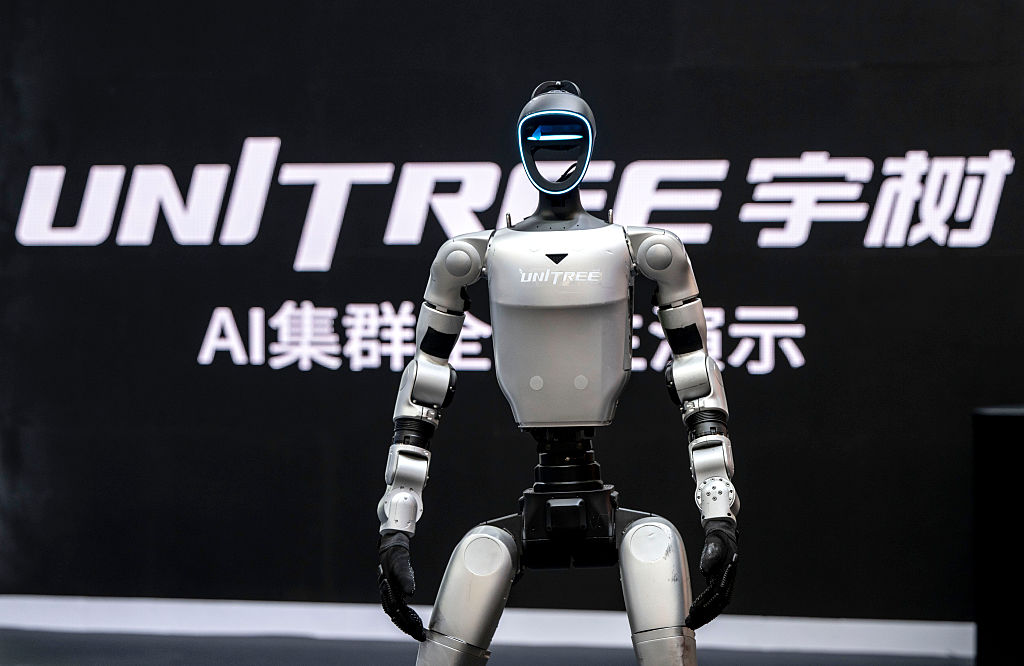
Recently, the stock price of Utree Technology has been on a continuous decline after its initial public offering, with the market value evaporating by approximately 200 billion yuan over four trading days. Many analysts believe that the previous market pricing of the commercial prospects of humanoid robots was too high, and the company’s scalable profit model has not yet matured. With low research and development expenses, the gap between valuation and fundamentals has become a controversial focus.
On August 19, Utree Technology debuted on the market at 1,100 yuan (Renminbi, RMB), surging by 629% at one point during the trading day, reaching a market value of about 444.9 billion yuan.
The downward trend in the stock price continued over the following trading days. The closing price on the debut day dropped to 845 yuan. On August 20, the company’s stock price further declined, reaching a low of 685.01 yuan and closing down by 18.70%.
By the fourth trading day, the company’s market value had significantly shrunk. On the 24th, Utree Technology closed at 603.08 yuan, a 10.3% drop for the day, bringing the total market value down to around 243.9 billion yuan. Compared to the opening price, the stock price had retracted by 45.1%, with approximately 200 billion yuan of market value evaporated over four trading days.
A stock trader in China expressed strong doubts about the market value of Utree Technology on its debut day. In an interview with a popular science host, he mentioned that on the first day of the IPO, the market value of Utree Technology reached over 400 billion yuan, while the company’s annual revenue was only a few billion yuan with profits of around two billion yuan. Evaluating the company based on its revenue, profits, and research and development investment, the valuation appeared significantly inflated.
According to a report from the Phoenix Eye platform, economist Fu Peng stated that Utree’s pre-listing valuation was already significantly higher than the market consensus. The robotics industry is still in an early stage, and while the company has completed its IPO, it currently resembles a first-level market venture investment more than a fit for investors seeking stable returns.
Public data shows that Utree Technology’s revenue for the first half of 2026 was 1.152 billion yuan, a 48.54% year-on-year increase, while the non-net profit was 244 million yuan, a 19.34% decrease compared to the same period.
Currently, the low level of research and development funding at Utree Technology is a focal point of concern across various sectors. Fu Peng pointed out that as a benchmark in the humanoid robot industry, Utree Technology’s post-listing funding should logically be channeled into research and development. However, an examination of financial reports reveals that the company’s research and development expenses are even lower than those of a pig farming business like Muyuan Group.
The aforementioned trader also noted that, based on his understanding, Utree Technology’s research team and the number of doctoral personnel are not substantial, despite the company’s market valuation reaching hundreds of billions of yuan after going public. There is a clear disparity between the company’s research and development capabilities and its capital market valuation.
He compared Utree Technology’s research and development investment to the industry average, stating that, in his estimation, the industry’s average proportion of funds raised for research and development is around 25%, while Utree Technology’s related percentage may be only about 8%.
He emphasized that for a robotics company to maintain a long-term advantage in technological competition, continuous substantial investment in research and development is necessary. If research and development spending significantly lag behind industry competition levels, the company’s future technological edge could be challenged as competition intensifies.
On the potential for humanoid robots to form a large-scale market, financial commentator Liu Ge pointed out that Utree’s main advantages currently lie in robot hardware and dynamic balance capability. However, they still have a significant distance to go before being able to accomplish complex tasks in most unfamiliar environments, and the technological conditions for household applications are not yet mature.
Liu Ge believes that the current overvaluation of humanoid robots in the market includes expectations for a vast future market space. However, if general humanoid robots cannot enter households, the business models of related companies will mostly remain confined to specialized scenes such as industrial, research, patrol, and performance sectors. He provided an estimated reasonable valuation range for Utree of 60 billion to 100 billion yuan.
In 2025, public data showed that within Utree Technology’s income sources, 73.6% came from customers in scientific research and education, including high schools and research institutions, with commercial consumer scenarios accounting for 17.39% and industry applications at 9.01%.
A trader under the alias “Lin Xicheng’s Promised Land” believes that ultimately, robotics companies still need to enter practical application scenarios to generate continuous income through product sales and scaled application. Relying solely on the capital market’s pursuit of the robotics concept, without products entering a wide range of actual scenarios, may struggle to sustain long-term overvaluations.
He noted, “When the majority of embodied intelligence companies truly have the ability to invest in actual applications in the market, and you have invested so little in research and development, whether you can survive in the robot market is a question mark.”
He expressed skepticism about whether Utree Technology could maintain long-term competitiveness and predicted that the company might be eliminated in five years.
Following the dissemination of these opinions on the internet, the trader’s account “Lin Xicheng’s Promised Land” was promptly banned after expressing the aforementioned views, and the account of the science popularization host “This Is Easy” also exhibited abnormalities. However, the specific reason for the account ban is yet to be confirmed to be related to the comments made.