
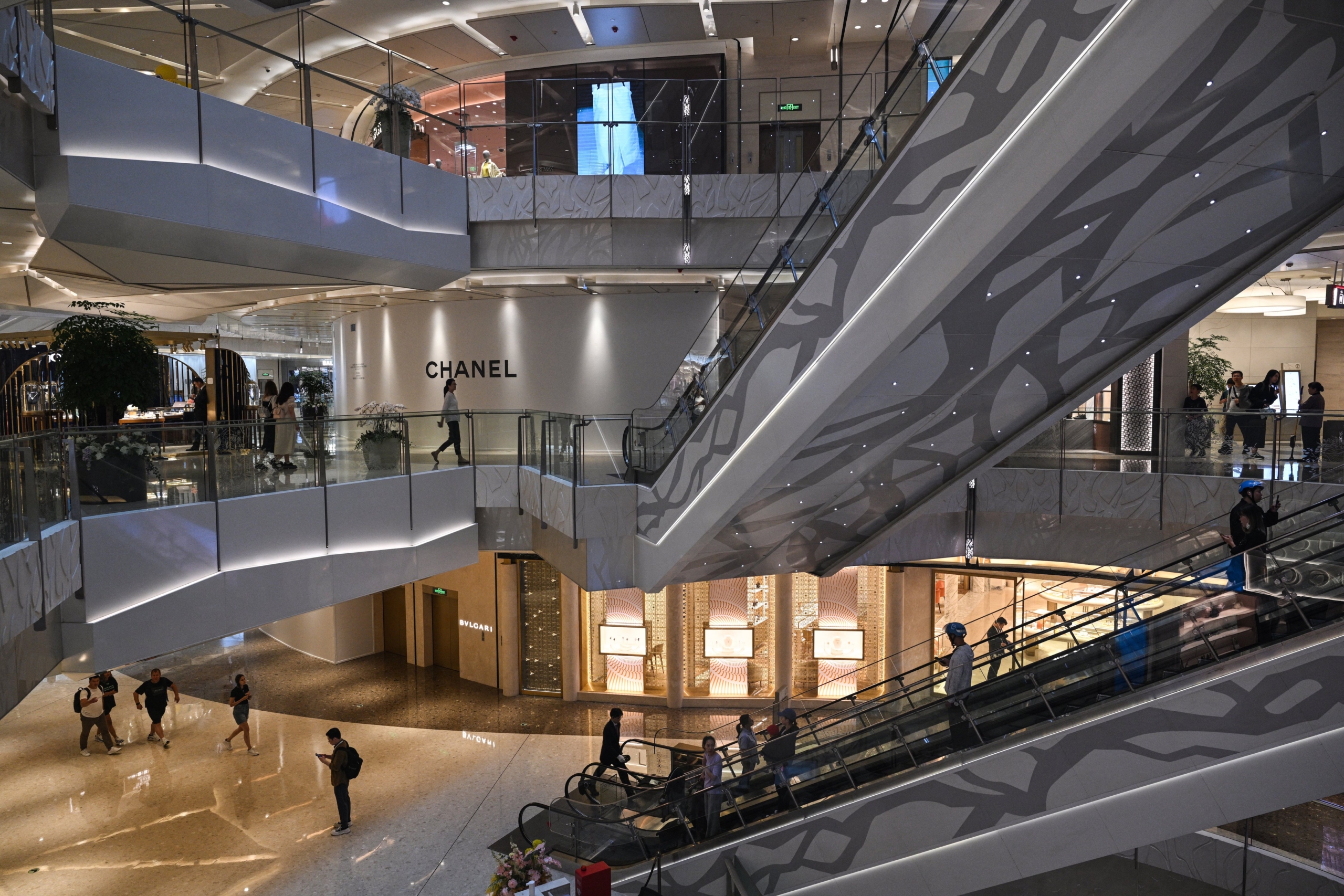
Shanghai, once thriving and bustling with financial prosperity from land revenue, has suffered a significant downturn after the pandemic lockdown. With the mass exodus of foreign investments and a sluggish economy, people in Shanghai are either going abroad or choosing to be idle. The residents of Shanghai resentfully remark that “the dictator has sounded the death knell for the Chinese economy.”
As the most economically developed city in mainland China, Shanghai accounts for about 4% of the national GDP and has been a leading city in mainland China for many years.
However, a report from the Chinese Ministry of Finance at the end of July revealed that none of the 31 provincial-level administrative regions in China had a self-sufficiency rate of 100% in the first half of the year. The combined local fiscal self-sufficiency rate of all provincial-level administrative regions was only 56.3%. Even financially robust cities like Shanghai could not cover all expenditures with their local fiscal revenue alone.
Sun Guoxiang, a professor specializing in international affairs and business at the University of Nanhua in Taiwan, told Epoch Times that if the self-sufficiency rate in high-income areas like Shanghai continues to decline, it indicates a weakening of real estate, enterprise profits, and local tax bases, which is no longer just a problem in central and western China.
Dai Yu, familiar with the real estate industry, recently stated to Epoch Times, “Actually, the economy in Shanghai is quite sluggish.” He resides in the Huamu Street, Pudong, facing the Lujiazui Financial and Trade Zone and backing onto the innovation engine, Zhangjiang.
“Due to the decrease in online shopping and consumer purchasing power, many well-known malls that used to be crowded have closed down. Places like Bailian Shopping Mall are struggling, and many high-end restaurants in Lujiazui have shut down.”
However, this is not the main reason, Dai Yu explained. Many multinational corporations have evacuated, leading to the relocation of numerous companies and factories, resulting in a significant decrease in foreign executives, including Chinese managers working for foreign companies, thereby dampening consumer spending in Shanghai.
According to media reports, in the past three years, foreign companies have been withdrawing or significantly downsizing their operations in Shanghai. In 2026, high-end beauty foreign companies like Filorga from France and hince from South Korea shut down their Shanghai operation centers and withdrew from domestic e-commerce operations. Industrial coatings manufacturer Sherwin-Williams liquidated its Asia-Pacific headquarters in Shanghai and completely withdrew from the Chinese market.
Dai Yu mentioned that someone calculated that a foreigner, along with their family, spends two million in Shanghai annually, with a significant portion going towards their child’s education and housing expenses. These expenditures were reimbursable. He also noted that many high-ranking local managers employed by foreign enterprises in Shanghai received similar subsidies. Their presence would boost consumption, the economy, and local schools.
“Shanghai used to be wealthier than Tokyo or New York, but companies like Huawei for cost-saving purposes moved most of their operations to rural areas like Qingpu a couple of years ago. As a result, a group of talented middle-level executives rebelled, some resigning to work abroad,” Dai Yu lamented.
A report from industry media, Light Reading, in August indicated that Nokia Shanghai Bell, after fully reclaiming ownership of its joint venture, was gradually reducing, merging, or phasing out traditional business and research and development activities in bases in Shanghai, Beijing, Chengdu, Qingdao, among others.
Dai Yu went on to say that even Zhangjiang High-Tech Park has faced hardships. The pharmaceutical and semiconductor industries there have also stagnated. Many of Dai Yu’s former tenants and friends, especially young individuals, who used to work in Zhangjiang, are now unemployed, with some opting to go abroad. “Young people who had the chance to leave have gone, while those who couldn’t leave simply lay low or moved to rural areas.”
An IC design company employee at the Zhangjiang Integrated Circuit Port, who worked there for 12 years, mentioned online that from 2025, foreign companies in Shanghai experienced a “peak retreat” with a concentration of departures by American technology companies, mainly closing research and development centers and massive layoffs, including IBM, Microsoft, SAP, Intel, Dell, Micron, AWS, SAS, among others.
Dai Yu added that previously, there was fierce competition for renting factories and office buildings in Zhangjiang, but now they are vacant. “The economy is really not doing well,” he remarked.
In an attempt to stimulate home purchases, facilitate relocation, and boost the economy, Shanghai quietly removed certain housing market restrictions in 2024. Measures such as the 7090 policy affecting unit area ratios, ceiling prices for land sales, and subsequent fading of linked prices were also eliminated.
From August last year to August this year, the Shanghai Housing Commission and six other departments successively introduced the “Shanghai Six Measures,” “Shanghai Seven Measures,” and the latest “Shanghai Eight Measures.” The newest policy, the “Shanghai Eight Measures,” includes introducing subsidies for “selling old to buy new” and optimizing housing loan discounts to guide residents to absorb the vast new housing inventories outside the Outer Ring Road.
Wang Guochen, the deputy research fellow of the Mainland Economy Institute at the China Economic Research Institute, stated to Epoch Times that local governments in mainland China are now confirmed to be financially strained, as after the tax devolution system in 1994, local government expenditures exceeded their income, leading to a general lack of funds. Additionally, with the continuous departure of foreign firms causing the economic downturn, local government revenues have also been impacted.
Wang Guochen further explained that before, when local governments were short of funds, they could rely on selling land for money. However, now that real estate is depreciating, and land cannot be liquidated, land income has greatly shrunk. “Shanghai is a gathering place for office buildings. With foreign companies leaving, there are no tenants for the office spaces. Without foreign investment, the real estate sector suffers.”
The latest statistics from the Chinese Ministry of Finance show that the state-owned land use rights transfer income saw an annual decrease of 30.8% from January to July this year, marking four consecutive years of decline since 2022.
Dai Yu revealed that the public reserves in Shanghai are currently positive, but the central government forcibly transferred the Shanghai public reserve fund pool to the national pool. He mentioned the frustrations of retirees and colleagues, including a former comrade in arms who served in Vietnam and later worked at their unit, expressing discontent about the situation and criticizing the Chinese leader, Xi Jinping.
Dai Yu explained that if these funds are transferred, Shanghai will eventually deplete its reserves. “Shanghai is in a dire state now, with frequent changes in leadership. Once the leadership changes too frequently, it’s over.”
Regarding Shanghai’s local finances, Dai Yu mentioned that during the era of Hu and Wen, there was an agreement between the local and central governments, whereby roughly six-tenths of the revenue remained locally, with four-tenths going to the central government. This arrangement was advantageous to Shanghai. However, the details of this revenue-sharing ratio have now become confidential.
“Shanghai, still receiving a significant portion, now faces demands from Xi Jinping. The central government likely receives much more than before, leading to a loss of autonomy for Shanghai’s local finances,” Dai Yu emphasized. “Many people have told me that if Xi Jinping goes after Taiwan, it will be like Russia. The countdown has started, preparing to hang him. By that time, Shanghai will seize the opportunity to declare independence, alongside Jiangsu and Zhejiang provinces, breaking away. People are unwilling to cooperate with the central government.”
Currently, even bank employees are cursing Xi Jinping. With falling property prices, the banks are struggling. Dai Yu mentioned a friend who is a manager at a major bank, noting that Xi’s policies have led to a decline in business, with many branches closing down.
“Therefore, they (the government) are now resorting to redevelopment of dilapidated buildings to spur employment and stimulate the economy. If property prices continue to fall, Shanghai’s economy will turn negative, leading to potential unrest. During the lockdown, the Wulumuqi Road experienced a ‘blank paper’ movement, demanding the ousting of the dictator,” Dai Yu added.
Dai Yu criticized Xi for mishandling Shanghai’s economy, remarking on the dire situation. “At that time, during the unrest, the youth rose up. If Xi Jinping seeks reelection and continues to deteriorate the economy, when there is no way out, people in their forties and fifties will join the dissent. The Chinese Communist Party will face bankruptcy.”
Cao Peng, who worked in a foreign company, stated, “The authoritarian leader’s self-willed actions have struck the death knell for the Chinese economy.”