
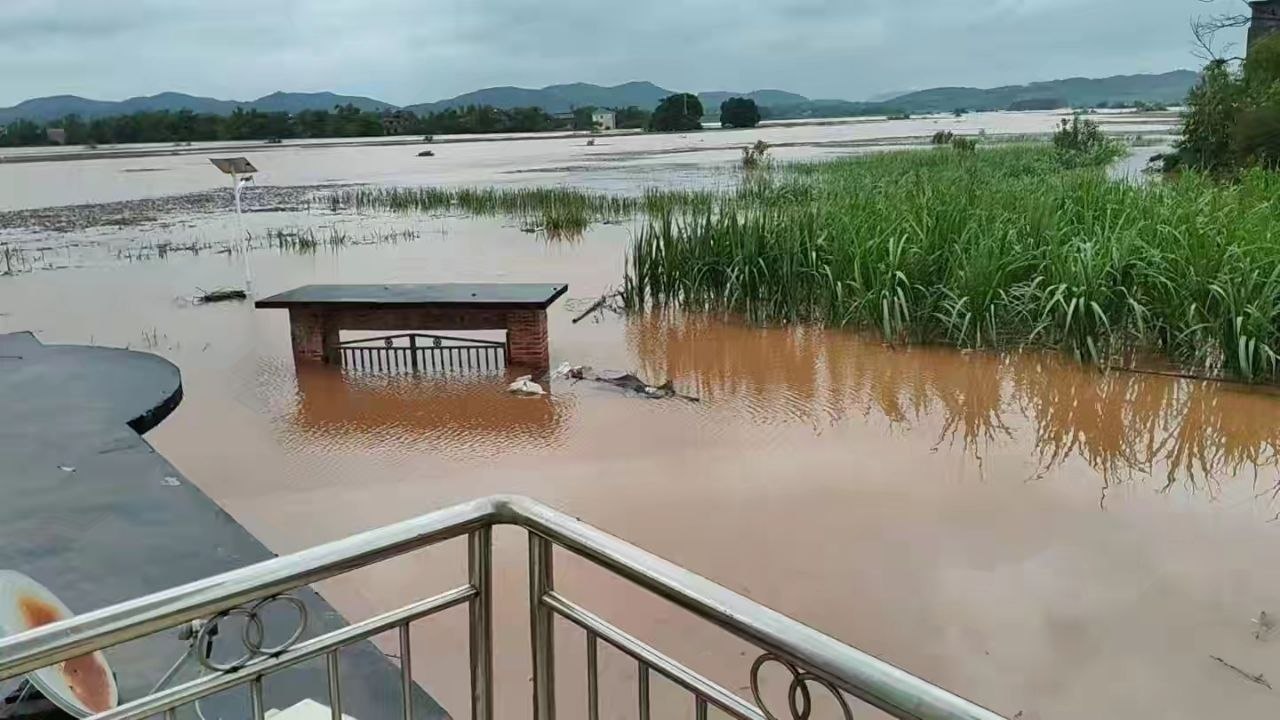
Due to the continuous heavy rain brought by Typhoon “Purple Sand” and the impact of upstream water influx, multiple areas in Chongzuo, Guangxi, have been hit by severe flooding. On August 25th, the water monitoring stations in Ningming and Longzhou recorded record-breaking floods. Local residents told Epoch Times reporters that the floodwaters rose rapidly, with many people unable to evacuate in time, and some houses were submerged up to the second floor. Villagers interviewed reported that three days after the disaster, the area still lacked water, electricity, and food supplies, with some residents stranded on the upper floors waiting for aid.
In the Qiaodong district of Ningming County, a female resident shared with Epoch Times that her area had been flooded for two days, with the floodwaters rising up to the second floor. She and her child were trapped at home, unable to move on the first floor and with no escape windows on the second floor. Their household had been without water and electricity for two to three days, and their phone was running out of battery.
“We’ve been passing around messages in our group chat, all waiting, with no rescue in sight,” she said. She admitted to not evacuating in advance and described how the water rose rapidly, quickly submerging the first floor. The previous night, civilian rescue workers had brought bread and drinking water, and a civilian drone was used to deliver supplies.
A male villager from Liyue Tun in Mingjiang Town, Ningming County, stated that his home had about 1.5 meters of accumulated water, with lower-lying houses flooded up to the second floor. He mentioned that nearly 3000 people in their village were mostly trapped in their homes.
After the floodwaters rose, water and electricity supply were quickly cut off in the area. Fortunately, they had moved their batteries to the second floor in advance, enabling them to charge their phones. While they still had rice at home, they were lacking fresh vegetables and had to ration their food supplies.
In Longxiang Village near the East Asia Sugar Factory in Zhongzheng Town, Ningming County, severe flooding was observed. A relative of a trapped individual informed Epoch Times that their family had been rescued from the factory on the 24th, but there were still people inside who had not been rescued, some of whom had not eaten anything for an entire day.
The relative recounted how the Longxiang vegetable market near the sugar factory was almost submerged under floodwaters up to the roofs of buildings. Although rescue personnel were on site, some were unfamiliar with the local roads, making it difficult to locate and evacuate the trapped individuals.
An unmanned aerial rescue worker from Xiashi Town in Pingxiang City, who rushed to Longxiang Village, mentioned receiving a distress call from a friend and heading to support the sugar factory operation. He was informed that over a hundred people were trapped inside.
“I brought gasoline and food supplies, but the rescue boat ran out of fuel,” he said. He arrived at the scene at noon on the 24th, and by night, the water level had risen by about one meter. The exact number of people rescued from the factory was still unknown.
A female villager from Mufan community in Longxiang Village, Chengzhong Town, described how the floodwaters had risen to the second floor, submerging Longxiang Bridge and inundating numerous vehicles, electric scooters, and household appliances in the water. With no water, electricity, or food supplies for three days and nights, some residents were still stranded upstairs, including elderly individuals, patients, and persons with disabilities.
She mentioned the lack of external aid in the early days of the disaster. It was only after she shared the situation online that drones and rescue boats brought mineral water and bread supplies.
“We are used to self-rescue here; it has become a habit,” she said. Despite the area’s lower terrain, which typically experiences floods in past years, the severity of this year’s situation caught them off guard. While some residents had stored some food provisions, they were unprepared for sustaining themselves for multiple days. Some villagers could use boats to go out and buy supplies, while those without boats found it challenging to leave their homes.
She emphasized that many people in the village were trapped at home, with elderly and children reluctant to leave even when evacuation was proposed, unsure of where they would be relocated. Some villagers believed staying in their own homes upstairs was safer in their situation.
The villager mentioned that there had been no reports of casualties in their area yet, but many high-value items, such as cars, electric scooters, refrigerators, and sofas, were submerged under water due to the lack of time to move them upstairs. Even though these items were worth tens of thousands of yuan collectively, it was still a significant loss for them.
She explained that their livelihood depended mainly on fishing, while surrounding villagers predominantly grew sugarcane. However, the sugarcane and other crops in the surrounding villages were flooded, and poultry and livestock such as pigs, ducks, and cows were washed away by the floodwaters.
She appealed for assistance from the outside world, expressing hope that the donated supplies and funds would reach the affected residents, ensuring they receive more than just a few packs of noodles and bottles of mineral water in the end.
A male villager from Nakang Town in Ningming County detailed how the floodwaters began rising after 11 p.m. on the night before, reaching up to one and a half floors by early morning the next day. Despite experiencing a recent flood, many locals underestimated the severity of the current situation, not expecting the water levels to rise rapidly overnight.
He described how most streets in Nakang Town had been previously submerged by the flood. In some villages near the Daying Reservoir, the floodwaters rose to the second or third floor at one point.
He and his family were stranded for almost two days, surviving on whatever food they had left at home. The water supply had only partially resumed on the 25th after the water level receded, with electricity and communication services still down. The streets were covered in mud and debris, and their household had incurred losses with damaged electric vehicles, refrigerators, televisions, and washing machines.
While aid had been delivered previously, the village lacked sufficient open space and coordination for proper distribution of resources, hindering the relief efforts.
As the floodwaters receded, residents began cleaning up the mud and debris, although water supply remained unstable. He mentioned, “We were halfway through cleaning up today when the water supply was cut off again. We couldn’t finish the clean-up.”
A female villager from Zixian Village, Zijiang Town, in Ningming County, shared that the floodwaters had surged to over three meters, causing a two-day power outage and interrupted communication services in the entire village. Even after the water receded, there was still a shortage of drinking water and other essential supplies.
Approximately 700 people resided in her village. Despite receiving only 20 boxes of water and some eight-treasure porridge, far from meeting the full village’s needs, she explained, “We are relatively remote, and essential supplies barely reach us.”
A villager from Pentong Village in Taiping Street, Jiangzhou District, Chongzuo City, highlighted that the majority of their village had been submerged by floodwaters, resulting in power outages and a lack of supplies. During the flood peak, most surrounding residents stayed at home, unable to evacuate.
While the water levels seemed to be slowly receding after the flood peak, the interviewee estimated that it had only dropped by a little over ten centimeters at the time of the interview. No external personnel had been seen entering the village in the past two days. In the aftermath of the rising waters, provisions for food, drink, and daily necessities mainly relied on self-sufficiency among villagers, who supported each other during the challenging times.
Meteorological data revealed that from 8 a.m. on August 21st to 8 a.m. on the 24th, Zhilang Township in Ningming County received a total rainfall of 618.2 millimeters. Due to the continuous heavy rain from Typhoon “Purple Sand” and the influx of upstream water, water levels in multiple rivers in Chongzuo rose rapidly.
According to official information released by the Guangxi Water Resources Department, on August 25th, the water monitoring stations in Ningming and Longzhou all recorded record-breaking floods. The Ningming Mingjiang Hydrological Station reached a peak water level of 124.59 meters, the Ningming County town station recorded 123.69 meters, and the Longzhou Hydrological Station reported 124.54 meters.
The Guangxi Water Resources Department reported that the two stations in Ningming recorded the largest floods measured since their establishment, while the Longzhou Hydrological Station recorded its largest measured flood since 1986.
Public images revealed that in some low-lying areas of Ningming County, only treetops and roofs were visible above the water, with water levels reaching up to about 4 meters deep near Xingning Avenue East.
As of the evening of the 24th, Longzhou County reported 21,559 people affected and 5,816 houses submerged.