
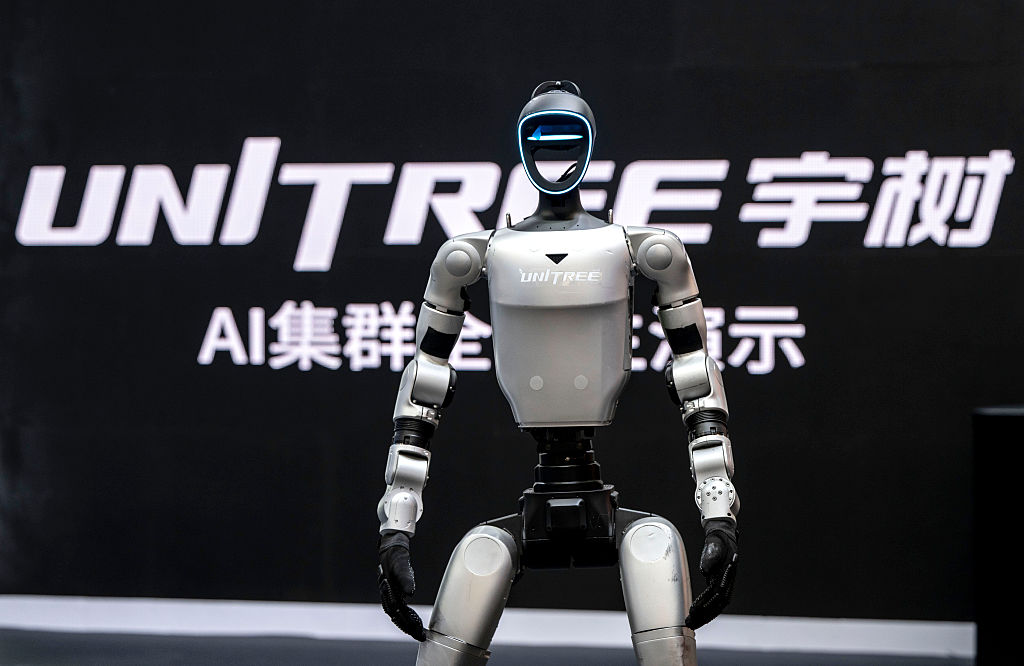
On August 25, 2026, Chinese humanoid robot manufacturer Unitree Technology (Unitree) saw its stock price surge more than fivefold on its first day of trading in Shanghai, only to later plummet by around 45%. The drastic fluctuations in Unitree’s stock price have raised concerns in the market about bubble risks, losses for retail investors, and deficiencies in the IPO (Initial Public Offering) system under the Chinese Communist Party.
According to a report from Reuters on August 25, Unitree Technology’s valuation briefly soared to $66 billion before shrinking by $30 billion, prompting questions about whether the market’s enthusiasm for artificial intelligence (AI) and robotics technologies has departed from fundamentals.
Unitree is one of the world’s largest manufacturers of quadruped and humanoid robots, and the selling pressure following its IPO has led to a reevaluation of the listing mechanism under the CCP. Some analysts believe that this mechanism has distorted pricing.
After experiencing three consecutive days of declines (with a cumulative 45% drop since its listing last Wednesday), Unitree Technology’s stock price stabilized on Tuesday.
“Investors have been blinded by the narrative of the ‘technological revolution,'” said Dong Baozhen, Chairman of Beijing-based asset management company Lingtong Shengtai, warning that “all bubbles will eventually burst.”
According to Reuters, the IPO performance of Unitree Technology reflects market froth rather than genuine prosperity in the Chinese technology sector.
While Unitree Technology posted signs of slowing profit growth in the first half of the year, the company’s robots, known for their ability to run, dance, and perform martial arts, have garnered attention, but their broader commercial applications have yielded minimal returns. According to the prospectus, Unitree Technology reported a 53% decrease in adjusted net profit to 40 million yuan (approximately $5.95 million) in the first three months of 2026.
Abraham Zhang, Chairman of China Europe Capital, stated that loopholes in the Chinese (CCP) IPO system allow major shareholders to cash in profits while shifting risks onto retail investors participating in secondary market trading.
Analysts suggest that investors were drawn to Unitree Technology’s IPO because amidst the US-China competition for technological dominance, the market believed the company had received support at the national level from the CCP. They pointed out that the company’s swift listing on Shanghai’s STAR Market dedicated to technological innovation also signaled government approval.
Yuan Yuwei, hedge fund manager at Trinity Synergy Investments, noted that companies like Unitree Technology and DRAM storage chip manufacturer CXMT have been sought after because “quality enterprises in the Chinese stock market are few.”
Gao Xingkun, fund manager at China Southern Asset Management, remarked, “Many robot manufacturers invest heavily in research and development, but commercial orders have yet to materialize.”
Under CCP control, securities exchanges not only scrutinize companies planning to go public but also guide IPO pricing to limit investment banks’ operating space during market frenzies.
Mr. Dong pointed out that the significant price disparity between IPO issuance prices and first-day performances means “one of them must be wrong,” attributing the issue to improper pricing on the latter. He stated, “The first-day performance serves as a barometer of market sentiment, and overheated sentiment often breeds bubbles.”
Mr. Yuan, the hedge fund manager, observed that due to restrictions on short selling activities, manipulative behaviors such as “pump-and-dump” are common in China’s new stock market.
“The actual value of an IPO stock may only be 10 yuan, but the opening price can soar to 100 yuan, followed by a continuous decline lasting for years. It’s simply a rip-off,” he said.
A retail investor who incurred losses when investing in Unitree Technology wrote in a blog post that while supporting innovation, “the rapid accumulation of wealth should not be built on the pain of retail investors.”