
In a recent weeks, the issue of outbound control of Chinese citizens has become highly sensitive in Chinese society. On July 31, 2026, the State Council of the Chinese Communist Party announced that a new “Exit and Entry Management Regulations” would be implemented from September 15. However, various regions’ “border controls” and outbound inspections may have already entered a state of “wartime readiness”.
A confidential document from the Xinjiang Public Security Bureau obtained recently by Epoch Times reveals that certain inspection methods seen at ports nationwide – such as checking mobile phones, scrutinizing social media, and group accountability – were already institutionalized in specific areas for border controls back in 2017 based on a law enforcement guide secretly printed nine years ago.
Once a “control experiment” aimed at counterterrorism, is it now evolving into an outbound “iron cage” for ordinary Chinese people nationwide?
According to reports from BBC Chinese on August 20, in June of this year, a 25-year-old man from Hunan, Li Ming (pseudonym), was traveling in Malaysia when for unknown reasons, the Chinese authorities listed him as a “high-risk for telecom fraud”. Local police later called and demanded that he return to China within three days, or else he would be regarded as a “fraudster” and have his household registration revoked.
To prove his innocence, Li Ming quickly returned to China, but instead of having his suspicions withdrawn, he was further placed on an “exit restriction list” and would be unable to leave the country for a considerable period.
Simultaneously, more online revelations have surfaced, causing anxiety among the public.
On August 19, a passenger flying from Shanghai to Seattle shared their personal experience with a well-known blogger who focuses on sudden events in Chinese society, revealing that Shanghai Customs not only required passengers to fill out an extremely intrusive “Exit Registration Form” but also forcibly unlocked and inspected a large number of passengers’ phones in a “small black room” using both machines and manual checks.
According to the “Shanghai Pudong International Airport Exit Registration Form” provided by this passenger, Customs required personal information, details of the outbound itinerary, family members, overseas relationships, internet and social media activities, online behavior, asset and financial status, among others.
One passenger had all new applications on their phone, which led authorities to confiscate the phone on the spot for allegedly using a secondary phone and concealing their “regular phone”. With intense scrutiny, passengers were anxious, and ultimately about half of them were removed from the flight.
People are realizing that outbound inspections are evolving into a comprehensive “pocket-style interrogation”. However, many are unaware that these seemingly sudden strong control measures were not impulsively initiated. These outbound interrogation measures, evaluated by netizens as “like being on trial” and “frustrating”, were in fact used by Xinjiang Public Security for tracking, interrogating, and suppressing inbound and outbound personnel nine years ago.
The 2017 internal document obtained by Epoch Times mandates relevant agencies to fully utilize “integrated joint operations platform, anti-terrorism big data platform, technical investigation platform, etc.” to deeply check the target’s “online identity, communication, social media accounts” during inbound and outbound controls.
The “Exit and Entry Sensitive Country Personnel Check List” in the manual specifically requires police and border inspection personnel to collect mobile numbers, online communication accounts, bank accounts, funding sources, online payment tools, addresses, social relationships, reasons for entry and exit, overseas activities (such as work, travel, seeking medical treatment), and almost all conceivable related matters.
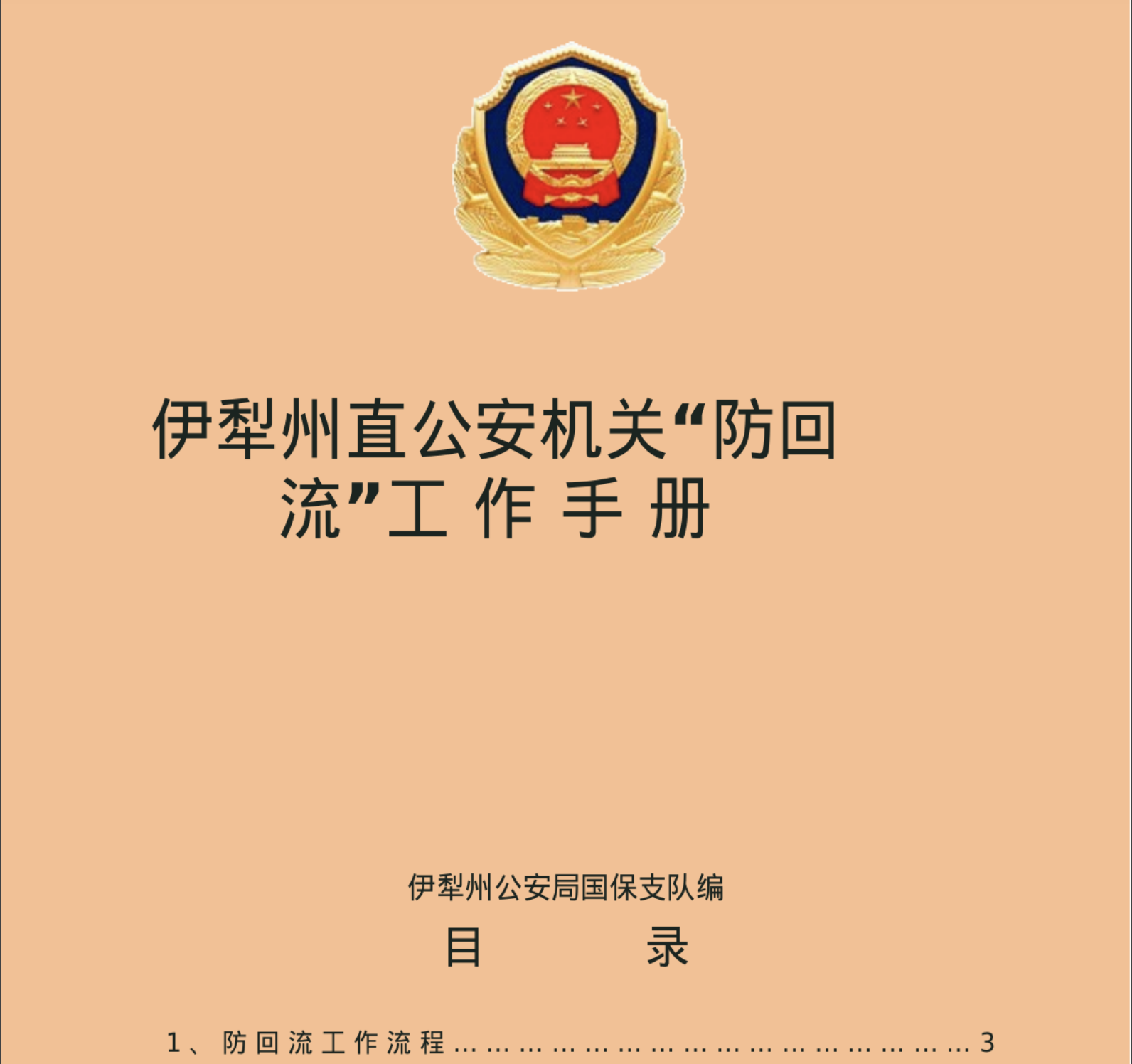
Epoch Times exclusively obtained this confidential Xinjiang 2017 document titled “Yili State Public Security Bureau ‘Anti-Backflow’ Work Manual (2017)”.
Here, “anti-backflow” refers to an extremely stringent special “border control system” established by Xinjiang Public Security targeting anti-terrorism and counter-terrorism goals. Specifically, it aims to prevent and intercept overseas individuals and their ideologies, funds from re-infiltrating the country through online information screening and offline grid control.
This border control system consists of three main aspects: defining the preventive targets, identifying them, and implementing prevention measures.
Firstly, in defining the preventive targets, the document lists dozens of indicators covering terrorism-related individuals, unreduced returnees, students studying abroad, business people, unexpected dropout students, etc., not only categorizing key groups but extending control to their immediate family members and major social relationships.
Secondly, in identifying the preventive targets, the police have established an online and offline cross-checking review model – online collecting travel, communication, financial, and network social traces through the integrated joint operations platform for a so-called “electronic health check” (document term); offline community police carry out “face-to-face contact” and so-called “manual health check” within 7 days, coordinating with special teams to collect information.
Lastly, in terms of specific prevention measures, this system includes “90-day monitoring” for high-risk targets, “communication record prevention” for families, mandatory pre-departure interrogations, strict 21 interrogations upon arrival, and mandatory confiscation of passports and full process reporting physically.
The document indicates that this border control mechanism for specific regions was already in place at least nine years ago, combining a round-the-clock grid control model that integrates “digital and human resources”.
If the inspection of electronic devices and social software shows the “technical means” of this system, the management of passports outlined in the document reveals how authorities take control of what should be a legal citizen’s travel document, turning it into a “political chain” fully controlled by public security agencies.
Accompanying the manual is a “Passport Application Processing Flowchart”, which clearly demonstrates the complete control of a passport from application, approval, possession, and throughout the entire cycle.
In this process, after the applicant submits materials, they not only undergo a background check by community police on their behavior, social relationships, and family income but are also compared against the “Three Major Databases” (including the national statutory restricted outbound personnel database, Xinjiang restricted outbound personnel database, and the national civil servant database) by the entry and exit department. Subsequently, the security department intervenes, pushing applicant information to the “Integrated Joint Operations Room” for multi-platform trajectory analysis and conducting thorough inspections of the applicant’s family financial accounts. Only with approval from all departments can a passport be issued.
Once the passport is mailed to the local police station, the passport applicant and outbound individuals must additionally attend centralized training at the local National Security Brigade, with only qualified applicants being able to finally collect their passport at the police station.
Moreover, the most striking aspect is the control requirements after obtaining a passport. The manual in the flowchart clearly states: “Report to the police station before each departure and return the passport to the police station for registration within 7 days of returning. In order to leave the country again, approval must be re-applied from the local government and public security.”
This means that even when a passport is issued to a citizen, it is by no means a document they can freely dispose of. In fact, as early as around 2016, overseas media widely reported that in many parts of Xinjiang, residents were required to hand over their passports to public security agencies for “centralized management”.
A passport, originally a legal travel document for citizens, is now embedded in an extremely stringent security review and personnel control system as shown in this 2017 Xinjiang Public Security internal document’s process.
In other words, the public security agencies do not truly control just a passport, but the entire personal privacy of the passport user and their right to free travel. This sheds light on today’s outbound inspections causing concern throughout China, allowing for a historically traceable comparison.
If the “anti-backflow” of the past were specialized control mechanisms for certain regions and populations, then with the implementation of the new version of the “Exit and Entry Management Regulations,” a core focus that should concern the public is whether this extreme control logic originally used for “counterterrorism” has extended beyond territorial restrictions, evolving into a standardized inspection model targeting ordinary citizens.
Therefore, under stringent control measures, who exactly in Xinjiang is restricted from traveling? How did Xinjiang Public Security determine who posed a “risk”?
Stay tuned for more reports in this series.