
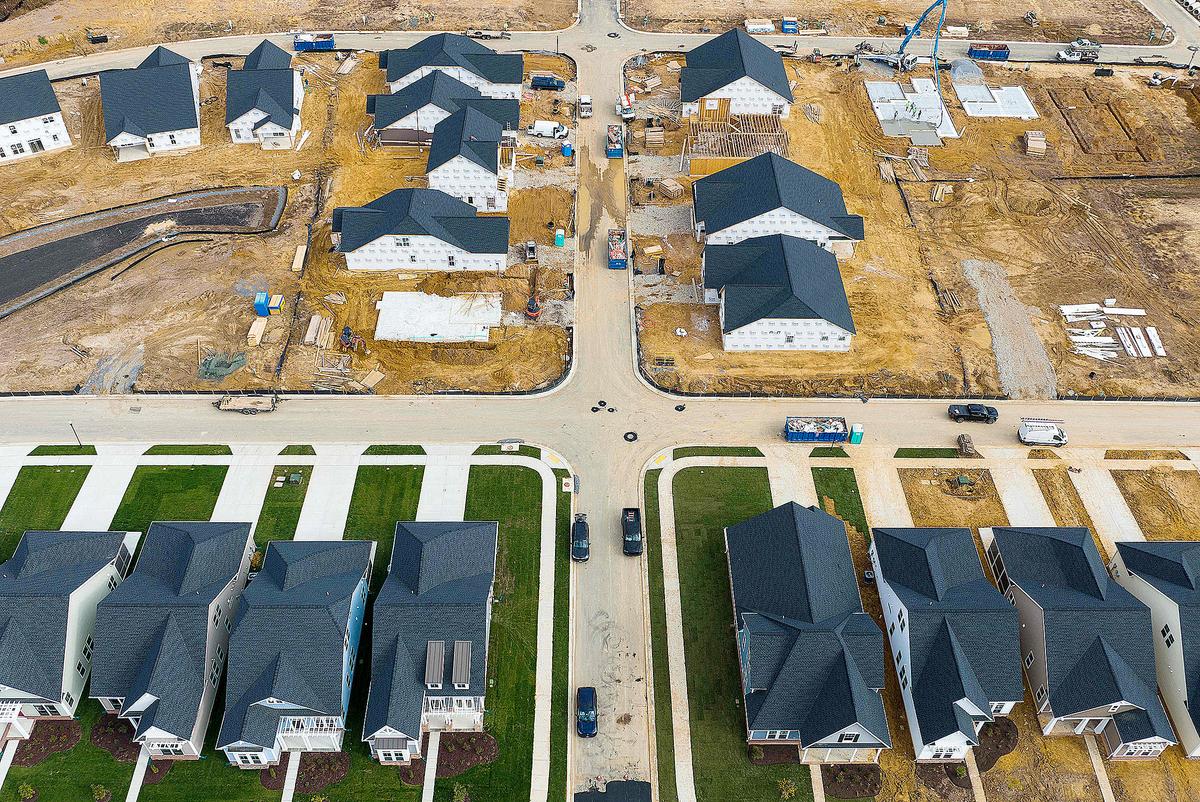
Everyone wants to learn Warren Buffett’s investment strategy, but in simple terms, Buffett’s investment philosophy is to “buy stocks means buying partial ownership of a business.” He advocates buying outstanding companies with sustainable competitive advantages at prices below their intrinsic value and enjoying compound growth through long-term holding. How many people actually do this? Furthermore, as the one who once led Berkshire Hathaway, during the real estate freeze, Buffett once again increased his stake in construction company stocks. Do you think this is a wise decision?
With the news of Berkshire Hathaway increasing its holdings in Lennar on August 17th, the company’s stock price rose by 0.5 percentage points. In fact, during the second quarter of 2026, Berkshire Hathaway simultaneously disclosed buy-in operations for two construction companies, but the scale and nature of the investments in these two companies were completely different.
Lennar Group – Large-scale heavy increase: Berkshire Hathaway increased its stake by about 30% (covering A-shares and B-shares) in that quarter, with a total market value of holdings rising to about $1.157 billion, showing long-term confidence in its core business.
D.R. Horton – Symbolic minimal exploration: Berkshire Hathaway only purchased about 3,564 shares, worth about $580,000, which was of an observational nature and a small position.
This is not the first time Berkshire Hathaway has simultaneously invested in these two construction companies. In the past few years, they have adopted a strategy of “a basket of construction stocks,” but subsequent operations have diverged:
Berkshire Hathaway adds to construction stocks. What’s the plan? Five reasons | Why does Berkshire Hathaway favor Lennar? | Are big builders destined to eat small builders? | This matter is even more significant #USPropertyHotspot August 22, 2026
Q2 2023: Berkshire Hathaway simultaneously took long positions in the three major US construction companies, buying a large amount of D.R. Horton, Lennar, and NVR stocks, only to divest from D.R. Horton by the end of 2023.
First half of 2025: Berkshire Hathaway again invested in the two construction companies (approximately $800 million in Lennar and $191.5 million in D.R. Horton), but then reduced its holdings in D.R. Horton once again.
Q2 2026: Berkshire Hathaway maintained the pattern of “heavy on Lennar, light exploration on D.R. Horton,” and with the full acquisition of Taylor Morrison, created a residential layout with Lennar and Taylor Morrison as the core.
1. Contrarian Bargain Hunting
Currently, the US mortgage rate is around 6.75%, and the National Association of Home Builders (NAHB) housing market index has been below 40 for 16 consecutive months (in the contraction zone), leading to a 30% price reduction by over 30% of builders.
The pessimistic market sentiment is suppressing construction stocks, allowing Berkshire Hathaway, with ample cash reserves and solvency, to expand at a discount cost while peers are cutting expenses.
With nearly 4 million housing shortages in the US, sustained population growth and fundamental demand from households, the only way to bridge this gap is through continuous construction of new homes.
Although high short-term rates may temper immediate buying enthusiasm, unmet demand will only be deferred and not eliminated. Once rates fall, Berkshire Hathaway anticipates that the long-accumulated demand will accelerate.
Many existing homeowners are locked into super-low mortgage rates of around 3%, resulting in low willingness to relocate, leading to extremely limited inventory of existing homes on the market.
With scarce availability of existing homes, buyers with rigid housing needs are forced to turn to the new home market, enabling builders to maintain shipment channels even in adversity.
Large builders like Lennar and DR Horton can reduce inventory risks through land options and have the capacity to offer mortgage rate subsidies to attract buyers.
Small and medium-sized builders, facing tight financing and high cost pressures, are exiting the industry, further tilting the industry concentration towards nationwide giants with financial advantages.
By combining previous full acquisitions of upscale builders like Taylor Morrison, prefabricated home manufacturer Clayton Homes, and its building material and paint brands (Shaw, Benjamin Moore, among others), Berkshire Hathaway is transforming the stagnant real estate sector into a long-term cash flow engine resilient against inflation.
In other words, Berkshire Hathaway is not chasing highs in the housing market boom. They are seizing opportunities during periods of weakened demand, price reductions, offering significant Mortgage Buydowns, and compressed profit margins.
This is in line with Berkshire Hathaway’s typical capital allocation strategy: not speculating on “how much house prices will rise next year,” but rather finding sectors at cyclical lows with lasting demand and an industry structure trending towards concentration.
So why does Berkshire Hathaway continue to buy into Lennar rather than DR Horton or others?
Simply put, Lennar fits closely with Berkshire Hathaway’s preferred company characteristics. In the second quarter of the 2026 fiscal year, Lennar’s results were not impressive: with a housing sales gross profit margin of only 15.6%, down from 17.8% in the same period last year; to maintain sales pace, the average incentives amount to about 12.9% of the selling price.
However, on the other hand, Lennar managed to deliver 20,519 homes, a 2% increase year-over-year, with $1.8 billion in cash, an untapped $3.1 billion revolving credit line, less than 5% of land held on the balance sheet, and ongoing cost reductions and construction cycle improvements.
This last point is crucial. One of the biggest cyclical risks for builders in the past was the cycle of boom-buy land crazily → housing market crash → land price drop → massive inventory impairments → cash flow crisis.
What Lennar is currently pursuing is an Asset-Light / Land-Light model, controlling large land quantities via options, land banks, rather than outright purchases. This makes them less susceptible to the typical high-leverage land speculators of the past and more akin to a “residential production and sales platform.”
In simpler terms, Lennar is not eager to spend billions to acquire all land upfront, but instead secures the rights to use or purchase the land, only buying when it’s time to build.
Traditional builders would spend $300 million upfront to buy all desired land, then gradually build 1,000 homes. Lennar may now use options or land banks to lock down land for fewer funds, buying 100 plots based on immediate needs this year, possibly only securing 80 plots next year if market conditions worsen. This is the essence of Land-Light.
Therefore, even though Lennar may not own the land outright, they have ensured future access, albeit at a cost or premium, without the need to stake out multiple billions at once or bear the risks of land value declines.
This model aligns perfectly with Berkshire Hathaway’s preferences for “scale + cash flow + anti-cyclical capabilities.”
Additionally, Berkshire Hathaway’s true bet lies in the “big builders feasting on small builders.” While high rates are painful for all builders, the capacity of large listed builders compared to small local builders to withstand high rates is significantly different.
Large builders have their mortgage lending business, can buy down rates for buyers, bulk purchase materials like lumber, appliances, construction materials, standardize building specs, secure better terms from land developers, and have enough capital to acquire land and communities when smaller builders exit.
Lennar itself stated that their strategy is not to wait for affordability issues to disappear but to gain market share through price cuts, maintaining sales pace and scale.
Thus, in this high-rate environment, small builders facing high financing costs and slow sales are being pressured to sell land and development projects, allowing larger builders to acquire land, increase market share, with more profitability flexibility in the next housing market recovery.
If Berkshire Hathaway’s core judgment is based on this premise, then the longer the housing market takes to recover, to some extent, the more advantageous it is for Berkshire Hathaway to establish its position in the industry.
Moreover, the acquisition of Taylor Morrison by Berkshire Hathaway stands out because stock investments only provide capital gains, whereas direct ownership of builders allows for deeper integration with Berkshire Hathaway’s existing assets.
Berkshire Hathaway’s building product business already includes factory homes by Clayton Homes, on-site built homes, residential finance services, and within the same group are Shaw, John Manville, Benjamin Moore, and MiTek, among other construction-related companies.
Therefore, Berkshire Hathaway is not merely “investing in US housing.” It has expanded into land/housing development, construction, building materials, manufactured homes, housing finance, insurance, and other residential sectors.
Hence, portraying the acquisition of Taylor Morrison as a move by the new CEO, Greg Abel, indicates the transformation of the housing industry into another long-term industrial platform for Berkshire Hathaway. Investments in stocks like Lennar may reflect the same long-term industry evaluation for capital allocation.
Conversely, why has Berkshire Hathaway invested so little in DR Horton? As of June 30th, Berkshire Hathaway only held 3,564 shares worth approximately $580,000 compared to the total in various classes of Lennar exceeding $1.2 billion.
In reality, D.R. Horton is a good company itself, but it is currently under evident economic pressure. Net profit decreased by 12% year-over-year, cancellation rates rose from 17% to 20%, the company cited affordability issues, cautious consumer spending suppressing demand, and anticipates maintaining high sales incentives.
Also worth noting is that Berkshire Hathaway has bought and sold a large amount of D.R. Horton stock in the past. This reflects Berkshire Hathaway’s stance towards D.R. Horton as appearing more like: optimistic buy-in, but conditions or pricing change, selling off for further observation, rather than adopting a long-term hold strategy as they would for companies like Coca-Cola or American Express.
Therefore, Berkshire Hathaway’s approach to D.R. Horton seems more like “keeping one foot in the door,” while their position with Lennar is akin to a real commitment.
The new CEO, Abel, who previously oversaw Berkshire Hathaway’s non-insurance business and energy infrastructure for years, with the recent billion-dollar deal (Taylor Morrison acquisition) and ongoing bets on builders, indicates a preference for solid, cost-advantaged, predictable cash flow-heavy industries.
However, as tech stock valuations reach historic highs, the strategic placement of significant cash reserves in low P/E, high-demand real assets, reflects the new management’s defensive philosophy in combating macroeconomic uncertainties. ◇