
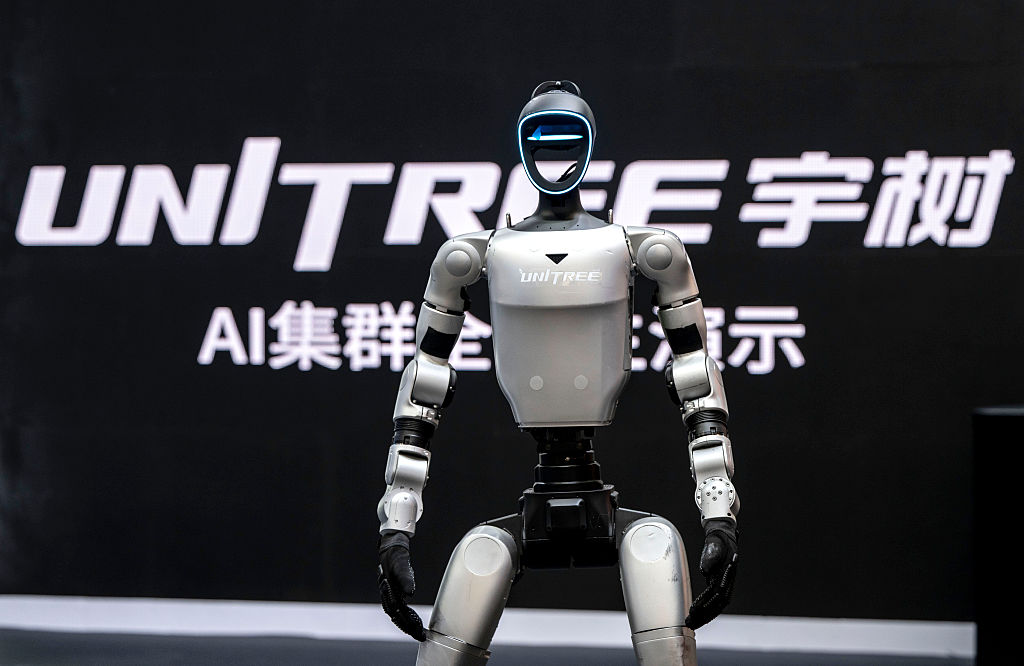
On August 24, the stock price of China’s “Humanoid Robot First Stock” Yushu Technology continued to plummet. In just 4 trading days since its listing, the stock price has fallen by 45% from the opening price of 1100 yuan (RMB) on the first day, leading to a total market value shrinkage of about 201 billion yuan to 243.9 billion yuan.
Yushu Technology’s stock price opened low and continued to decline on August 24. By the close of trading, it was at 603.08 yuan per share, a 10.31% drop, with a total market value of about 243.9 billion yuan. Compared to the closing price on the previous trading day (August 21), the company’s market value evaporated by over 20 billion yuan in a single day. In comparison to the initial market value of around 444.9 billion yuan on the first day of listing (August 19), it has decreased by approximately 201 billion yuan, and compared to the closing price of 341.8 billion yuan on the first day, it has dropped by nearly 100 billion yuan.
On August 19, Yushu Technology was listed on the Shanghai Stock Exchange Sci-Tech Innovation Board with an opening price of 1100 yuan, a staggering 629.44% increase from the issuing price of 150.80 yuan. The total market value soared to around 444.9 billion yuan but quickly retreated from the peak, ending at 845 yuan, a 460.34% increase, with the total market value dropping to 341.8 billion yuan. The trading volume that day reached 24.5 billion yuan, with a turnover rate of 85.28%.
Subsequently, Yushu Technology’s stock price continued to decline: a 18.70% drop on August 20, followed by a 2.12% drop on August 21, and another 10.31% drop on August 24. In just 4 trading days, the stock price fell from the opening price of 1100 yuan on the first day to 603.08 yuan, a cumulative drop of about 45%.
Despite the consecutive declines, Yushu Technology’s stock price is still about 300% higher than the issuing price of 150.80 yuan. As of August 24, the company’s total market value still stands at 243.9 billion yuan. However, compared to its earnings scale, the valuation given by the market to the company remains at a relatively high level.
In terms of performance, from January to June this year, Yushu Technology achieved operating income of 1.152 billion yuan, a year-on-year increase of 48.54%. Net profit attributable to shareholders was 274 million yuan, turning around from a loss of 32.0245 million yuan in the same period last year. However, after deducting non-recurring gains and losses, the net profit was 244 million yuan, a decrease of 19.34% year-on-year. The so-called “adjusted net profit” essentially reflects the money a company earns from normal operations after deducting one-time gains such as government subsidies and asset sales, better reflecting the profitability of its core business.
It is worth noting that the company’s revenue growth rate is significantly slowing down. The year-on-year revenue growth for the full year of 2025 was 332%, dropping to 68.49% in the first quarter of 2026, and further decreasing to 48.54% in the first half of the year. In other words, while Yushu Technology’s revenue is still growing, the growth rate has noticeably slowed down.
“The sharp drop in Yushu Technology’s stock price is understandable, as the stock price was inflated, detached from fundamentals,” said Pan Helin, a member of the Information and Communication Economy Expert Committee of the Ministry of Industry and Information Technology, to the “China Newsweekly.” “The issuing price of Yushu Technology was actually too high.”
“The underperformance of applications is just a symptom. What is really unexpected is the development of the humanoid robot’s brain. Currently, humanoid robots have made good progress in mechanical capabilities, being able to run, rotate, and jump, but these abilities do not meet market demand,” Pan Helin stated. Achieving these capabilities comes at a high cost, and even if these abilities are realized, it does not necessarily mean they are useful. The market needs humanoid robots to have autonomous capabilities, which require the development of the robot’s brain, a lengthy process in the industry’s development.