
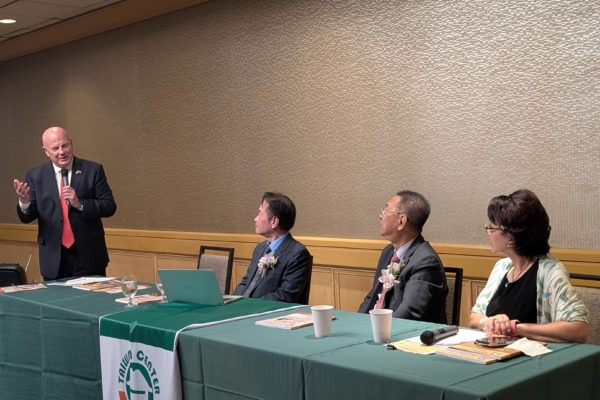
The Taiwan Center in Los Angeles held a fundraising luncheon in Orange County on Saturday, August 22. Thomas P. McDevitt, the Chairman of The Washington Times, attended the event and accepted media interviews to introduce the “Taiwan Freedom Project” that the newspaper has been promoting recently. He expressed the hope that through media coverage and special features, more American people could understand the importance of Taiwan and recognize the threat posed by China to Taiwan.
“Why is Taiwan important?” This is the question that McDevitt posed, summarizing the significance of Taiwan in terms of economy, technology, and diplomacy. He emphasized that Taiwan’s visibility in the international community has been increasing, and through the “Taiwan Freedom Project,” The Washington Times aims to showcase Taiwan to American society from different perspectives such as economy, technology, diplomacy, and the connections between Taiwanese and American communities.
McDevitt believes that only by deepening Americans’ understanding of Taiwan can broader support and consensus be built to help Taiwan maintain its freedom and the status quo in the Taiwan Strait.
Regarding the security situation in the Taiwan Strait, McDevitt stated, “The threat of China to Taiwan cannot be ignored.” He pointed out Hong Kong and Ukraine as examples, indicating that if China were to treat Taiwan in a similar manner to its handling of Hong Kong or follow Russia’s military actions in Ukraine, serious consequences could ensue.
He emphasized that the United States and the international community should not wait until a crisis occurs before taking action but should “consider the consequences earlier” and clarify what measures should be taken now.
McDevitt’s connection with Taiwan dates back to 1994 when he visited Taiwan with former Soviet leader Mikhail Gorbachev. Since then, he has had a deep bond with Taiwan. McDevitt’s wife is also Taiwanese, and jokingly referring to himself as a “Taiwan son-in-law,” he said he loves Taiwan as much as his wife, demonstrating the strong and special emotional connection between him and Taiwan.
Understanding the history of a country is crucial, according to McDevitt. He pointed out that Taiwan society, like the United States, has diverse opinions, but establishing a common vision and basic consensus can help find intersections between different perspectives.
As part of the “Taiwan Freedom Project,” The Washington Times launched the special feature “Why Taiwan Matters, Now More Than Ever” this year, focusing on Taiwan’s roles in the economy, technology, diplomacy, and the connections between Taiwanese and American communities.
McDevitt emphasized that the core goal of this project is to assist Taiwan in maintaining its freedom, preserving the current situation in the Taiwan Strait, and continuing to develop while increasing Americans’ awareness of Taiwan. He stressed that Taiwan is not just a region in Asia but a vital issue concerning the United States and the free world.
McDevitt mentioned that he is currently collaborating with the U.S. Congress and several experts to release a second special feature on Taiwan in a few weeks. He hopes to involve Taiwan historians and academic institutions to bring Taiwan’s history and research findings into American media platforms.
He stated that The Washington Times aims to serve as a bridge connecting Taiwan and American society, enabling more American people and policymakers to understand Taiwan’s history, democratic development, and international significance. These Taiwan-focused features will be part of a long-term plan, with ongoing expansion in reporting content and partnerships in the future.
McDevitt also highlighted The Washington Times’ significant media influence in Washington, where they provide newspapers to members of the U.S. Congress daily, aiming to bring Taiwan-related issues into more discussions on American politics and public policy.
Regarding future cooperation with Taiwan, he expressed hope for further exchanges with Taiwanese historical research institutions and scholars to integrate Taiwan’s own historical narratives into American public discourse and allow more American readers to understand Taiwan’s story.