
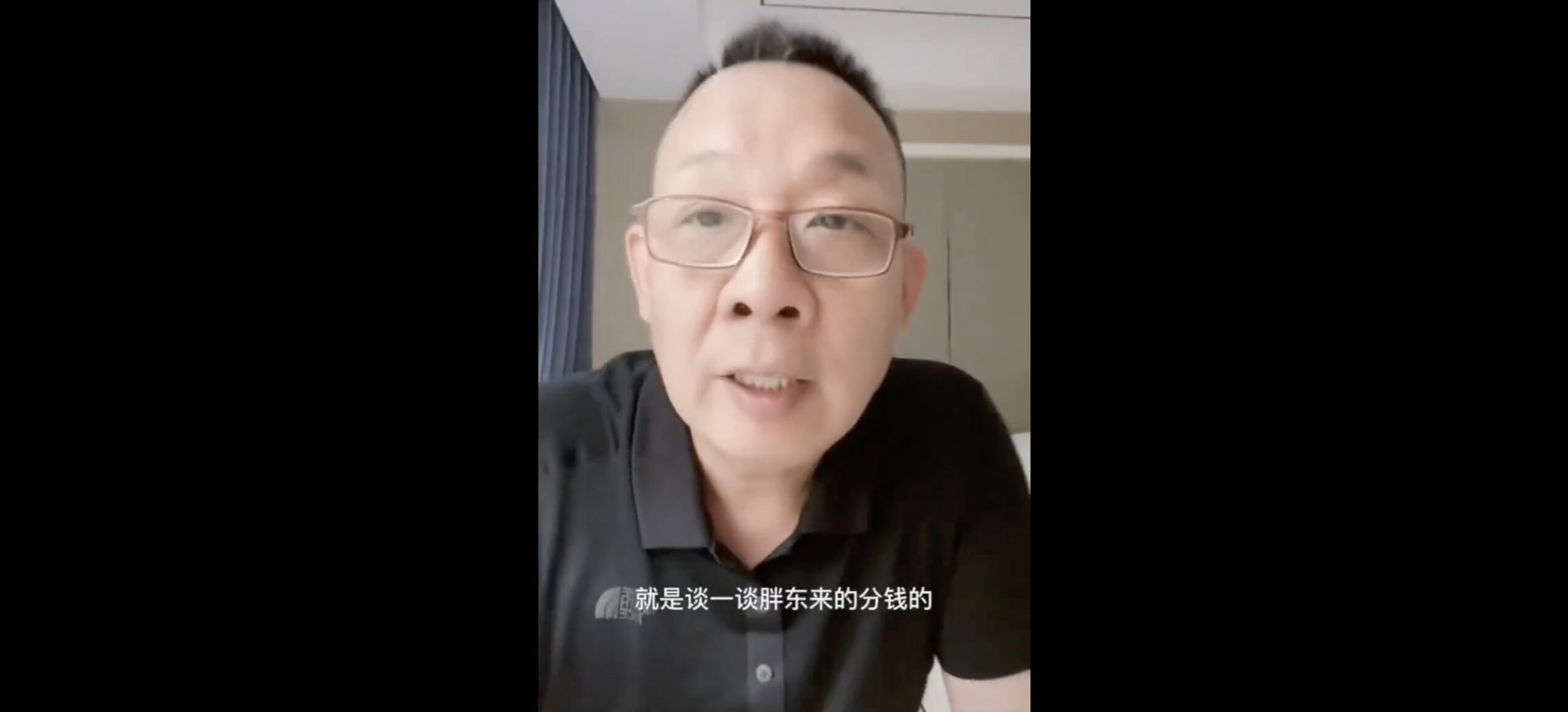
On August 9th, Yu Donglai, the founder of Pang Donglai Trading Group Co., Ltd. in Xuchang City, for the first time responded positively to the closure of Xuchang Life Square on his personal social media platform. Yu Donglai revealed that the main reason for the closure was due to certain tenants’ uncontrolled rent, which affected emotions.
According to Yu Donglai’s posts on platforms like Douyin and WeChat, he explained the reasons for the supermarket closure at Xuchang Life Square. He mentioned that around 2015, the project had issues because responsible personnel did not follow company regulations, lease contracts were not uniformly signed, leading to certain tenants’ rent spiraling out of control, far beyond fair levels.
It is reported that Pang Donglai did not fully own all the property rights of the entire Life Square at that time. Some shops belonged to scattered small property owners, or were cooperation merchants introduced by Pang Donglai in the early stages. The staff in charge of the project around 2015 did not sign unified leases for the entire store according to company regulations. Instead, they separately negotiated lease terms with these scattered property owners and merchants. During individual contract signing, rent for some scattered tenants/property owners was unreasonably raised, eventually exceeding fair market levels.
Pang Donglai could not control the rent of these tenants, causing the company to be in a dilemma: “Unable to terminate the lease, continuing operation affects emotions.” “Therefore, even though Xuchang Life Square had an annual sales of 2 billion yuan and annual profits exceeding 100 million yuan, faith and happiness always come first.”
Yu Donglai also stated, “In life, avoid dealing with people on different paths to preserve happiness.”
On August 7th, Yu Donglai suddenly revealed during a live broadcast that the Pang Donglai Xuchang Life Square store with a history of 24 years would officially cease operations in December 2026.
Xuchang Life Square opened in 2002 and was Pang Donglai’s first large-scale comprehensive shopping mall.
On August 9th, Yu Donglai also mentioned the reason for the closure of the PDL store in Xinxiang in a dynamic post on his personal account: “Back then in Xinxiang, the annual profit exceeded 60-70 million! When the rent expired, the landlord increased it directly from over 8 million to 24 million, and there were immature businesses causing trouble behind the scenes! I didn’t even think about it and just gave up!”
Public records show that the Xinxiang PDL closed in September 2015 and officially went out of business on September 24, 2015. The closure of the store caused a huge uproar locally, with the government intervening. In September 2016, the Xinxiang Pang Donglai PDL store reopened after renovation.
According to mainland Chinese media “青梅旭史” on August 10th, despite several waves of businesses taking over the former site of Xinxiang PDL, the lively scene driven by Pang Donglai in the entire street no longer exists, and the commercial area’s popularity has rapidly declined.
“青梅旭史” believes that this incident exposes a common misconception in commercial leasing, where property owners often mistake the prosperity created by tenants’ operations for the intrinsic value of the property itself.
The Macro Observation Room of Weifang Yicai Media under the Rabbit Head also stated on the 10th that there is a deep-rooted illusion in the Chinese commercial real estate circle called “My location makes you successful”, forcing tenants to raise rent, and if the tenants do not accept it, they have to bear the cost of relocation.
However, many landlords have not realized that the market has changed. Data from Cushman & Wakefield shows that in the first half of 2026, the vacancy rate of premium shopping centers in Shenzhen was 9.2%, with the average rent of the top tier decreasing by 0.5% to 693.5 yuan per square meter per month. In Chengdu, the first floor rent of shopping centers reported 338.3 yuan per square meter per month, a 1% decrease, with a vacancy rate of 9.1%. Guangzhou’s top tier shopping centers saw a 1.1% decrease in average rent to 622.5 yuan per square meter, with a vacancy rate of 9.3%. The first-floor rent of shopping centers in Hangzhou slightly decreased by 0.4% compared to the end of last year, reporting 21.5 yuan per square meter per day, with a vacancy rate of 5.2%.
The Macro Observation Room of Rabbit Head pointed out that in these four cities, rents are generally declining and vacancy rates are high. In this context, landlords using the old tactic of “raising rents to pressure tenants” are going against the entire market. However, there are many choices for brands.