
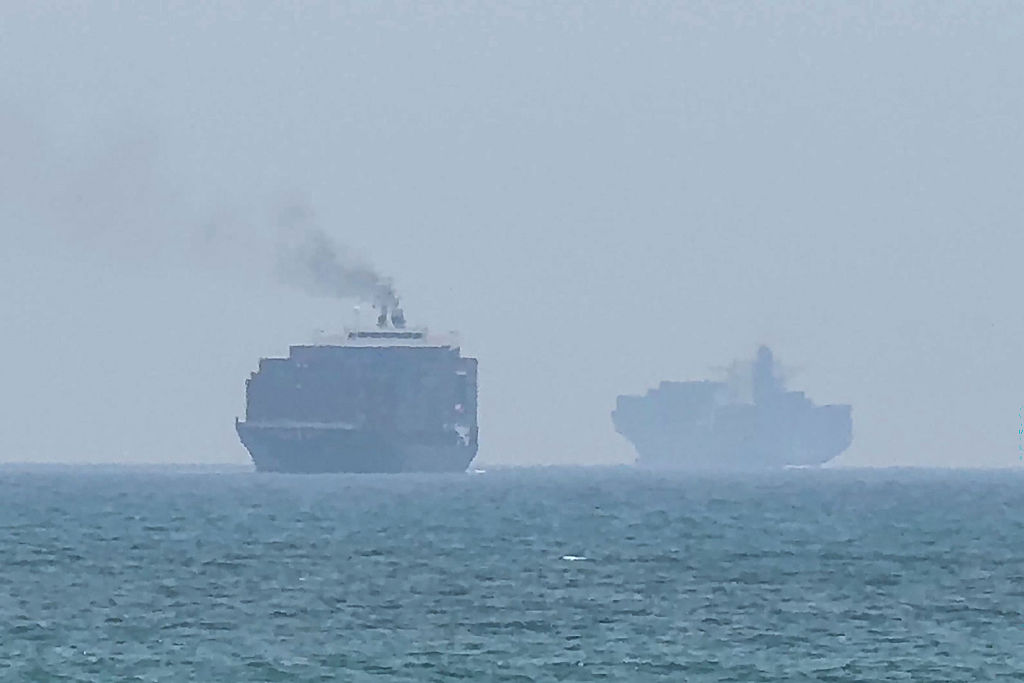
In the Middle East, the security situation in two major maritime passages continued to deteriorate on Tuesday, July 21st. The United Kingdom Maritime Trade Operations Office (UKMTO) reported that an oil tanker was hit by a missile in the waters off Oman, near the Strait of Hormuz, and authorities are currently investigating the incident.
Meanwhile, Saudi Arabia has responded officially to the threat of a maritime blockade by the Houthi militants in Yemen, stating that they would take “all necessary measures” to protect their own vessels.
The UKMTO issued a statement on Tuesday, indicating that the incident occurred about 13 nautical miles southeast of Limah, Oman. The vessel involved was an oil tanker that was reportedly hit by a missile while navigating outbound along the southern channel of the Strait of Hormuz.
According to the UKMTO, “The United Kingdom Maritime Trade Operations Office received a report of an incident 13 nautical miles southeast of Limah, Oman. An oil tanker reported being hit by a missile while sailing outbound along the southern channel. Authorities are currently investigating.”
The UK maritime authorities did not disclose the name of the tanker or specify which party launched the missile. The extent of damage to the vessel and whether there were any casualties remain unclear at present.
Recent weeks have seen a series of maritime security incidents around the Strait of Hormuz.
Previously, UKMTO reported a ship catching fire after an attack in the Strait of Hormuz, with the crew subsequently abandoning the vessel. The agency later notified another incident where a ship was attacked near the United Arab Emirates waters close to the Strait of Hormuz, with all crew reported to be safe.
The Iranian Revolutionary Guard stated that two oil tankers attempting to pass through the Strait of Hormuz “exploded and were forced to stop.”
It is currently unknown whether the above incidents involve different vessels or if there is some overlap in events, hence the exact number of vessels under attack cannot be confirmed at this stage.
The United States and Iran are currently in a standoff over the control of the Strait of Hormuz. As both sides vie for control of this crucial passage, international oil prices briefly rose to their highest level in a month on Monday.
The Houthi militants announced on Monday, July 20th, the immediate implementation of a maritime blockade against Saudi Arabia.
In their statement, the Houthi armed forces declared that in response to what they described as the “unfair and oppressive siege imposed by Saudi on Yemen,” the organization would impose a maritime blockade on the “evil Saudi enemy” based on the principle of “an eye for an eye.”
Saudi Arabia’s Foreign Ministry subsequently condemned the Houthi military spokesperson’s accusations regarding the Saudi blockade of Yemen and the implementation of a maritime blockade.
Saudi Arabia stated in its declaration that it would take “all necessary measures” to protect their vessels. They strongly condemned the threats from what they termed as “terrorist Houthi militias” and reiterated their support for the Yemeni people and their legitimate government.
Shipping data shows that, including in recent weeks, cargo ships and other vessels continue to regularly arrive at the port of Hodeidah under Houthi control, transporting food, fuel, and other supplies.
The Houthi militants have not clarified how they will enforce the blockade, and there is no evidence to indicate that Saudi ports have been physically blocked.
The Houthi blockade threat has raised concerns in the energy market. During peaceful times, about one-fifth of the global oil passes through the Strait of Hormuz. In the event of a blockade in the strait, Saudi Arabia could still export millions of barrels of oil each month through the port of Yanbu along the Red Sea coast.
The Houthi militants control most of Yemen’s Red Sea coastline and are adjacent to the Bab el-Mandeb Strait, which connects the Red Sea to the Gulf of Aden. If the group resumes attacking merchant ships in the Red Sea and Gulf of Aden, more Middle Eastern oil may be prevented from entering the global market.
The hostile relationship between Saudi Arabia and the Houthi militants has persisted for over a decade. In 2015, Saudi-led military coalition intervened in the Yemeni civil war in support of the internationally recognized government. After reaching a ceasefire in 2022, the conflict had momentarily eased.
However, Saudi Arabia and the Houthi militants engaged in the first firefight in years last week, jeopardizing the ceasefire situation maintained since 2022.
Since the outbreak of the US-Iran war at the end of February this year, the Houthi militants had largely avoided direct involvement in the conflict. With the recent announcement of a maritime blockade against Saudi Arabia, their role in the regional conflict has once again come under scrutiny.
With ships being attacked consecutively in the Strait of Hormuz and the Houthi militants threatening a blockade against Saudi Arabia, the security risks facing the two key energy passages in the Middle East are simultaneously escalating. If the situation continues to escalate, it might further impact global energy supply, shipping insurance, and international trade.