
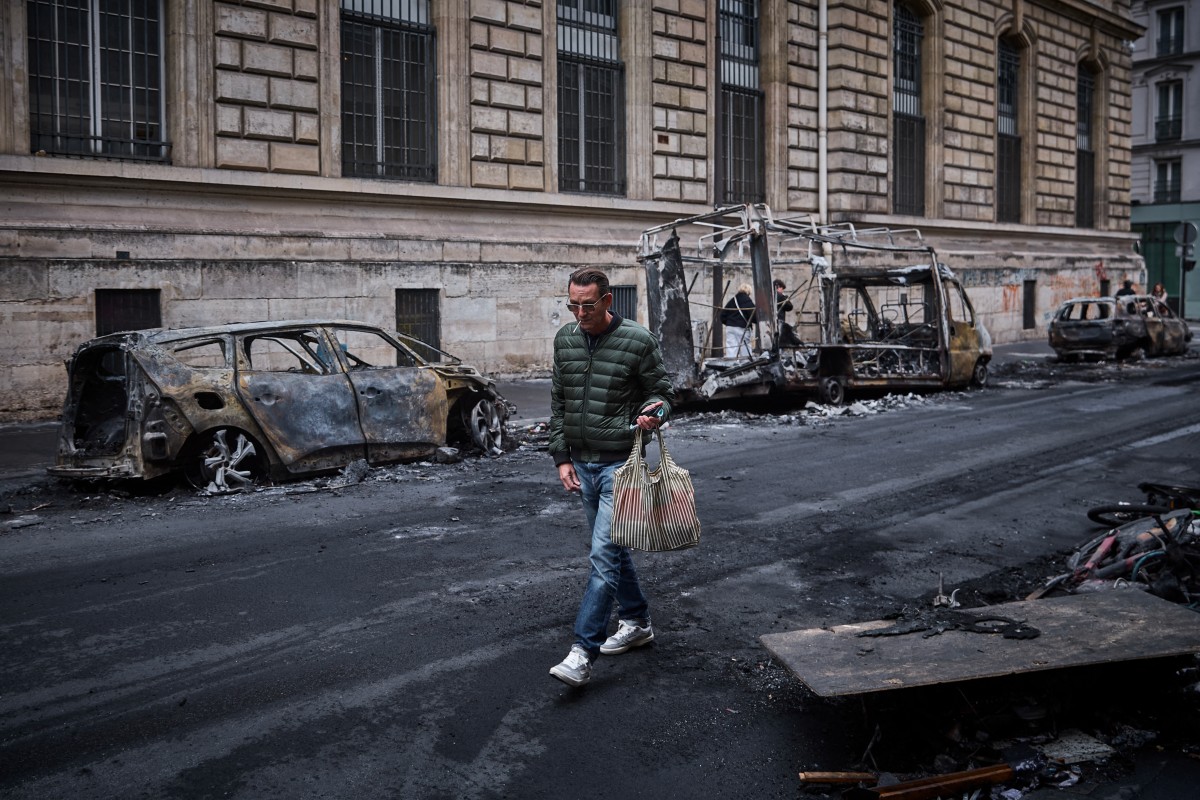
Over the weekend, France witnessed massive protests which eventually escalated into violent riots following the involvement of radical individuals. On Monday, French authorities implemented curfews in certain areas of Paris and other cities.
Interior Minister Laurent Nunez admitted that the police had “lost control” during the protests that took place in multiple cities over the weekend. Simultaneously, the “Yellow Vest movement” has called for a new round of protests to take place on Saturday, October 24.
French police stated that the government has enforced partial curfews and banned demonstrations in certain areas of Paris to restore order. Prior to this, Paris experienced one of the most serious outbreaks of street violence in recent years.
The Paris police department announced that in several districts of the capital, the partial curfew would take effect from 11 p.m. on Monday night until 6 a.m. on Tuesday.
Furthermore, demonstrations are banned in several Paris neighborhoods from 8 p.m. on Monday to 6 a.m. on Tuesday.
On Monday, in Republic Square in central Paris, cleaners were still busy clearing burnt plastic debris from the streets. The sound of hammers and power drills could be heard intermittently around the square as workers repaired vandalized storefronts.
Shared mobility operator Dott stated in a press release to Reuters on Monday that about 300 electric bicycles were destroyed and 120 severely damaged during the nationwide protests on Saturday, October 17 in Paris. Dott operates 6,000 shared bicycles in the city.
Another shared electric bicycle operator, Lime, reported that some of its shared bicycles and scooters in Paris were destroyed or damaged during the protests, leading to approximately a 6% loss in their Paris fleet.
Approximately 3,000 businesses across France were vandalized or looted last Saturday night. Many of these incidents occurred in Marseille, including a clothing store owned by Gerard Nouchi, who described the situation as “like encountering a real tornado.”
The mayor of Nice announced a curfew for young people from 9 p.m. to 6 a.m. daily until next Sunday. Additionally, local provincial officials announced a ban on carrying certain items and equipment that could be used to incite public disorder.
According to local media citing reports from the government of Rhône Province, Lyon also implemented a curfew from 9 p.m. on Monday to 6 a.m. on Tuesday.
The mayor of Coulaines, a city in the northwest, declared a curfew for young people, prohibiting them from going out after 11 p.m.
The office of Prime Minister Sébastien Lecornu confirmed that several cities in the north, including Lille, Douai, Wattignies, and Denain, have enforced partial curfews from 8 p.m. to 6 a.m.
The eruption of these large-scale protests primarily stems from high prices, low wages, and the deterioration of public services. French unions and student organizations called for hundreds of thousands of people to take to the streets. As radical elements infiltrated the protest marches, demonstrations turned into riots in multiple cities.
According to an investigation report by Fox News Digital, behind this turmoil lies a political ecosystem propelled by communist organizations, revolutionary left-wing groups, and a network of global radical extremists.