
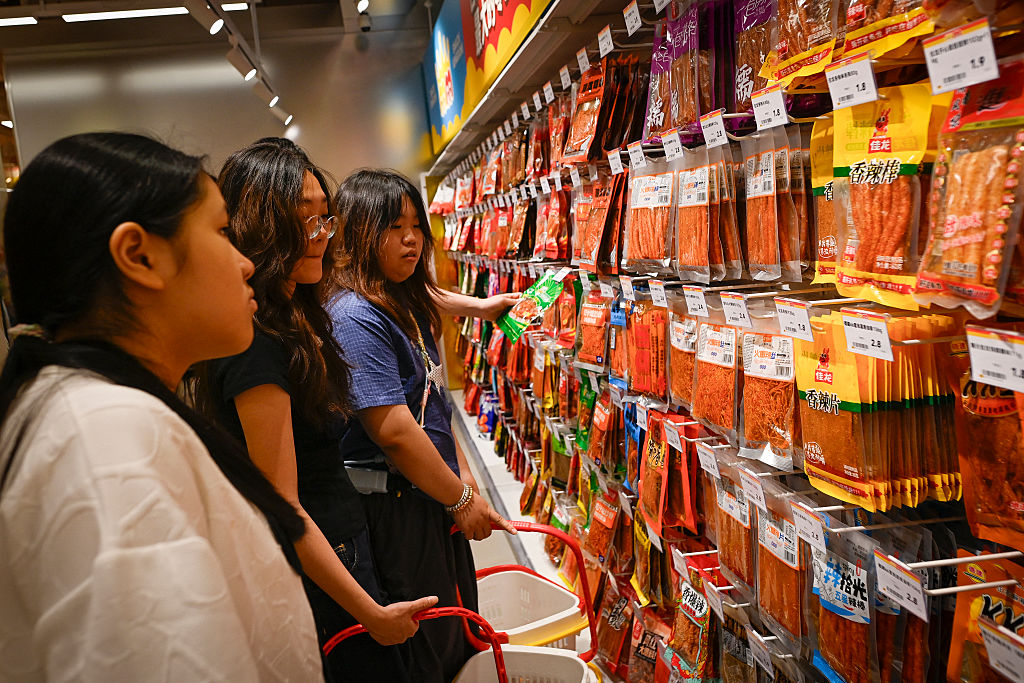
Sales of konjac snacks on the mainland through traditional offline channels have seen consecutive declines for two quarters, with the decrease widening to 14.84% in the third quarter. Snack enterprises Weilong and Yenjinzhupu related business revenue is still growing, but the growth rate has significantly slowed down.
According to a report by “Jiemian News”, data released recently by the offline retail monitoring platform “Win immediately” shows that in its monitored traditional offline channels, konjac snack sales in the third quarter decreased by 14.84% compared to the same period last year, an increase from the 8.03% decline in the second quarter. In the third quarter, overall sales of snacks decreased by 12.63%, with spicy strips dropping by 22.22%.
The platform’s monitoring scope includes supermarkets, convenience stores, and grocery stores, and the data does not include online sales or sales from other channels.
Previously, konjac snacks had maintained relatively fast growth. Data from “Win immediately” shows that from December 2024 to November 2025, sales in this category increased by 17.45% year-on-year, the highest growth rate among various leisure snacks.
Lin Yue, an analyst at Lingyan Management Consulting, told “Jiemian News” that the decline in konjac snack sales is mainly due to overall weak consumer spending, with the entire leisure snack market contracting, not just the konjac category slowing down. He believes that there is still demand in the konjac market, but the growth rate is returning to normal.
Financial reports from related companies show that in the first half of this year, Weilong’s vegetable products business revenue, including konjac and seaweed products, was 2.441 billion yuan, a year-on-year increase of 15.8%, lower than the 44.3% growth in the same period last year; the capacity utilization rate of this business decreased from 77.5% to 71.3%.
During the same period, Weilong’s vegetable product output increased by 29.8% year-on-year, higher than the revenue growth of 15.8%. Based on this, “Titan Media” analyzed that the growth in output is faster than revenue, indicating price pressure on products.
Yenjinzhupu’s konjac snack revenue in the first half of the year was about 880 million yuan, with the year-on-year growth rate falling from 115.16% in the same period last year to 11.28%. The company attributes the slowdown in growth to channel structure and product strategy adjustments.
Upstream raw material processor Unicom Konjac had operating income of 379 million yuan in the first half of the year, a year-on-year increase of 5.62%; however, net profit attributable to the parent company decreased by 43.90% to 22.9557 million yuan, and the gross profit margin decreased from 21.75% to 14%.
Mainland brokerage Five Minerals Securities stated in a tracking report that rising konjac raw material prices have increased costs, while product price increases have not kept up.
According to “Jiemian News”, it’s estimated that there are now more than 30 brands in the mainland entering the konjac snack market.
Financial self-media “Zebra Consumption” analysis pointed out that the processing technology of konjac snacks is not complicated, and with a large number of brands entering the market, products mainly focus on konjac chips and vegetarian tripe, with flavors centered around spicy, numbing, sour and sesame paste, leading to a decrease in consumer novelty.
Lin Yue stated that current brand competition still mainly focuses on seasoning, with limited innovation in product taste. “Jiemian News” analysis suggests that in the absence of significant product differentiation, brands rely more on price, channels, and marketing to compete in the market.
Data from “Win immediately” shows that the average price per 100 grams of konjac snacks has been continuously decreasing since the second quarter of 2024 until stabilizing in the third quarter of 2025.