
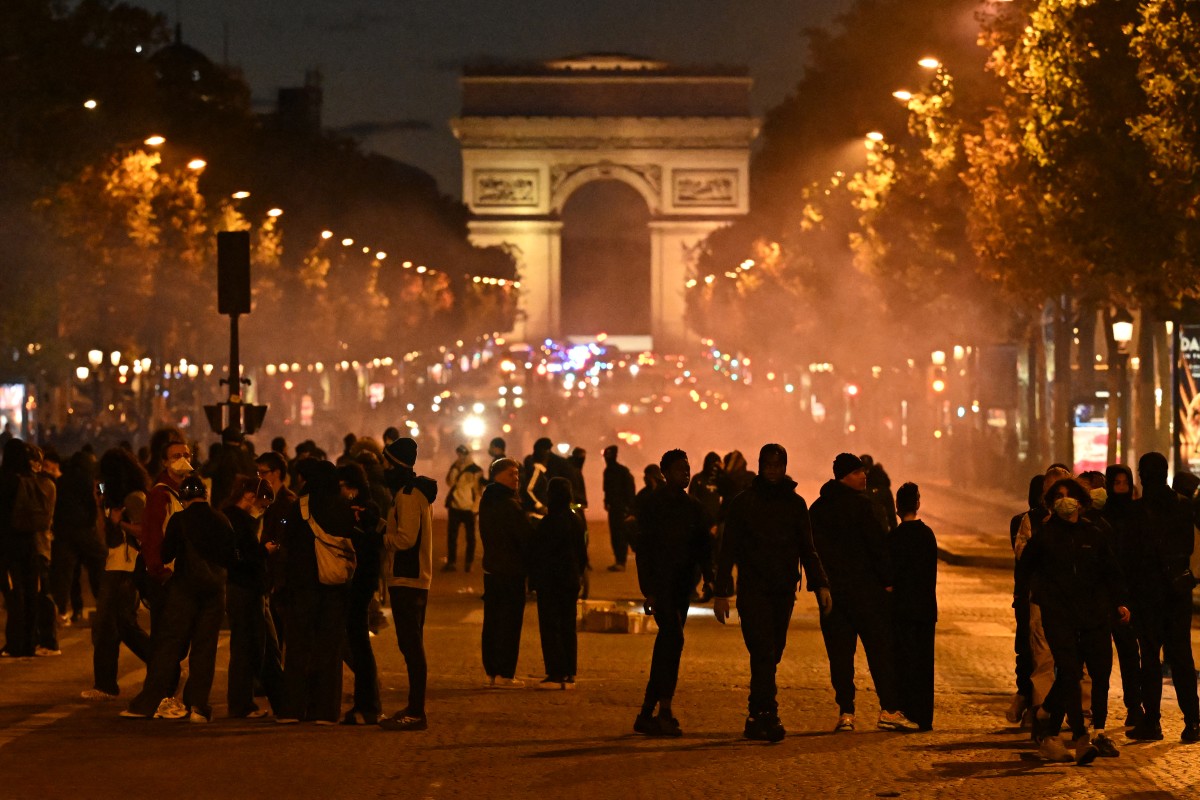
On Saturday, October 17, protests erupted in several countries including France, Portugal, and Italy. Citizens expressed discontent with the rising cost of living and housing, believing that the government’s provision of basic opportunities and social safety nets is insufficient.
In France, multiple cities saw protest activities on Saturday. The French Ministry of the Interior reported violent incidents involving masked individuals in cities including Paris, Marseille in the south, Toulouse in the southwest, Angers in the west, and Lyon in the east, with at least 272 people currently arrested.
With the increasing cost of living in Europe, Belgium, Portugal, and Italy also witnessed smaller scale protests on Saturday. In Albania, protesters gathered once again to oppose government corruption, lack of employment opportunities, and low education standards.
The General Confederation of Labour (CGT) in France revealed to AFP that 800,000 people participated in the protests nationwide on Saturday. The French Ministry of the Interior did not provide a specific estimate.
Protesters stated that the majority conducted peaceful marches and attributed most violent acts to troublemakers intentionally causing destruction and clashing with law enforcement.
The protests in France originally sparked at high schools in a relatively impoverished suburb north of Paris last month. Students expressed dissatisfaction with issues such as inadequate teaching staff and aging school buildings, leading to a nationwide movement against inequality, insufficient public service investment, and declining living standards.
At the protest site in Paris, a 19-year-old protester named Lola said, “We take to the streets to protest because the cost of living is too high, gas prices are too expensive. High school students across the country simply hope to increase teacher staffing and improve learning environments through protests but are subjected to violence, and even injuries.”
As President Macron’s term nears its end, he leaves behind a polarized electorate and a fragmented political landscape. France’s efforts to curb rising public debt have failed to win investors’ trust, resulting in continuous outflows from the French government bond market, causing French 10-year bond yields to rise to levels not seen in over 20 years.
According to Reuters, tens of thousands gathered for a march in downtown Lisbon, Portugal, on Saturday, protesting the country’s soaring cost of living and worsening housing crisis, putting greater pressure on the center-right government.
The rally’s organizer, Portugal’s largest labor union organization, the General Confederation of Portuguese Workers (CGTP), stated that “tens of thousands” of people filled a major avenue in the capital. The police did not provide a specific estimate of the crowd size.
Protesters pointed out that low wage levels cannot keep up with the rising housing costs and living expenses, making it difficult for many to make ends meet. Portugal, as a member of the EU and NATO, is facing economic hardships.
In September, Portugal’s inflation rate reached 3.6%, primarily driven by food and fuel price increases; fuel prices rose by 15% year-on-year, influenced by escalating tensions in the Middle East. Since 2017, Portugal’s housing prices have more than doubled, and rents for new leases have almost doubled, sparking one of Europe’s most severe housing affordability crises.
Reportedly, in Milan, Italy, police used tear gas after being attacked by protesters throwing stones in front of the Gothic Cathedral square, while in Bologna, protests over cost of living issues escalated into conflicts.
The Italian news agency ANSA reported that in Bologna, protests turned violent, with police using water cannons to disperse the crowd and arresting seven individuals.
Italian Prime Minister Giorgia Meloni condemned the violence. She wrote on the social platform X, “Protesting is a right, but turning our cities into battlefields is not.”
Meanwhile, Belgium also saw smaller scale protests.
On Saturday, hundreds of predominantly young protesters demonstrated in Brussels, where riots broke out, leading to clashes between protesters and police. These disturbances were partly influenced by the protests in neighboring France.
The Belgian student group stated that they were protesting against rising education costs and opposing reforms they believed would undermine accessibility to higher education.
In Albania, large-scale student protests continued for five days, demanding the resignation of Prime Minister Edi Rama; during this period, the police reportedly fired what appeared to be rubber bullets at protesters.
Corruption issues, lack of employment opportunities, and a widespread sense that the government is not serving the people have accumulated profound grievances. This week, this discontent finally erupted: large groups of young protesters flooded the capital, Tirana, setting fire to government buildings and banks, and hurling stones at the police.
The government and police condemned these acts of violence. According to police statistics, 500 protesters were detained, with 330 already released. Data shows around 120 police officers and 45 protesters were injured; however, considering many injured individuals were not officially recorded, the actual number of protesters injured may be higher.