
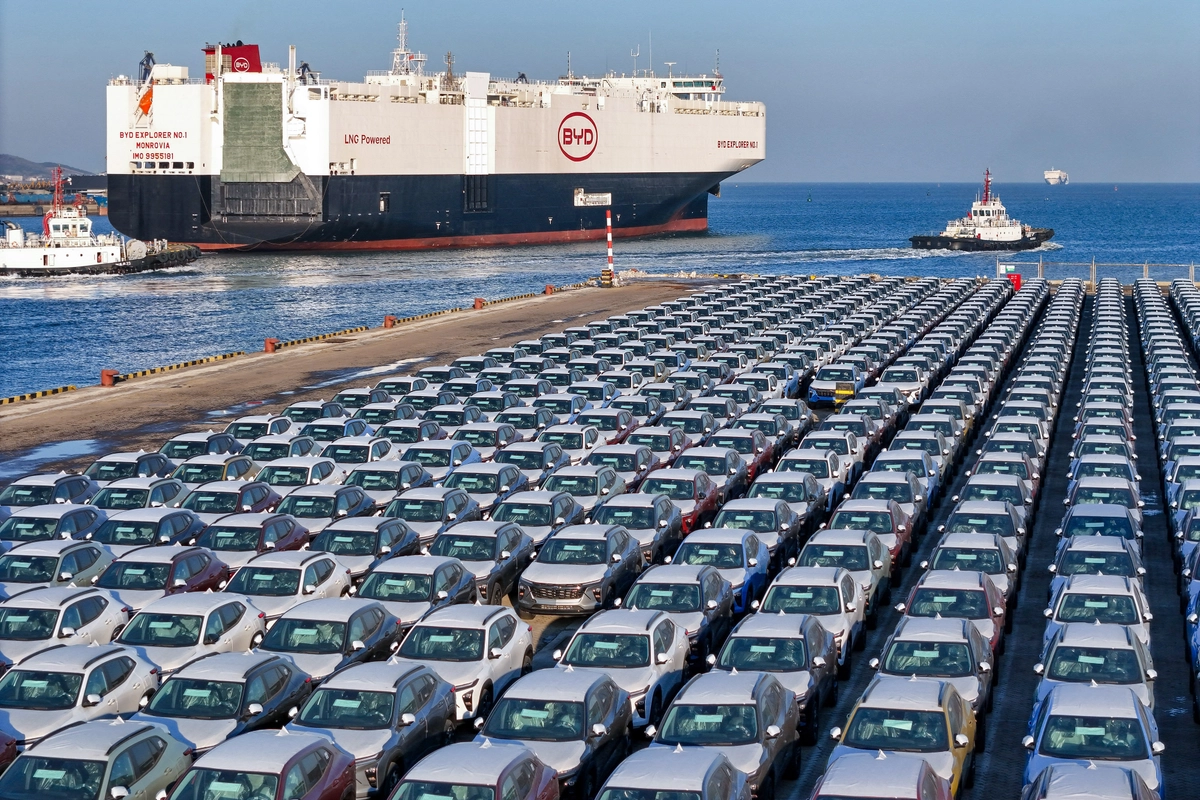
In recent times, South Korean politicians have been exposing serious military security vulnerabilities. According to the latest data obtained by lawmakers, nearly 200 Chinese-made “Connected Cars” equipped with high-precision sensors and networking capabilities are freely entering and exiting major military bases in South Korea.
These vehicles are equipped with multiple cameras and GPS, raising concerns that military secrets could face a high risk of being instantly transmitted to Chinese intelligence agencies.
Reported by the “Chosun Ilbo” on Friday (October 16), National Power Party member Kang Dae-jik (Daegu East District and Gunwi-gun Yeop) obtained the latest data the day before, showing that there are currently at least 190 Chinese-made vehicles with networking capabilities – such as BYD – registered and able to freely access South Korean Ministry of National Defense facilities, as well as core facilities of the army, navy, and air force.
What is concerning is that the range of these vehicles covers several highly sensitive military sites:
Air Force Bases:
Including the Chungcheongbuk-do Cheongju 17th Fighter Squadron, where South Korea’s latest F-35 stealth fighter jets are stationed, and the Gyeongsangbuk-do Yecheon 16th Fighter Squadron, where the domestically produced supersonic fighter KF-21 was delivered last month.
Naval Strategic Hubs:
Such as the Busan Naval Operations Command Headquarters where US aircraft carriers dock, and the Gyeongsangnam-do Jinhae Submarine Command Headquarters, which is a core unit for submarine security defense.
Military Command Centers:
Including the Ministry of National Defense, Joint Chiefs of Staff Headquarters building, as well as the Army Headquarters in Chungcheongnam-do Gyeryongdae, the Ground Operations Command in Gyeonggi-do Yongin, and the Special Operations Command.
Earlier, Democratic Party member Kim Byeong-joo released parliamentary data at the beginning of October, further confirming the severity of this loophole. According to the preliminary military data obtained by Kim, there are 135 registered Chinese-connected vehicles (44 for the army, 42 for the navy, 41 for the air force, and 8 for the marine corps), with 118 owned by officers and non-commissioned officers, and 17 being external vehicles for distribution, construction, and inspection.
Kim’s data revealed blind spots of unregistered vehicles – just in naval facilities, unregistered Chinese-connected cars have entered critical units like the Jinhae Naval Command Headquarters, Naval Logistics Command, and Submarine Command Headquarters a total of 565 times this year alone. When combined with Kang’s recent investigation, it shows a significant disconnect in the military’s control and statistics regarding Chinese vehicles.
Connected cars typically come equipped with over ten optical cameras, high-precision GPS coordinates, radar, LiDAR (laser sensors used for mapping three-dimensional maps), and microphones, enabling them to transmit surrounding data in real-time over the network.
The Chinese National Intelligence Law clearly states that “all organizations and citizens shall support, assist, and cooperate with national intelligence work.” This implies that the real-time location, terrain, and image data collected by these vehicles inside South Korean military bases could potentially flow directly to Chinese intelligence agencies as permitted by law.
The Estonian Foreign Intelligence Service stated in their 2024 report that reliable intelligence indicates Chinese-developed LiDAR systems scan the vehicle’s surroundings and transmit data to Chinese databases, warning that automated vehicles using Chinese technology are highly prone to being used for intelligence gathering.
South Korean military officials find this situation highly absurd. A military official admitted, “Within military facilities, for security reasons, even using an iPhone is strictly prohibited (or requires covering cameras with stickers and restricting voice recordings), yet no measures have been taken to control Chinese vehicles with numerous cameras and sensors, which is utterly ridiculous.”
The United States has banned manufacturers with ties to China from selling connected cars made in 2027 or later in the US, and the European Union initiated data leakage security reviews in March.
Though the South Korean Ministry of National Defense acknowledged in a meeting in April that “collecting image information at military-related facilities poses security vulnerabilities,” there are still no specified measures in place to prohibit Chinese-made connected cars from entering military bases.
Kang Dae-jik pointed out, “South Korean military facility intelligence could potentially flow to China at any time, and Seoul’s authorities are severely lacking in awareness and response to this issue.”
Legislator Kim Byeong-joo urged the government and military to immediately restrict Chinese-made connected cars from entering core military facilities and conduct comprehensive security standard reviews on all vehicles entering and exiting the bases to eliminate the risk of instant leakage of national security information.