
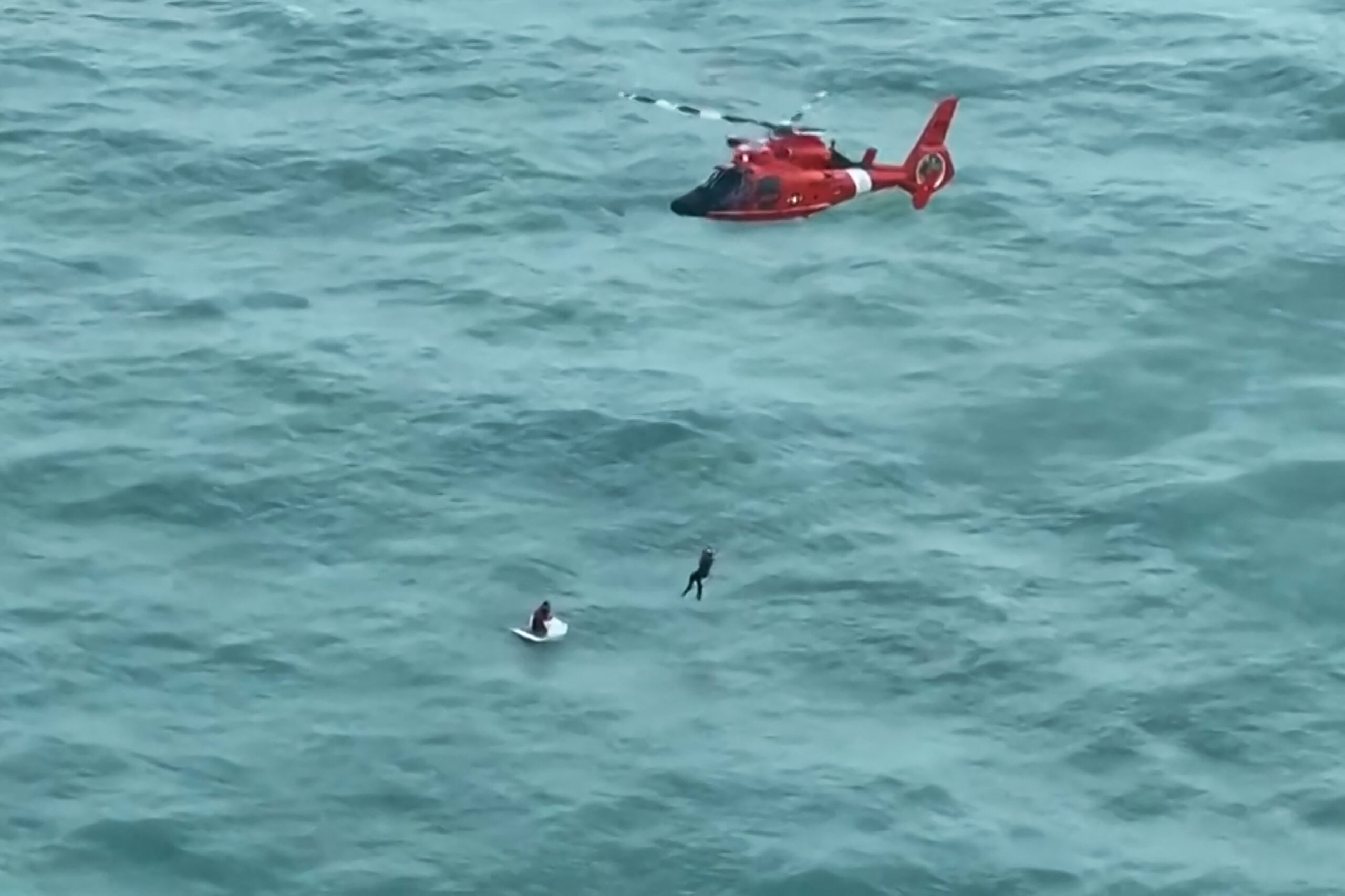
On Friday, the U.S. Coast Guard rescued 16 people who had fallen into the Pacific Ocean off the coast of Baja California, Mexico, with 11 others believed to be missing. Authorities have not yet confirmed the exact origin, destination, and purpose of the capsized vessel. However, this area where the ship sank is a popular route for human smuggling groups transporting migrants to the United States, with past incidents of similar tragedies involving overturned smuggling boats and drowning victims.
According to the Associated Press (AP), Lieutenant Santiago Tamburini of the Coast Guard stated that around 1 a.m. on Friday, they received a distress signal from a crew member of the distressed vessel reporting that the ship was sinking. The incident occurred approximately 225 kilometers west of Ensenada, Mexico, in the Pacific Ocean.
A rescue helicopter arrived at the scene about two hours later. Coast Guard Petty Officer Chris Sappey recalled that when the rescue team arrived, they could no longer see the vessel, only individuals floating in the water.
Tamburini mentioned that the survivors were supporting each other, clinging to floating debris, and treading water to stay afloat until they were rescued.
It took about 90 minutes for the rescue team to lift the 16 survivors onto the helicopter. A Coast Guard rescue swimmer also took part in the operation.
The Mexican consulate in San Diego stated that all rescued individuals were Mexican citizens. They were airlifted to San Diego by helicopter and received assistance from the consulate.
Janice Collins, a spokesperson for Scripps Mercy Hospital in San Diego, mentioned that three of the survivors were brought to the hospital, with one believed to have suffered a shark bite, and the other two receiving treatment for exposure.
Steve Carpowich, a spokesperson for Scripps Health, stated that three additional individuals who were evaluated at Scripps Memorial Hospital La Jolla have since been discharged.
San Diego city spokesperson Matt Hoffman noted that two patients are in critical condition, but it was not specified if they were among the previously mentioned injured individuals.
The Coast Guard reported that survivors indicated there could have been as many as 27 people on board the vessel. Some of the rescued individuals were wearing life jackets, but not all of them.
The U.S. Coast Guard and the U.S. Navy deployed two helicopters, one fixed-wing aircraft, a Coast Guard patrol boat, and a Navy warship to search for the missing persons in an area of approximately 3,200 square kilometers.
Col. Rob Tucker of the Coast Guard stated that as long as there is a possibility of survivors, the search and rescue operation will continue.
The Mexican Navy also initiated search efforts from Ensenada.
Currently, the U.S. has not confirmed the type of the sunken vessel, its origin, destination, and the activities of the people on board at the time of the incident.
Tamburini mentioned that vessels in this area may be used for fishing or recreational activities, but it is also a route frequented by vessels suspected of smuggling migrants. It remains unclear whether the vessel lost its way, experienced engine failure, drifted offshore due to currents, or intentionally navigated to that location.
Jonathan Suk, a meteorologist at the National Weather Service office in San Diego, stated that at the time of the incident, local wind speeds were around 18.5 kilometers per hour (10 knots), with waves approximately 1.5 meters high and water temperature around 20 degrees Celsius.
Suk pointed out that there was wind at sea, but overall, the weather conditions were similar to the typical conditions in the area, and vessels navigating in this region generally have the capability to handle such sea conditions.