
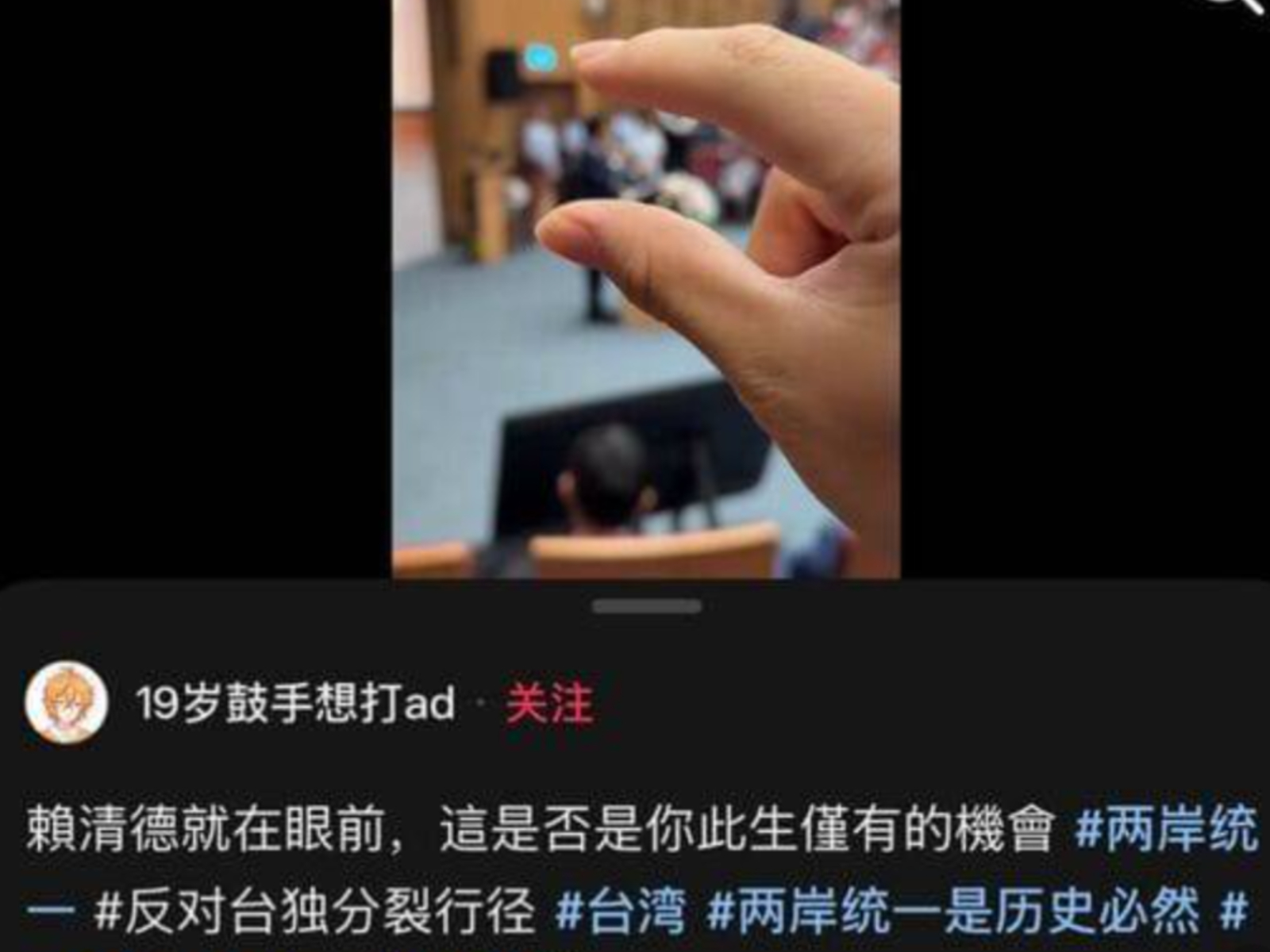
Recently, a Chinese exchange student sparked outrage in Taiwanese society by using a mobile phone to snap a photo pretending to pinch Premier Lai Ching-te’s head from a distance during an event. The student then posted the photo along with propaganda statements such as “Lai Ching-te being taken down,” “cross-strait unification is inevitable,” “upholding the One China principle,” and “opposing Taiwan independence” on a mainland Chinese social media platform.
On October 12, the closing ceremony of the “Taiwan Bridge Project” was held at National Taiwan University, where President Lai Ching-te, also serving as the honorary chairman of the “Taiwan Bridge Project,” attended and delivered a speech, expressing hopes for Taiwan to produce more Nobel Prize laureates.
According to reports from media outlets like Newtalk News, during the event, the Chinese exchange student sat in the audience to the right of Lai Ching-te and took the aforementioned photo. Investigation revealed that the student was from Nanjing and had posted pictures of the flight ticket and passport before coming to Taiwan on Douyin, a Chinese social media platform.
After the incident came to light, Taiwanese netizens criticized the disrespectful behavior towards a foreign head of state, demanding the student be expelled from Taiwan.
As public opinion continued to escalate, the Chinese exchange student deleted the relevant post, issued an apology stating that they realized the inappropriate nature of the post and expression, apologized to the “relevant communities” and those who felt uncomfortable, and expressed willingness to accept reasonable criticism and suggestions.
In response, prominent Taiwanese writer Sun Wei-mang questioned the Chinese exchange student on Facebook, asking, “Would you dare to play like this with Xi Jinping?”
Sun Wei-mang stated that the Chinese exchange student “bows and submits in authoritarian societies while behaving arrogantly and mocking in democratic societies,” abusing Taiwan’s freedom of speech. He gave a hypothetical scenario where if it were Xi Jinping speaking on stage, a Taiwanese student playing with a mobile phone in the audience could be arrested by Chinese authorities for disrespecting the leader and disseminating provocative content online, leading to severe legal consequences.
On the matter, Taiwan’s Mainland Affairs Council held a regular press conference on the afternoon of the 15th. Deputy Minister and spokesperson Liang Wen-chieh stated that they had received relevant reports, and according to the regulations under the “Regulations Governing the Entry of People from Mainland China into Taiwan,” if mainland Chinese individuals engage in inappropriate behavior violating the principle of mutual dignity during activities in Taiwan, the National Immigration Agency may revoke or cancel their stay permits, nullify their permits, and prohibit them from re-entering Taiwan for a period of time. Currently, the case is under discussion for further handling by the relevant authorities.