
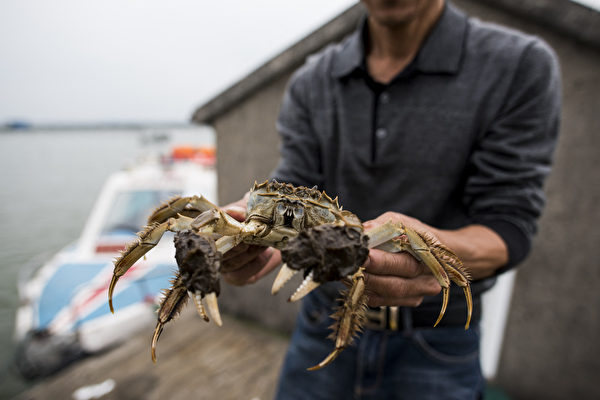
During the Mid-Autumn Festival and the National Day holiday in China, the hairy crab has always been a popular choice for feasting and gift-giving. However, this year, the price of hairy crabs has dropped significantly, leading some crab farmers to choose to stop breeding. Many farmers have mentioned that the increased costs of crab seedlings, frozen fish, and other expenses have added to their breeding costs. Additionally, factors such as a decrease in the quality of hairy crabs, market demand, and prices have put pressure on the crab farmers.
According to reports from mainland Chinese media, on October 9th in Shanghai’s Putuo District on Xinhulu Road, a Taihu crab weighing around 2 to 3 taels was being sold for only 10 yuan. In Beijing’s Xinfadi Market, the wholesale price of 125 grams of female river crabs dropped by 15 yuan per catty within a week. On October 10th, in the seafood section of the Wen’er vegetable market in Hangzhou, the price of hairy crabs had fallen by over 20 yuan compared to the Mid-Autumn Festival and National Day period.
Market sources have indicated that this year, the quality of hairy crabs has declined, leading to price drops starting from late September and intensifying after the National Day holiday. “普蟹” refers to ordinary specification and quality hairy crabs within the industry. However, prices of some premium crabs have recently seen an increase.
Some crab farmers have expressed that this year, they are facing the dual pressure of rising costs and falling selling prices. Farmer Yu Hong mentioned that due to the rising price of feed this year, some farmers are reluctant to feed their crabs properly, affecting crab development. She also pointed out the increased cost of frozen fish and marine fish which has impacted expenses significantly.
Yu Hong, who leased over 40 mu of crab ponds, emphasized the high costs involved in breeding, mentioning that the cost had soared due to the expensive feed prices this year. She indicated that she has been mainly selling premium crabs, which could offset some of the losses. However, some ponds have crabs of poor quality that can only be sold at regular prices, not as premium goods.
Another farmer, Cheng Kai, expressed his struggle with crab farming this year due to the steep rise in expenses like seedlings and frozen fish, leading to a 20% to 30% increase in breeding costs. He stated that the difficulties this year made crab farming less appealing.
Wholesaler Tian Ze noted that the quality of male crabs this year is inferior to previous years, affecting sales as customers are aware of the immature state of male crabs. Consequently, sales have been declining significantly as the demand for male crabs diminishes.
Wholesaler Hao Yi attributed the decrease in crab consumption this year to the overall economic downturn, mentioning a lower product quality compared to the previous year. He expressed concerns about the current market conditions, stating that his sales have dropped to only a quarter of what they were previously.
Looking towards the future market, Cheng Kai acknowledged the possibility of price increases as the male crabs mature, but emphasized the difficulty in predicting specific outcomes.
All individuals interviewed have been provided with pseudonyms.