
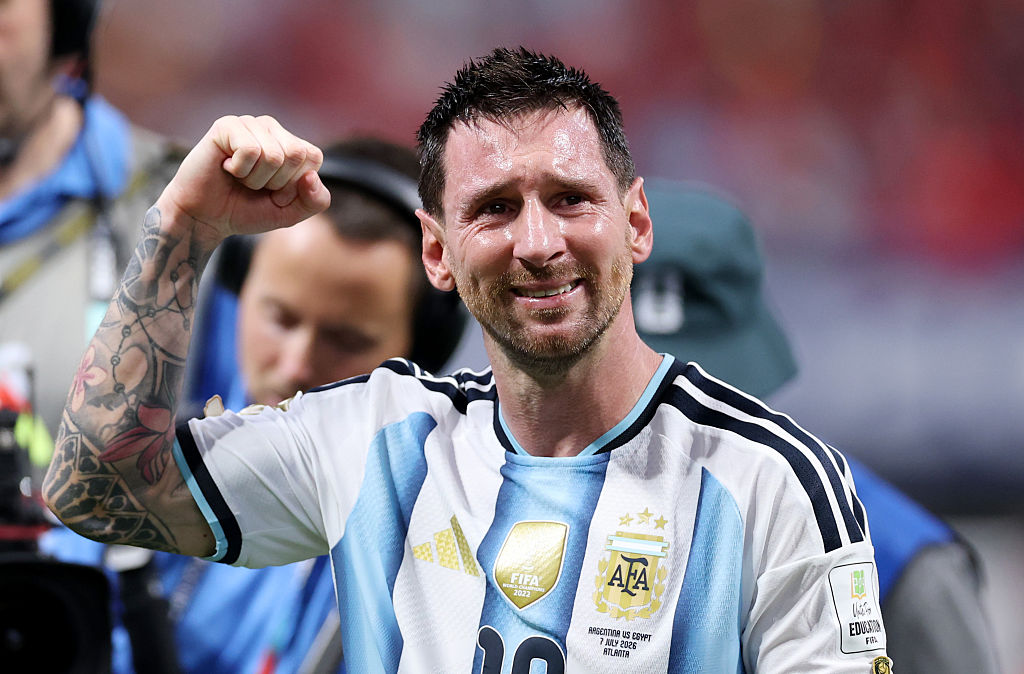
On June 24, 1987, a little boy was born in Argentina. He is the legendary Lionel Messi who has achieved greatness in the football world.
From a very young age, Messi showed exceptional talent in football. At around 4 years old, he started playing football. His coach initially thought he was too thin and fragile to avoid getting hurt, but his grandmother insisted on letting him play. Eventually, he joined Newell’s Old Boys’ youth training system.
Compared to kids his age, Messi appeared particularly small and frail. But once the football was at his feet, he seemed like a completely different person; his speed, dribbling skills, and understanding of the game far exceeded his peers.
As a child, Messi was not one to seek the spotlight. He was not talkative or attention-seeking, but once the game started, all eyes would slowly focus on him.
However, just as his football talent began to shine, a serious issue presented itself to his family.
Around the age of 10 or 11, Messi was diagnosed with Growth Hormone Deficiency. This meant that his body’s growth rate was significantly lower than normal. For a child aspiring to become a professional footballer, this was an incredibly harsh reality.
Doctors prescribed a growth hormone treatment plan for him, which meant he needed regular injections. The cost of this treatment was approximately $900 to $1000 per month, a significant amount for an average family.
Messi’s father Jorge worked in a steel factory, his mother Celia in a workshop, and their household was not affluent. His father managed to support for a while, but the economic environment in Argentina and the attitude of clubs were not optimistic.
In 2000, the 13-year-old Messi went for a trial at Barcelona. At that time, Messi was still thin, but his football skills left a strong impression.
Carles Rexach, the head of the club’s youth academy, was impressed and worried that delaying could lead to other teams snatching Messi. So, while dining near a tennis club, he wrote a promise on a napkin: Barcelona was willing to sign Messi on agreed terms.
It wasn’t a formal agreement, just a decision by the club to give this Argentine boy an opportunity. Afterwards, Messi entered Barcelona’s youth academy, and the club covered his treatment costs.
If Barcelona provided Messi with the opportunity to become a professional player, it was his family who instilled in him the belief that he could play football. Among them, his grandmother Celia had a particularly profound impact on Messi.
As a child, Messi wasn’t someone who made people think “he will become a superstar in the future” at first glance. He was small, making some adults worried if he was suited for intense competitions. But his grandmother always encouraged him to play. She accompanied him to matches, believing in the potential others couldn’t see.
However, when Messi was 10 years old, Celia passed away. For a child of that age, it was a departure he couldn’t truly comprehend and accept.
Later, Messi became a world-class soccer star. Whenever he scored a goal, he often looked up and pointed his fingers towards the sky. This gesture became one of his most famous ways of celebrating.
In his heart, this gesture was connected to his grandmother. The one who took him to play football earliest, believed in him earliest, but now couldn’t watch him play anymore. It’s as if he was telling his grandmother: “Look, I made it.”
After entering Barcelona’s youth system, Messi’s growth was unbelievable. He broke through from the youth team. In 2004, the 17-year-old Messi made his official debut for Barcelona’s first team.
The following decade, he almost redefined the modern football’s imagination of a “superstar”. He could dribble through several defenders in tight spaces, score incredible goals with his left foot, and change the game’s dynamics with accurate passes.
He wasn’t just a goal scorer; as his career progressed, Messi gradually became the core of the entire team. At Barcelona, he won La Liga, Copa del Rey, UEFA Champions League, and received numerous FIFA Ballon d’Or awards.
Messi gradually became the undisputed central figure in the world of football.
If Messi’s club career was nearly glorious, his national team career with Argentina was full of regrets.
He represented Argentina in multiple World Cups and Copa Americas, reaching the finals several times, but always falling short at the last step.
In the 2014 World Cup in Brazil, Argentina made it to the final, and Messi won the World Cup Golden Ball, but Argentina ultimately lost 0-1 to Germany in extra time; in the 2015 Copa America final, Argentina again lost to Chile; in the 2016 Centennial Copa America, Argentina once again lost to Chile in the final.
After the 2016 final, Messi announced his retirement from the national team. At that time, there were widespread doubts: why could he win everything with Barcelona but not lead Argentina?
Shortly after Messi announced his retirement from the national team, a then 15-year-old Argentine boy sent an open letter, hoping Messi would stay and continue playing for the national team. That boy turned out to be Enzo Fernández, who later won the World Cup with Messi.
In 2016, the 15-year-old Fernández wrote a message on social media to persuade Messi to stay. At that time, Enzo was an unknown youth. Messi eventually changed his mind and returned to the Argentina national team.
No one could have imagined that these two Argentines with a decade age gap would wear the national team’s jersey together.
In the 2021 Copa America final, Argentina defeated Brazil. Messi finally won a championship for the national team. At that moment, he almost knelt on the field.
On December 18, 2022, Argentina played against France in the World Cup final, winning 4-2 on penalties. Messi finally became a world champion. As the final whistle blew, he knelt on the field. He kissed the coveted World Cup trophy.
In the 2026 World Cup, at the age of 39, Messi once again donned the national team jersey. Argentina made it to the final but ultimately lost 0-1 to Spain, and Messi missed the World Cup trophy.
From his first World Cup participation in 2006 to now, it has been a full 20 years. On Monday, August 31, Messi officially announced his retirement from the national team on Instagram.
After becoming famous, Messi has gained huge wealth, honors, and worldwide attention. But in many people’s memory, he is still the boy from Rosario. He still places his family in an extremely important position.
The love story between Messi and his wife Antonela Roccuzzo is hailed as the most romantic fairy tale in the football world, as they went from childhood sweethearts to life partners.
When Messi was around 8 or 9 years old, playing at his teammate Lucas Scaglia’s house, he met Scaglia’s cousin, a year younger than him, Roccuzzo. Messi instantly fell for her, even writing in a love letter to her, “One day, we will be boyfriend and girlfriend.”
When Messi was 13, he went to Spain for treatment and training, while Roccuzzo remained in Argentina. In 2005, Roccuzzo’s friend tragically passed away in a car accident, and Messi immediately flew back to Argentina to comfort her through the ordeal. Their bond grew stronger over time. In 2017, they finally had their wedding in their hometown Rosario, an event that shimmered with stars and was dubbed the “wedding of the century” by Argentine media.
The couple now has three sons, Thiago, Mateo, and Ciro.