
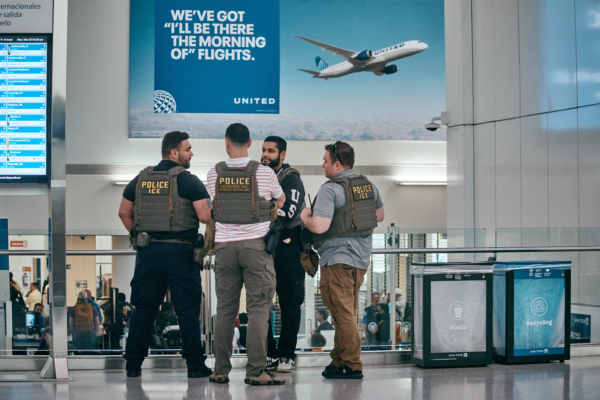
Recently, a number of individuals holding valid work permits under the C8 program, with no criminal records, and with pending political asylum cases awaiting interviews or immigration court hearings, have been detained by the U.S. Immigration and Customs Enforcement (ICE), causing concern among many asylum seekers.
Immigration lawyer Liu Ruhua, who has been practicing for 30 years, noted that many of his clients have been asking whether they can still fly or drive across states, with some who work out of state even afraid to return to New York for fear of encountering immigration enforcement along the way.
He explained that in the past, individuals who entered the U.S. legally with visas and later applied for political asylum would not typically become targets of ICE enforcement solely due to visa overstay if their asylum cases were still pending and they had no criminal records.
“It’s been 30 years of practicing immigration law, and I have never encountered this situation,” he said.
Although the recent cases of detention are still isolated incidents and not part of a widespread crackdown on all C8 work permit holders, they have led to significant panic. Many applicants are puzzled as to why they might be subject to ICE detention despite following the proper procedures, holding valid work permits issued by the government, and having no criminal records.
Liu Ruhua clarified that the key issue lies in the fact that having a pending asylum application and possessing a C8 work permit does not equate to having a legal non-immigrant status or immigrant status.
In a ruling in 2021, the Administrative Appeals Office of the U.S. Citizenship and Immigration Services stated that “a grant of employment authorization … by virtue of a pending asylum application also does not confer lawful immigration status.”
This leaves many asylum seekers in a limbo where they are not considered legal but cannot simply be called illegal.
Due to the lengthy wait times for asylum cases, many applicants have developed a belief that as long as their Form I-589 is pending, their C8 work permit is valid, and they have no criminal record, their status is secure. However, the recent ICE detention cases are challenging this sense of security.
“The ICE arrests indicate that the DHS no longer recognizes ‘having a work permit means you have legal status’,” Liu Ruhua said.
He pointed out a contradiction where many asylum applicants’ original non-immigrant statuses have already expired not due to their refusal to cooperate with the immigration process but because the asylum cases themselves have been backlogged for many years – either waiting for USCIS interviews or enduring long waits in immigration courts.
Liu Ruhua gave the example that since November 2014, China and the U.S. have reciprocally issued visas with the longest validity of 10 years for business and tourism purposes (B1/B2 visas), making it easier for Chinese nationals to obtain U.S. visas. Many Chinese nationals who came to the U.S. subsequently applied for political asylum and obtained C8 work permits. However, even after waiting for 10 years, many still have not had interviews with immigration authorities. “There are many who came in 2016 without interviews.”
“The government allows eligible asylum applicants to obtain C8 work permits precisely to enable them to work and support themselves during the lengthy wait period. If after ten years they still don’t have a work permit, how can they survive?”
He said that if the government believes that a particular asylum application does not qualify, it can make a decision through interviews, immigration courts, and other procedures. However, while the case is still pending, individuals might face detention due to visa overstay, creating uncertainty in the enforcement process.
“There’s an order of removal, or there are serious criminal records, being arrested by ICE in those cases would be more understandable; but waiting for questions, waiting for a hearing, following all procedures, why would you still be arrested? This is what everyone is finding hard to understand at the moment.”
Liu Ruhua noted that there haven’t been widespread arrests of C8 work permit holders by ICE yet, but the recent isolated cases have had a noticeable chilling effect.
Clients working out of state have been asking whether they can fly back to New York, some are worried about encountering immigration enforcement on long-distance drives, and some are reluctant to travel across state lines unless absolutely necessary.
However, asylum applicants are required to return to their place of residence to attend immigration court hearings, asylum interviews, or other immigration proceedings. “You have to come back for court, you have to come back for questioning, but right now, you’re scared to leave and you can’t not leave.”
Liu Ruhua also emphasized that there are distinctions between having a visa revoked and a visa expiring. Cases where visas are revoked involve questioning by immigration authorities and hearings in immigration courts, and differ from cases where visas have simply expired and not been revoked. How the DHS handles these cases will require further observation.
He pointed out that one particular concern is that once detained by ICE, individuals may be transferred to detention facilities far from their original residence, directly impacting the preparation of their asylum cases.
Communicating with lawyers, collecting evidence, contacting witnesses becomes more challenging during detention, and the ability to continue working and pay for legal fees may also be affected. “Preparing a case from inside a detention facility is totally different than preparing it outside.”
He stated that the immigration lawyer community is still monitoring the developments in enforcement. Different federal courts in various regions may render different rulings on immigration detentions, restraining orders, and other related cases. For asylum seekers with pending applications, the most significant change at the moment is not the emergence of a widespread crackdown on C8 holders but rather the increasing uncertainty of the enforcement practices that have been entrenched over a long period.