
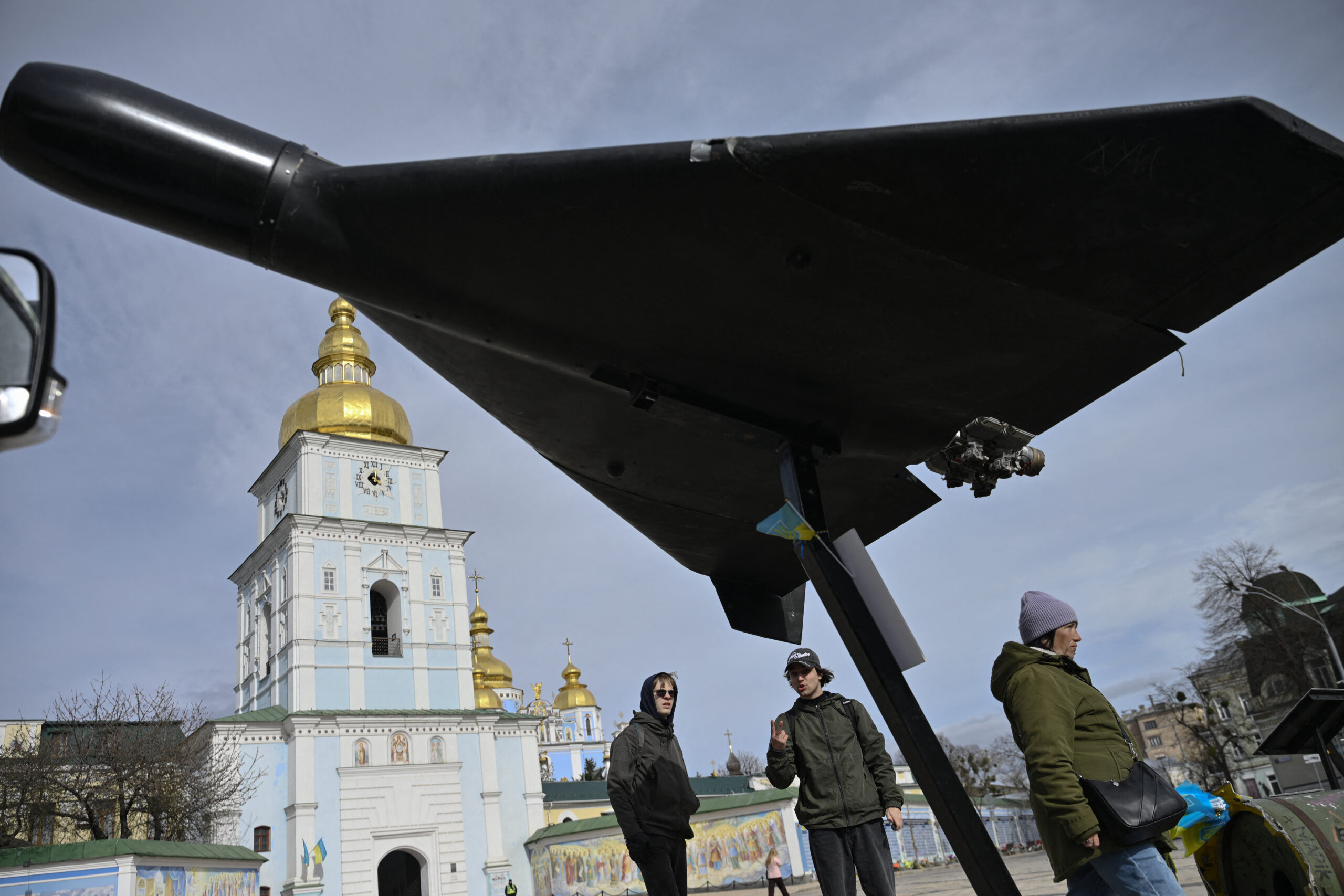
According to media analysis, the suicide attack drones, supported by the Chinese Communist Party and supplied with a large number of components, are changing the modern warfare trend in Iran with the “Shahed” drones.
The Washington Post published an analysis report on Tuesday (August 25th), indicating that the Iranian “Shahed” drones, due to their low cost and ability for mass production and launch, have been widely used by Russia on the battlefield in Ukraine.
For example, on a day in early July, eerie air raid sirens rang throughout Kiev as Russia launched a large number of new, cheap disposable attack drones powered not by propellers but by turbojet engines at the Ukrainian capital.
This attack also included ballistic missiles and cruise missiles, resulting in approximately 30 deaths.
Russia often uses “Shahed” drones in combination with ballistic and cruise missiles. While missiles have greater power, the low cost of the “Shahed” drones, approximately 20,000 US dollars each, allows for mass launches, forcing air defense systems to expend expensive intercept weapons.
Improved models of the Russian “Shahed” drones now resemble missiles, capable of speeds of approximately 300 miles per hour – roughly three times faster than older models. Ukrainian officials state that these high-speed drones are more difficult to intercept.
The analysis points out that these suicide attack drones are the latest innovation from the Russian military, and similar to other models, all of this is made possible thanks to the Chinese Communist Party – according to Ukrainian officials who examined some debris, Chinese factories provided the engines and other components for these drones.
Upon dismantling the drones used by Russia, Ukrainian authorities found that some of the new “Shahed” drones were equipped with more antennas, modems, and SIM cards, allowing for flight path corrections using local communication networks, with an increasing number of related components coming from China.
The Ukrainian government cited the example of the new turbojet “Shahed” drones used by the Russian military, powered by engines from Telefly Telecommunications Equipment, a company based in Shenzhen, China.
The company primarily manufactures computer and communication equipment and sells micro-turbojet engines. While related product information briefly disappeared from their English website after being disclosed, it was still available on their Chinese and other language pages.
The Chinese Foreign Ministry reiterated its consistent defense, stating that China strictly controls the export of dual-use items and opposes unilateral sanctions by the United States.
As the importance of the Chinese supply chain rises, the reliance of “Shahed” drones on Western components is decreasing.
Reports quoting current and former US officials and experts indicate that for a long time, the Chinese Communist Party, Washington’s main strategic opponent, has been the most significant supplier of components for “Shahed” drones, including engines, servomotors, gyroscopes, and more.
Analysts suggest that Iran, an isolated country, has been able to develop and export one of the most revolutionary military innovations of the time – inexpensive, flying killing machines – with the critical role played by the Chinese supply chain.
One significant case is the drone engines. The early “Shahed” drones of Iran used engines designed by the German company Limbach Flugmotoren.
In 2012, a Chinese enterprise began manufacturing engines for this company, and in 2017, directly acquired the German enterprise. Subsequently, the United States Treasury Department sanctioned this Chinese company involved in Iranian and Russian drone projects.
These suicide drones have not only posed challenges for the United States and its allies but have also intensified civilian casualties in Ukraine and weakened US military advantages in the Middle East.
The “Shahed” series of suicide drones is no longer limited to Iran and Russia. Related information indicates that China and India have developed similar drones, while Iran is exporting related technology to other countries.
Military analyst Mick Ryan points out that in the future, these low-cost attack drones may become “ubiquitous.”
The real impact of such weapons on future warfare is not just the destructive power of individual drones, but the ability to consume opponent’s air defense resources in large quantities at extremely low costs.
From Ukraine to the Middle East, the battlefield is showing a trend: modern military competition may not only depend on expensive fighter jets and missiles, but also on the ability to change the cost structure of warfare through low-cost, mass production, and continuous replenishment of weapons.