
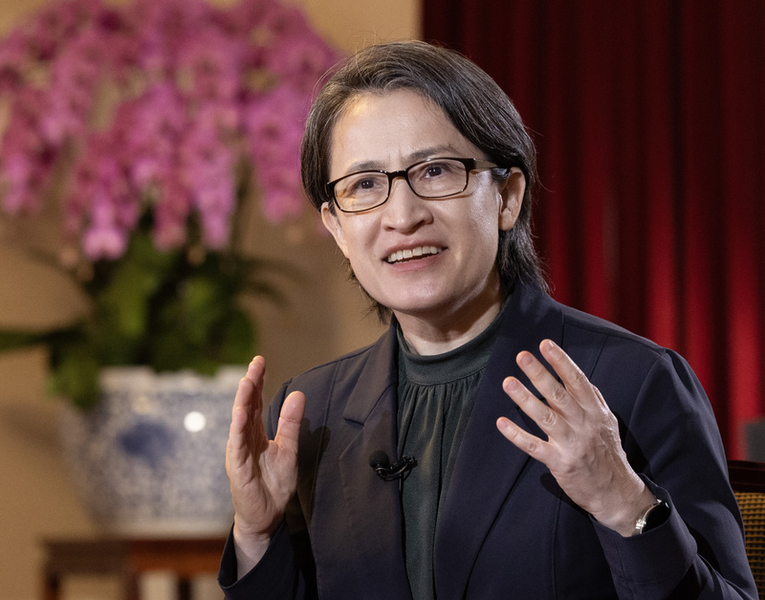
Taiwan Vice President Hsiao Mei-chin recently discussed the importance of drone budgeting in three aspects – the global strategic environment, Taiwan’s military security, and industry development in an interview with the Central News Agency. She emphasized the urgency of building drone defense forces to prevent the Beijing regime from misjudging Taiwan’s determination to defend itself.
The Executive Yuan of the Republic of China passed the draft of the “Special Act for the Purchase of Autonomous Unmanned Vehicles for National Defense Self-reliance” on June 18, which will allocate a budget of up to NT$210 billion annually. The aim is to procure maritime surveillance drones, maritime attack drones, and small unmanned suicide vessels. Fourteen versions of unmanned vehicle legislation proposals were submitted by various political parties in the Legislative Yuan, but as of the 20th, no consensus has been reached.
Vice President Hsiao Mei-chin pointed out in the interview that the development of the drone industry in Taiwan is crucial in the context of global strategic environment, military security, people’s livelihood security, and industrial advancement. She acknowledged the criticism of the government’s delayed investment in this sector but stressed that Taiwan, despite lagging behind, has the capability to swiftly catch up.
Referencing the significance of drones in global military strategy, she highlighted their role in the conflict between Russia and Ukraine, where drones have become a crucial asymmetrical warfare capability. She also mentioned the use of drones in various conflicts worldwide, such as the US-Iran tension, emphasizing the need for Taiwan to enhance its defensive capabilities with drones.
Hsiao Mei-chin underscored the importance of Taiwan’s defense deterrence and multi-domain resistance strategy to raise the threshold for potential aggressors. She stressed the necessity of promptly establishing defensive drone forces to signal Taiwan’s unwavering commitment to self-defense and deterrence.
Regarding President Lai Ching-te’s repeated affirmation of Taiwan’s determination to defend itself, Hsiao Mei-chin explained that the special budget allocation is a concrete demonstration of Taiwan’s commitment to national defense. She noted that Taiwan’s defense budget has been increasing annually to improve equipment and welfare for military personnel.
In addition to their role in military security, drones can play a crucial role in disaster relief efforts during natural calamities such as typhoons, heavy rainfall, and earthquakes. Hsiao Mei-chin cited instances where drones could have expedited rescue operations, such as in the aftermath of the Hualien earthquake in April 2024.
Furthermore, she emphasized the potential of drones to drive Taiwan’s non-red supply chain industry development. Despite starting later than other countries in the drone sector, Taiwan has seen a significant increase in drone exports in the first half of this year, surpassing the previous year’s total. The Vice President expressed confidence in Taiwan’s drone industry catching up quickly with effective budget allocation.
Hsiao Mei-chin highlighted the interest of foreign visitors in purchasing Taiwan’s drones, especially those seeking trustworthy drones from non-red supply chains. She pointed out that if Taiwan uses its own drones in defense and there is a demand for them in the international market, it would boost the industry’s competitiveness.
From a military security, livelihood security, and industry development perspective, Taiwan’s drone industry may have had a slower start, but with bipartisan support, Hsiao Mei-chin is optimistic that drones can become a key force in safeguarding national interests across various sectors.
(Source: Central News Agency)