
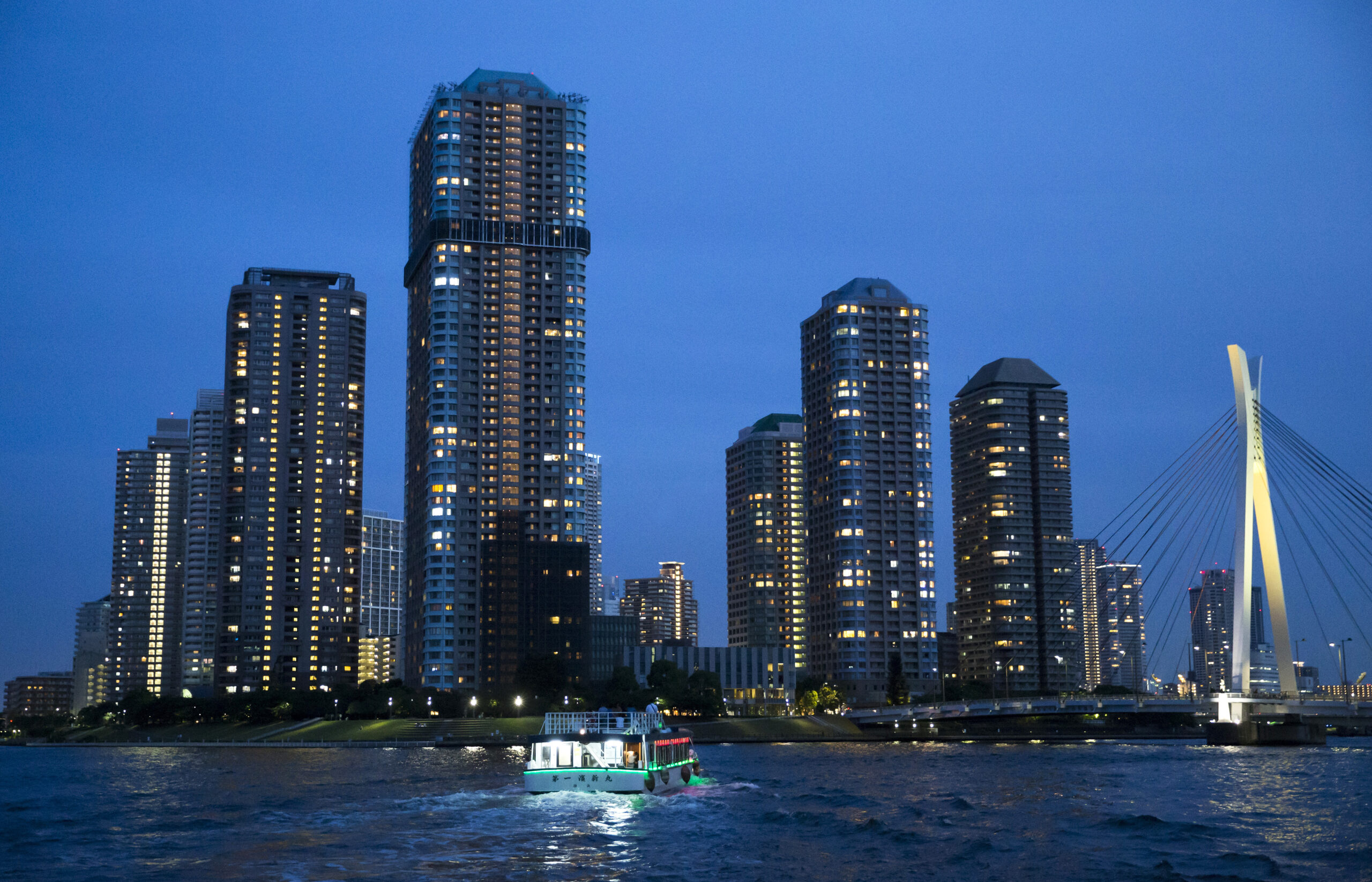
In recent years, the second-hand housing market in Tokyo, Japan has seen its first decline in nearly two years, with the high-end housing market also cooling down simultaneously. The latest data shows that both the prices in the 23 wards of Tokyo and the core six districts have decreased, and the demand for ultra-high-rise residential properties in Tokyo Bay has noticeably weakened. Market observers point out that after Japan significantly tightened the visa review process for the “Business Management” visa, the difficulty of new applications and renewals for Chinese buyers has increased. Some investors have started selling properties and even leaving Japan, leading to a shift in the important buyer profile that previously supported the high-end residential market, signaling a new turning point in the housing market.
Tokyo’s authoritative real estate valuation agency, “Tokyo Kantei,” released the market conditions for second-hand houses in Japan in June on July 23. The average price in the 23 wards of Tokyo was 127.41 million yen (approximately 5.94 million yuan), a decrease of 0.8% from the previous month, marking the first decline in 26 months. The main reason cited is an increase in listings, resulting in a larger inventory of properties for sale, forcing sellers to reduce prices. At the same time, areas around Tokyo such as Kanagawa, Saitama, and Chiba have maintained an upward trend.
Takahashi Masayuki, Chief Researcher at “Tokyo Kantei,” analyzed, “Previously, the influx of investment funds led to soaring prices, but now it is experiencing a rebound, and the market is evolving towards weakening.”
Furthermore, data also shows that the average prices of second-hand houses in the core six districts of Tokyo, including Chiyoda, Chuo, Minato, Shinjuku, Shibuya, and Bunkyo, were 185.12 million yen (approximately 8.64 million yuan), a decrease of about 1.3%, with consecutive declines in the past two months and an expanding downturn.
Statistics from the Japan Global Real Estate Research Institute show that from 2017 to 2024, the Chinese population in Tokyo increased significantly by about 70,000 people (a 38.4% increase), with a notable concentration in the aforementioned six districts. Their analysis indicates that this trend is due to the strong preference of high-income Chinese families in Japan for quality residences, education, and living environments.
According to reports in the Japanese media, after the end of the “zero-COVID” containment policies by the Chinese government post-2020 pandemic, a large number of wealthy Chinese individuals have sought security for their assets and political freedoms, sparking a “Rush to Japan” trend in recent years, leading to property purchases in Japan.
The “Tokyo Shimbun” once cited a middle-aged Chinese man surnamed Li’s experience of relocating to Japan post-pandemic. Li moved to Japan and purchased a mid-level luxury apartment in a high-rise residential building in Tokyo Bay. He currently works in the financial industry in Tokyo and enjoys a stable life.
He stated that for stability-seeking Chinese individuals, Japan is a very popular destination for relocation, with many similar examples among his peers. Not being easily discriminated against, the ability to read Chinese characters, access to authentic Chinese cuisine, and being close to China so that one can return home in 3-4 hours in the event of family emergencies are all attractive factors.
He openly expressed that he has established a foundation for his life in Japan and wishes to continue living there.
Nakajima Megumi, a veteran Japanese media professional who has been monitoring the Chinese community in Japan for a long time, pointed out that the “Rush to Japan” trend among Chinese individuals triggered by the pandemic includes many prominent figures such as former CEOs, senior executives, and entrepreneurs, often referred to as “elite Chinese individuals.”
However, Yujin Oki, President of the Style Act Real Estate Company, recently wrote in an article on the “Diamond” website that the current wave of affluent Chinese individuals rushing to Japan has caused an “abnormality” that is affecting the Tokyo property market sentiment.
He explained that for many years, the wealthy Chinese individuals relocating to Japan have driven up prices of high-rise properties and luxury apartments in Tokyo, but now a reverse and abnormal trend has emerged.
Oki mentioned that the main reason for this “abnormality” is the significant increase in the requirements for Japan’s “Business Management Visa.”
It is reported that in the past, the most common way for foreigners and their families to move to Japan was by applying for the “Business Management Visa,” with loopholes allowing even “shell companies” with no actual business operations to obtain the visa. To counter this, the Japanese government substantially tightened the review standards starting October 16, 2025. The new rules mainly include:
1. Increasing the company’s capital from 5 million yen (approximately 240,000 yuan) to 30 million yen (approximately 1.45 million yuan).
2. Requirement to hire at least one full-time Japanese national/permanent resident employee.
3. Applicants or full-time employees must have a certain level of proficiency in the Japanese language (JLPT N2 or above).
4. Need to have three years or more of business/management experience or a master’s degree in a related field.
5. Business Plan: Detailed and feasible business plans must be submitted and undergo stricter scrutiny (including business reality, tax compliance, social security compliance, etc.).
Official data from Japan indicates a significant decrease in approved applications following the implementation of these new standards. Before the new regulations were implemented, there were approximately 1,700 approvals per month, which plummeted to around 70 approvals per month, reducing by around 96%.
Although official data has not disclosed the nationalities of the rejected applicants, as of the end of June 2024, there were a total of 39,616 individuals holding the “Business Management” visa. Among them, 20,551 were of Chinese nationality, accounting for 51.9% of the total. It is widely believed that Chinese applicants may be more affected.
The Japanese financial magazine “Toyo Keizai” cited the head of the real estate agency “Le Ying,” who revealed that after the new rules for the “Business Management” visa were implemented, the inquiries and transaction volumes from Chinese clients sharply declined. The monthly transactions for properties ranging from 50 million yen to 200 million yen (approximately 2.33 million to 9.33 million yuan) decreased from over 10 in the past to 3-5, with some agencies even experiencing losses and closures among peers.
Oki mentioned that for Chinese individuals with immigration intentions, the sixfold increase in company capital may not be a significant obstacle, but the other requirements pose the highest challenges. For instance, in the current context of labor shortages in Japan, hiring qualified employees for small and medium-sized businesses is not easy; also, the requirements for Japanese language proficiency among applicants and three years or more of business management experience are considered “high difficulty conditions.”
Investigations by Dajiyuan Japan revealed that the number of rejected visa applications has dramatically increased for new applicants, and even among Chinese individuals seeking visa renewals post-October 2025, the number of rejections is on the rise. Many Chinese individuals are faced with the dilemma of handling their properties due to lack of confidence in renewing their “Business Management” visas.
After being rejected, individuals are required to leave within 30 days, and after 30 days, their local residency registration details and bank accounts will become invalid. Dealing with property matters becomes quite cumbersome once the related information becomes invalid, causing many Chinese individuals who lack confidence in renewing their “Business Management” visas to consider how to deal with their properties.
Oki revealed that the number of transactions for second-hand luxury residences in Tokyo’s Chuo Ward over 200 million yen (approximately 9.33 million yuan) has decreased significantly by about 60% since the beginning of 2026 compared to the same period last year. The number of buyers for ultra-high-rise residential properties in areas like Harumi in Tokyo Bay has also sharply declined.
Oki remarked, “Previously, one of the important buyers in the Tokyo property market was Chinese investors, but in the future, Chinese individuals may become the key sellers. We are currently at a crossroads of fate.”