
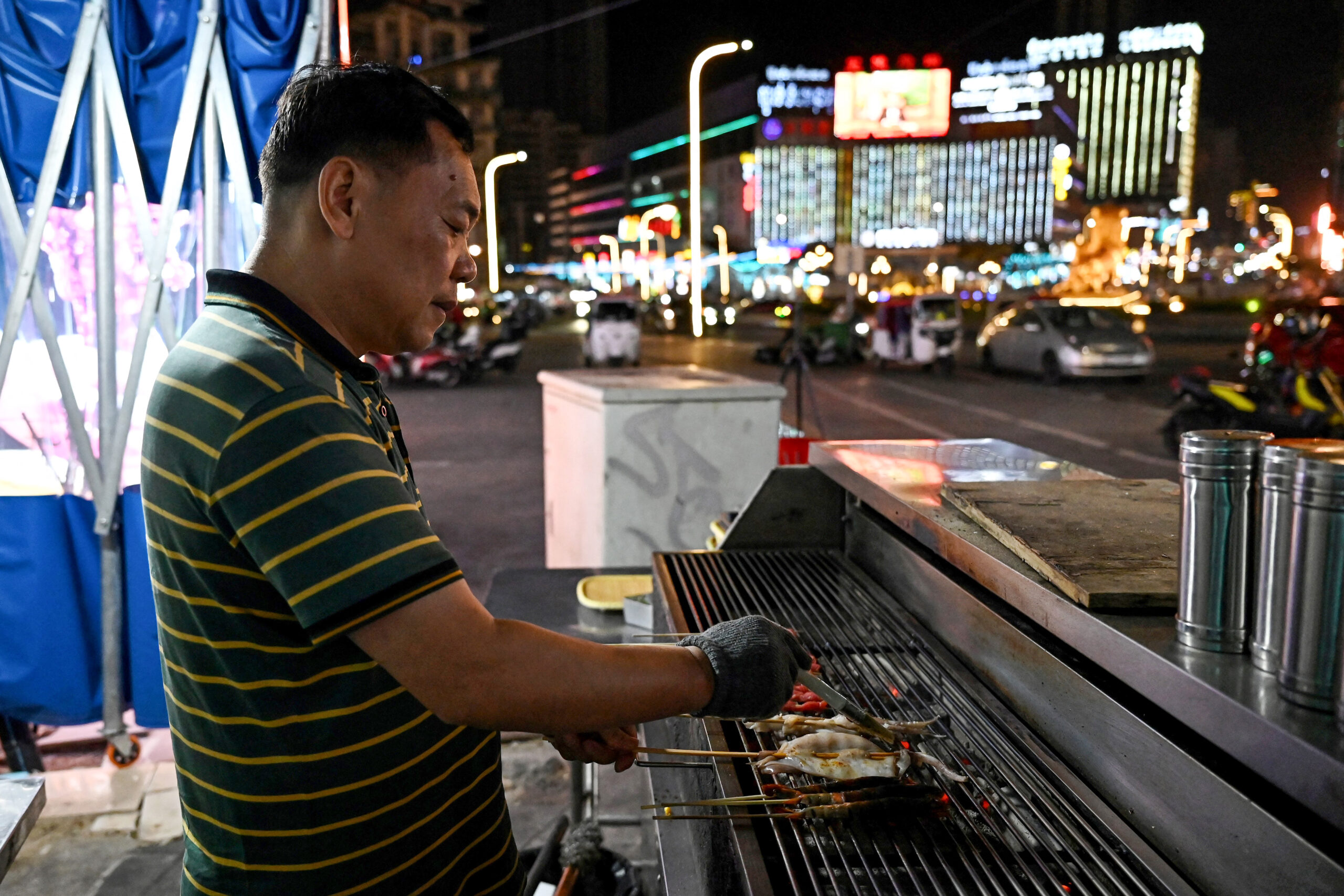
【Epoch Times, October 16, 2026】”I never expected to encounter a former colleague in such an undignified manner,” said Mr. Tao, who used to work at an internet company in mainland China. Ten years ago, he and his colleagues were riding the wave of the IT industry’s boom, only to find themselves in vastly different circumstances a decade later, with Mr. Tao selling balloons on the street while the other person was selling grilled squid on the opposite side of the road.
Mr. Tao recently shared a video on social media recounting an incident where he heard his name repeatedly called from across the street while selling balloons on the sidewalk. Intrigued, he walked over to the person calling out his name, carefully confirmed if they had worked together at a company writing code more than ten years ago. Upon receiving a positive response, Mr. Tao expressed his astonishment.
“I would never have believed that ten years later, he would be selling grilled squid on the street, and I would be selling balloons on the other side,” Mr. Tao said wistfully.
In another video, Mr. Tao revealed that he is from Changsha, Hunan Province, and after facing unemployment, he started selling balloons on the streets of Changsha. This news spread to his alma mater, becoming a hot topic on campus. Fellow alumni identified Mr. Tao as a graduate of the Electronic Information Engineering Department of Harbin Institute of Technology, one of the ‘Seven Sons of National Defense,’ in 2012.
Feeling ashamed for reaching his current situation, Mr. Tao was comforted and encouraged by the chairman of the Hunan Alumni Association.
However, upon unexpectedly meeting his former colleague from the IT industry, both men couldn’t help but reflect on their respective fates, pondering the uncertainties of life where one never knows whether “surprise” or “tomorrow” will arrive first.
According to Mr. Tao’s account, he left the company around a decade ago, after which the internet company where they worked shut down. His colleague struggled to find work after being laid off, experiencing a vicious cycle of unemployment, reemployment, and unemployment again. Subsequently, his colleague fell seriously ill, exhausting his savings for treatment, accumulating debts, selling his house and car to repay them, now making a living by selling grilled squid on the street.
“While earning money is extremely difficult now, I can barely sustain my livelihood, including my child’s school fees, and manage to get by with a bit of effort,” Mr. Tao recounted his colleague’s words.
Mr. Tao reminisced about their time working together at the internet company, where they enjoyed higher incomes and living standards, describing those years as “full of spirit.” “We used to have lavish dinners every week, buy the trendiest electronic products every year, and travel abroad annually,” he said. “We spent money like there was no tomorrow, never considering saving.”
He noted how his former colleague, who used to be a bit overweight, now looked thin and bald. Mr. Tao himself now sets up a stall for a living, saying, “I no longer care about my dignity to make a living.”
“You never know which will come first, the ‘surprise’ or ‘tomorrow,'” he reflected. “If we had known that we would endure such hardship in middle age, we would have definitely saved more in the past.”
Mr. Tao’s fluctuating life story resonated on the internet, with bloggers reposting messages expressing sentiments like, “From once being elite coders at a big company to now being street vendors, it was thought that hard work would always lead to success, but later came to realize that the youth of the older generation has been spent struggling to make a living.”
This case is not isolated but rather a microcosm of the shrinking job market and changing employment patterns in China today. Statistics show that over the past 18 months, the five major internet companies in China collectively laid off over 130,000 employees. Caixin reported that the number of employees at Alibaba and Baidu has been declining for three consecutive years. By the end of 2024, Baidu’s workforce had decreased by 21.1% from its peak in 2021 to 35,900 employees, and Alibaba’s number of full-time employees dropped from 254,941 in March 2022 to 124,320 in March 2025, a reduction of over 50%.
Official data indicates that in 2025, the national urban unemployment rate in China averaged 5.2%, below the expected target of around 5.5%. In reality, a significant number of workers are not counted as unemployed in statistical terms but have transitioned to flexible employment such as food delivery, ride-hailing, street vending, and small businesses. According to a report cited by Taiwan’s Economic Daily, the scale of flexible employment in China exceeded 200 million people by December 2025, accounting for approximately 27.6% of the workforce. Research institutions estimate that the number of flexibly employed individuals may reach 320 million by 2026.
The China New Employment Patterns Research Center at Capital University of Economics and Business judges that flexible employment has become a vast “reservoir” of employment opportunities. The balloon and grilled squid stalls operated by Mr. Tao and his colleague are vivid micro-samples of this “reservoir.”
In the video, Mr. Tao expressed feeling both nostalgic and relieved by the friendly greeting from his former colleague. He remarked that his colleague had “completely let go of his pride and shed his coat.”
“I hope we both work hard and resurface from our current struggles,” he said.
Currently, the two men work at their respective stalls across the street from each other: one selling balloons, the other selling grilled squid. A decade ago, they were coding together at the same internet company.