
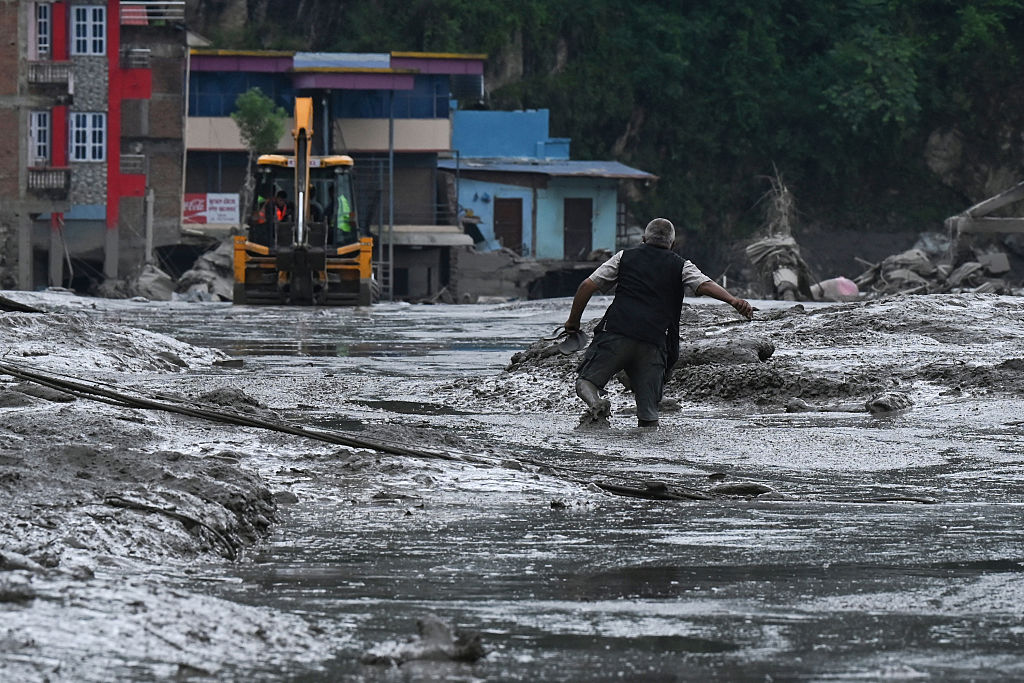
On the morning of August 26th, a sudden large-scale mudslide simultaneously affected northern Nepal and the Gyirong Port in western Tibet, China. However, despite the same disaster, the reporting methods and perspectives of the media in both Nepal and China were starkly different. While Nepal focused on the affected people, Chinese state media mainly highlighted the official actions and system operations.
After the disaster, Nepal quickly became the focus of international media attention. Local journalists and international media were able to access the disaster area, making it easier for the outside world to see “the people in the disaster”: moments of escape, survivors being rescued, villagers losing their homes, and the subsequent identification and mass burial of bodies.
Media outlets such as Reuters, Associated Press, Al Jazeera, etc., released a large amount of on-site videos and photos showing houses, roads, bridges, and infrastructure being washed away by floods and mudslides. They interviewed eyewitnesses describing people being swept away by floods or holding onto trees to survive. Platforms like YouTube showed continuous live broadcasts and ground reports, depicting rescue workers searching in the mud, residents recounting their missing family members, and scenes of a large number of bodies downstream.
Nepal also gradually disclosed data on deaths, missing persons, and stranded tourists. The tourism department, police, and disaster management agencies updated numbers almost daily and coordinated with on-site visuals.
On August 30th, Chinese state media Xinhua News Agency published a report titled “On the Scene: Eye-witness Account of Nepal Mudslide Disaster Area.” This report from Xinhua’s journalist in the Bagmati Province of Nuwakot County, northern Nepal, no longer simply reported official rescue data but interviewed a large number of local disaster-stricken people.
For example, a local resident, Santosh Tapas, mentioned that when the mudslide hit, his uncle and aunt were in the shop and escaped on a motorcycle after hearing the roar; many of his friends are still missing. Another local resident, Sabas, shared that when the mudslide arrived, the river suddenly surged, and people desperately ran for safety. He and his wife narrowly escaped, but their relatives couldn’t make it out.
Xinhua’s reporter also vividly described houses in the disaster area being buried in mud, vehicles trapped in mud, and survivors returning to their destroyed homes. The report’s images depicted affected residents clearing and moving household items.
In sharp contrast to the narratives of survivors, villagers, missing persons’ families, and eyewitnesses in Nepal, Chinese state media focused on the rescue efforts, resource allocation, and portrayed more of the “rescue system” in their coverage.
The official reports highlighted rescue personnel, engineering machinery, drones, resources, and emergency responses as frequent elements.
The headlines and content focused on phrases like “Emergency Aid from Multiple Sources,” “Integrated Rescue Efforts by Land, Water, and Air,” “2141 Personnel Deployed in Rescue Efforts,” “Party Flag Flying High at the Forefront of Rescue Efforts in Gyirong Mudslide Disaster,” emphasizing the involvement of the Chinese military, armed police, firefighters, and China National Energy in the central allocation of funds and activation of emergency responses.
Various reports featured phrases such as “Peoples’ soldiers mobilized in the Tibetan city of Xigaze County, Gyirong, for mudslide disaster relief,” “Three departments allocate 30,000 units of central disaster relief supplies,” “National level 2 disaster emergency response initiated,” “Ministry of Natural Resources activates Level II geological disaster defense in Tibet,” “Two departments allocate 120 million yuan to support emergency rescue work for Gyirong mudslide disaster in Tibet,” “Ministry of Water Resources deploys emergency disposal work for Gyirong mudslide disaster in Tibet,” etc., among others.
On August 30, a netizen “Laomao Yakouhao” expressed on the X platform of social media that Chinese journalists suddenly “recovered” their interviewing abilities upon reaching Nepal?
“Laomao Yakouhao” pointed out that Xinhua News Agency released the report “Eye-witness Account of Nepal Mudslide Disaster Area” on August 30. The journalist went to the disaster-stricken areas in Nepal, interviewed local residents, and documented the scenes of the disaster: houses buried in mud, daily essentials scattered in the mud, and displaced survivors returning to their destroyed homes.
On August 29, China News Service published a report titled “Journalist’s Notebook: Bringing 5 Rescued Compatriots Back to ‘Jia’ in Nepal.”
“Laomao Yakouhao” commented that the China News Service journalist went further. Reporter Cui Nan drove from Kathmandu towards the disaster area and could not proceed beyond Birendra. There, a military camp became a temporary rescue center, with family members and journalists from different countries waiting outside for news. She met five recently rescued Chinese individuals there and showed concern, recording their experiences. These five individuals were originally scattered in different locations but came together in a shed on the mountain after the disaster struck, surviving a night there before being rescued by a helicopter the next day.
When the China News Service reporter saw them, their clothes and shoes were still covered in mud. As some of them were extremely exhausted, the journalist stopped the interview and sent them back to Kathmandu.
“Laomao Yakouhao” stated that when in Nepal, Chinese journalists knew to seek out survivors, inquire about missing family members, and ask about the experiences during the mudslide, the personal escape process, and the last time they saw their loved ones. They would photograph the missing person notices on hospital walls, document the mud and debris on survivors, the routes they took to escape, and also focus on the anxious family members waiting for news.
However, across the border, once back in China and reporting in Gyirong, journalists were on-site, but the subjects of their reports shifted to rescue personnel, officials, drivers, equipment, and resources.
“Laomao Yakouhao” pointed out that the information exported by Chinese journalists on both sides of the border presented a stark contrast: in Nepal, they asked, “What did you experience?” while the reporting in Gyirong, Tibet, switched to, “What did the rescue system do?”
The same mudslide, two different sides of the border, displayed two types of disaster narratives – why is it so?
This difference is not coincidental. In China, the dissemination of information on major emergencies is constrained by a unified emergency and public opinion management mechanism. Official communications from the Chinese Communist Party often become the main source of “facts” to reduce the risk of “loss of control” and serve the needs of the “bigger picture.” In comparison, in relatively open environments like Nepal, journalists can freely collect and report personal narratives.