
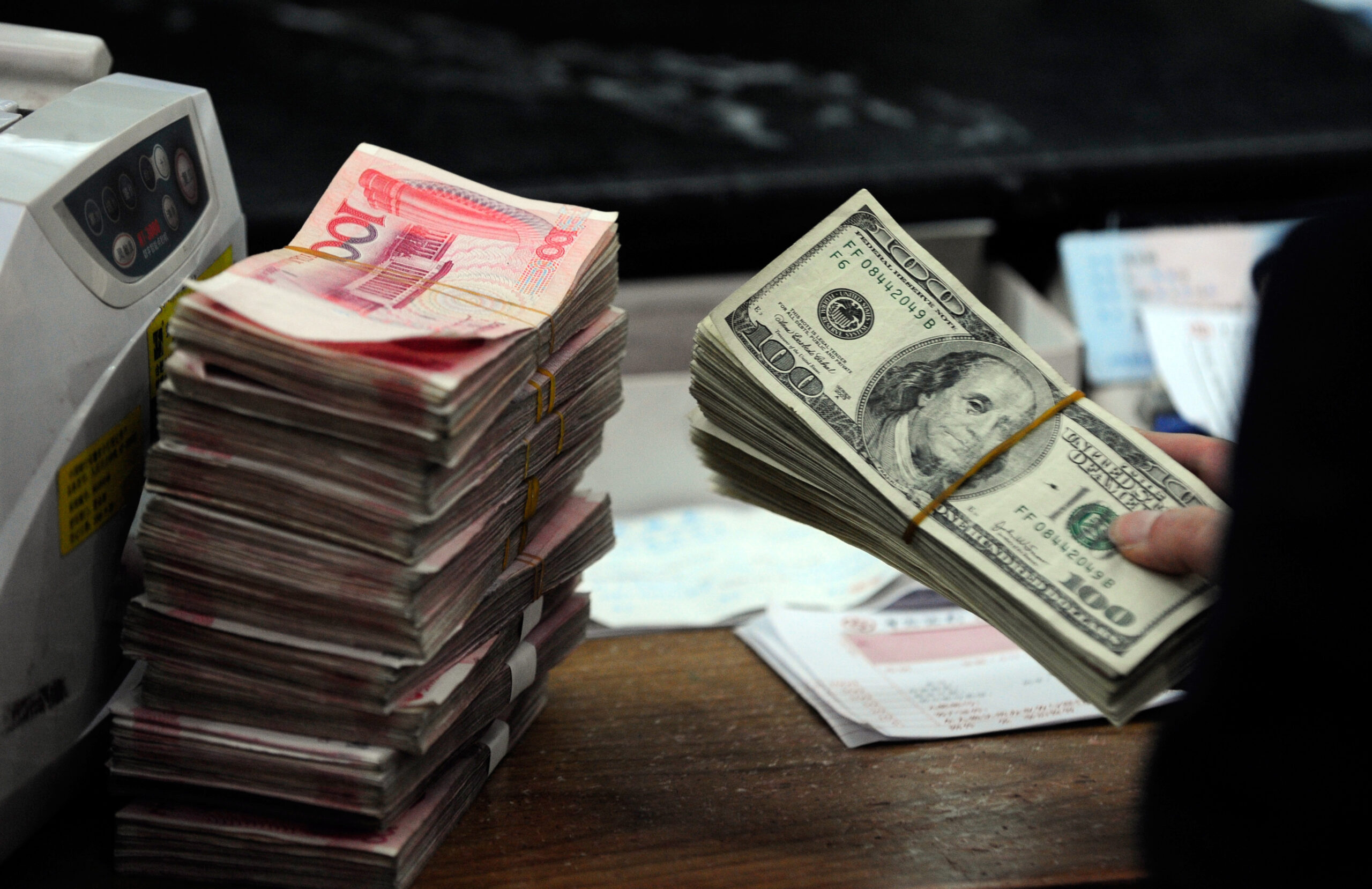
China’s huge and continuously growing trade surplus is gradually hollowing out the industrial base of its trading partners. For years, other countries around the world have been hoping for Beijing to change its economic model to rely more on domestic demand rather than exports, but the results have been limited. Senior commentator Ye Weiping from The Wall Street Journal suggests that a global currency agreement backed by tariffs could encourage Beijing to alter its export trade model.
The dissatisfaction with China’s trade policy is escalating, particularly in Europe. There is a global consensus that China’s export trade model is unsustainable.
Ye Weiping urges the world’s major economies, led by the United States, to reconsider a new “Plaza Agreement” to raise the undervalued Chinese yuan, as the timing is now ripe.
In 1985, at the Plaza Hotel in New York, the United States and its allies signed a Plaza Agreement to lower the exchange rates of the US dollar against the German mark and the Japanese yen, coupled with domestic reforms that ultimately helped narrow Germany’s and Japan’s trade surpluses.
Behind the Chinese yuan, there are two undisputed facts. Most economists argue that the yuan’s undervaluation is not due to China’s current account surplus (which covers trade in goods, services, and investment income), but rather insufficient domestic demand leading to the surplus and its consequences.
Firstly, China’s trade surplus is massive and continuously growing. According to Goldman Sachs, this figure could reach $1.2 trillion this year. China’s current account surplus is approaching 1% of global GDP, a share never before achieved by any country in post-war history.
Secondly, the current exchange rate of the Chinese yuan is significantly undervalued compared to levels determined by trade imbalances and purchasing power. Goldman Sachs believes it is undervalued by 19%, while Brad Setser from the Council on Foreign Relations argues it is undervalued by 35%.
The International Monetary Fund attributes China’s excessive savings to a range of structural factors, such as an inadequate social safety net and heavy household taxation under the fiscal system, which suppresses consumption. The property market collapse after 2020 led to investment contraction, further widening the current account surplus.
Some economists believe that China manipulates its exchange rate with the explicit purpose of promoting exports and suppressing imports.
Michael Pettis, a China expert at the Carnegie Endowment for International Peace, states that the undervalued yuan lowers the prices of Chinese goods abroad while raising the prices of foreign goods in China, thus increasing the surplus. Additionally, export-oriented policies instead of consumer-oriented policies squeeze Chinese consumption and enlarge the current account surplus.
Since the COVID-19 pandemic, the Chinese economy has further contracted due to lockdowns and the real estate market. As a result, commodity prices have declined. Meanwhile, in developed markets, prices are rising due to stimulus measures and supply chain disruptions. This means that the inflation-adjusted yuan against the dollar has significantly decreased compared to pre-pandemic levels.
In this context, the competitiveness of Chinese goods has been further enhanced. According to Goldman Sachs’ research, in the electric vehicle sector, Chinese prices are 32% lower; in the refrigerator sector, Chinese products are priced 38% lower; in the footwear sector, Chinese products are 53% lower. In theory, if the yuan were valued reasonably, such disparities should not persist and certainly not widen further.
Setser bluntly states that the undervalued yuan alleviates pressure on the Chinese authorities to undertake economic reforms, as they can still rely on exports while other sectors stagnate.
The world’s perception has undergone a shift. After the United States significantly levied tariffs to reduce its trade deficit with China, Europe is also gradually aligning its views on the use of “tariff tools.”
In February, the French government proposed unprecedented trade protection measures, equivalent to imposing a 30% general tariff on China or devaluing the euro against the yuan by 20% to 30%.
In June, German Chancellor and CDU leader Friedrich Merz called for a new “Plaza Agreement” with Beijing.
Ye Weiping stated in the article, “If political disputes can be transcended, the United States and its allies will recognize they face a common problem, and a currency agreement, regardless of China’s cooperation, may be the clearest, least convoluted, and most effective solution.”
However, this path undoubtedly requires more wisdom and courage.
In the eyes of the Chinese leader Xi Jinping, expanding exports and restricting imports can make the world more dependent on China while reducing China’s dependence on the world.
Chinese state media Global Times stated in June that it will never accept any pressure from Western countries using exchange rates as an excuse.