
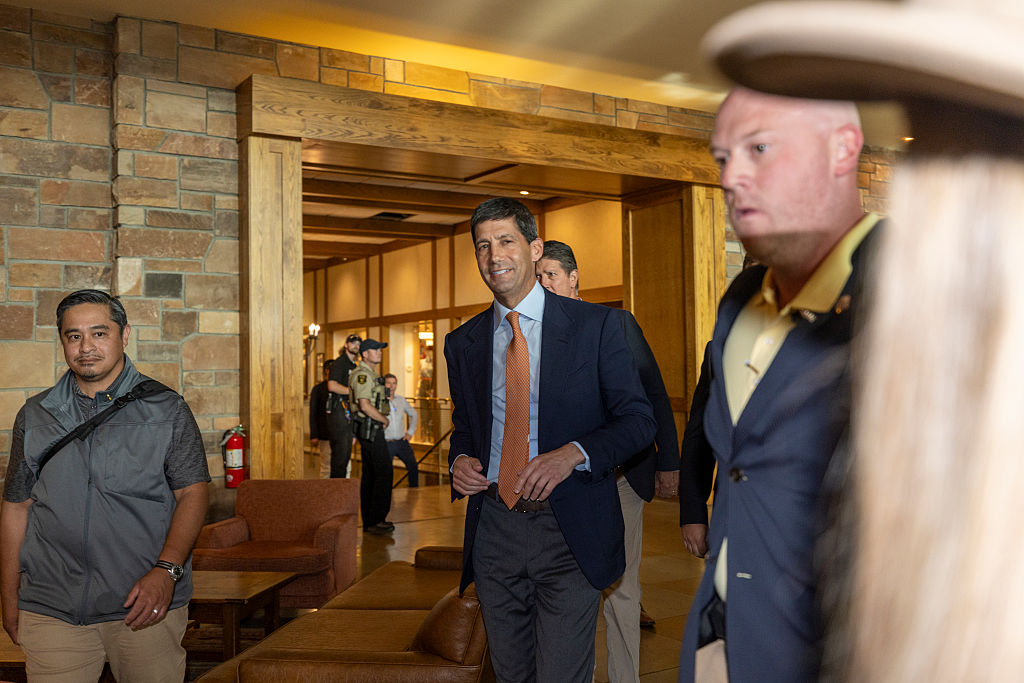
On Friday, August 28, at the Federal Reserve’s annual economic symposium in Jackson Hole, Wyoming, Federal Reserve Chairman Kevin Warsh delivered a keynote speech. This marked his first major address after 100 days in office.
Warsh highlighted the resilience of the U.S. economy, citing the potential for artificial intelligence (AI) to drive a new wave of productivity growth. However, he also noted that inflation remains above the Federal Reserve’s 2% target. Therefore, Warsh suggested that the Fed should refrain from making explicit commitments on future interest rate decisions and instead maintain policy flexibility based on the latest economic data.
After Warsh’s speech, traders began betting on a rate hike by the Fed in September.
Warsh discussed the long-term impact of AI on the economy, noting that the rapid development of AI has surpassed many industry expectations from years ago. He emphasized that AI could become a new factor of production, leading to increased productivity and economic growth.
Nevertheless, there is still uncertainty regarding AI’s ultimate impact on the labor market, corporate profits, and income distribution. Warsh pointed out that AI could either complement or potentially replace some jobs. Additionally, the economic benefits generated by AI may initially flow to AI labs, chip manufacturers, energy companies, and cloud service providers.
Warsh mentioned that shortly after taking office, the Fed had established several working groups, including the “Productivity and Employment Task Force,” to study long-term issues such as AI. The recommendations from these groups will be announced later but will not affect the Fed’s current policy decisions.
Warsh explicitly stated that under normal economic conditions, the Fed should not overly rely on forward guidance nor make commitments on future interest rate paths beforehand.
He argued that providing excessive policy details or approximating commitments on future rates could mislead markets, businesses, and households, thus limiting the Fed’s ability to adjust policy based on new data.
Warsh emphasized the need for the Fed to receive clear and “as unfiltered as possible” market signals, including government bond prices and trading volume, the U.S. dollar exchange rate, credit costs, asset prices, and commodity prices, to evaluate economic activity, inflation, and financial conditions.
In assessing the current economic situation, Warsh noted that the U.S. economy had seen recent strength with robust corporate investments, earnings, and consumer spending.
Equipment and intangible asset investments had increased by about 9% in the past year, the highest level since 2021, with over half of these investments likely related to AI. S&P 500 index component companies had reported profit growth of over 20% in the past year, and corporate profit margins were at historically high levels.
Real consumer spending had grown by over 2% in the past year, while private domestic final purchases had increased by nearly 3% this year. Warsh stated that these indicators often better reflected the economic situation than GDP and had been performing well recently.
The labor market remained stable, with an unemployment rate of 4.1%, persisting at a relatively low level; the four-week average of initial jobless claims was close to multi-year lows. Warsh believed that overall, the labor market was broadly consistent with full employment, though certain groups such as recent graduates still faced pressure.
On the other hand, the inflation situation raised concerns. Warsh noted that the Personal Consumption Expenditures (PCE) price index, favored by the Fed, showed a 3.7% year-over-year increase, with a six-month annualized rate of 4.1%, significantly above the 2% target.
Although inflation had fallen significantly from its peak in 2022, the progress in the past two years had been limited. The recent better inflation data was insufficient to prove a significant improvement in the underlying inflation trend.
“We must ensure that potential inflation is moving toward our target at a clear and sufficient pace,” Warsh said.
He observed that credit spreads on corporate bonds and leveraged loans were near historical lows, with strong issuance this year; while banks’ approval standards for commercial and industrial loans were at relatively loose historical levels.
Warsh believed that aside from sectors like real estate and agriculture facing pressure, the overall financial environment could not be characterized as “restrictive.” There were no clear signs of policy tightening effects in credit and loan markets.
His statements drew market attention. As the financial environment remained loose and inflation exceeded the target, market participants viewed Warsh’s comments as leaving room for further monetary policy tightening or even rate hikes.
CNBC reported that Warsh’s speech differed from those of past Fed chairs. Previous chairs often used the Jackson Hole symposium to hint at rate movements, announce policy framework adjustments, or outline new monetary policy strategies.
For example, former chair Jerome Powell had hinted at a possible rate cut at last year’s meeting, triggering a rise in Wall Street stocks. In contrast, Warsh deliberately avoided providing explicit rate guidance this time.
During his first 100 days in office, Warsh aimed to establish a different policy communication approach: reducing market reliance on predicting the Fed’s next steps and instead relying more on economic data and market signals for decision-making. Some viewed this approach as a return to the Fed’s pre-financial crisis mode, characterized by fewer commitments to future policies and weaker direct guidance to the markets.
He continuously called for the Fed to be “more discreet and purposeful in communication.”
“Market participants always try to predict our next move, but we should not allow them to make the Fed their main basis for the next trade,” Warsh stated during his speech.