
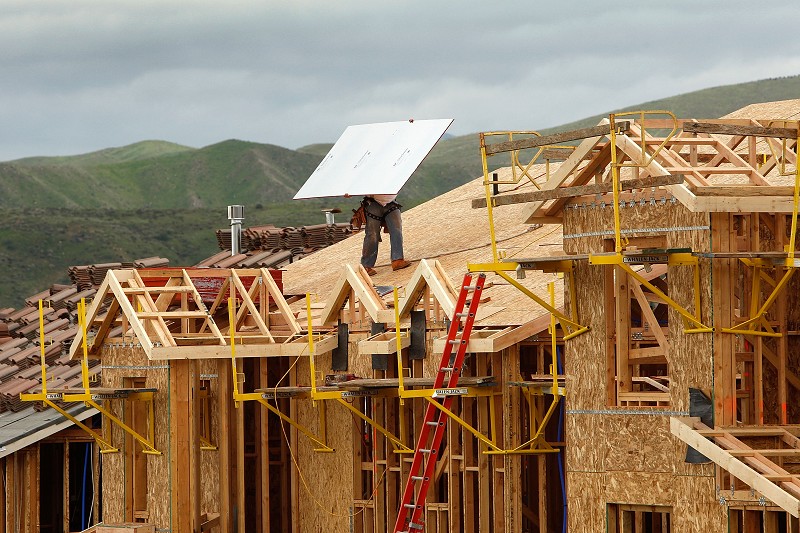
The latest data shows that new home prices in the United States have now dropped to the lowest level since July 2021. The persistently sluggish demand continues to force builders to offer significant discounts in order to attract hesitant buyers to close deals.
According to data released by the U.S. Census Bureau and the U.S. Department of Housing and Urban Development on Tuesday, new home sales in July have significantly cooled off. After seasonal adjustment, the annualized sales volume dropped to 607,000 units in July, a decrease of 10.5% from June’s 678,000 units and a 6.3% decrease compared to the same period last year.
Additionally, the median price of new homes has dropped to $393,800 in July, a 2.3% decrease from June and a 0.9% decrease from the same period last year, marking the lowest level since July 2021.
This new home price is even lower than the median price of existing homes in July, which stood at $434,100, presenting a rare pricing advantage for buyers.
However, the decrease in home prices has not led to an increase in demand, as high mortgage costs remain a major obstacle. According to Freddie Mac data, the average interest rate for a 30-year fixed-rate mortgage in the U.S. was 6.65% as of the week ending on August 20.
The National Association of Realtors (NAR) previously announced a 1.7% decline in existing home sales in July.
Market experts point out that high home prices, high interest rates, and consumer concerns about economic and income prospects are still limiting homebuying intentions.
There is significant regional variation in the real estate market. The South is the largest region in the U.S. new home market, with new home sales in July decreasing by 13% compared to June and a 5.2% year-on-year decrease. In contrast, the Midwest region saw a drastic month-on-month drop of 42.7% and a year-on-year drop of 50.6%.
On the other hand, new home sales in the Northeast increased by 30.3% month-on-month and a significant 95.5% year-on-year increase, reaching the highest level this year. The West also saw a month-on-month increase of 6.2% and a year-on-year increase of 2.2%.
Market analysis suggests that in some areas of the South, there has been a significant construction of housing in recent years. States like Florida and Texas attracted a large influx of population during the pandemic, stimulating builders to expand supply. However, with rising mortgage costs and cooling demand, some markets are beginning to experience inventory pressures.
As of the end of July, there were approximately 488,000 new homes for sale in the U.S., an increase of 1.9% from June. Calculated based on the current sales pace, this is equivalent to a 9.6-month supply, higher than June’s 8.5-month supply.
The increased supply gives buyers more options and forces builders to continue offering incentives such as mortgage rate subsidies, free upgrades, and price reductions. However, the latest data shows that these measures have not been sufficient to reverse the sluggish new home sales situation.
At the same time, single-family housing starts in July decreased by 9.9% from June and a significant 15.7% year-on-year decline, reflecting builders slowing down new home construction due to weak demand.
Joel Berner, Senior Economist at Realtor.com, pointed out that the current new home market is clearly favoring buyers, making it easier for homebuyers to get price concessions and other benefits.
For builders, tariffs, rising labor and construction costs, coupled with buyer hesitation, are further squeezing their profit margins.
Some analysts believe that U.S. home prices are unlikely to experience the significant increases seen during the pandemic in the short term.
Forecasts from Realtor.com suggest that the nationwide housing price increase may remain at a low level of 1% to 3%, while some markets in the southern regions with more housing supply still face price pressure decline.