
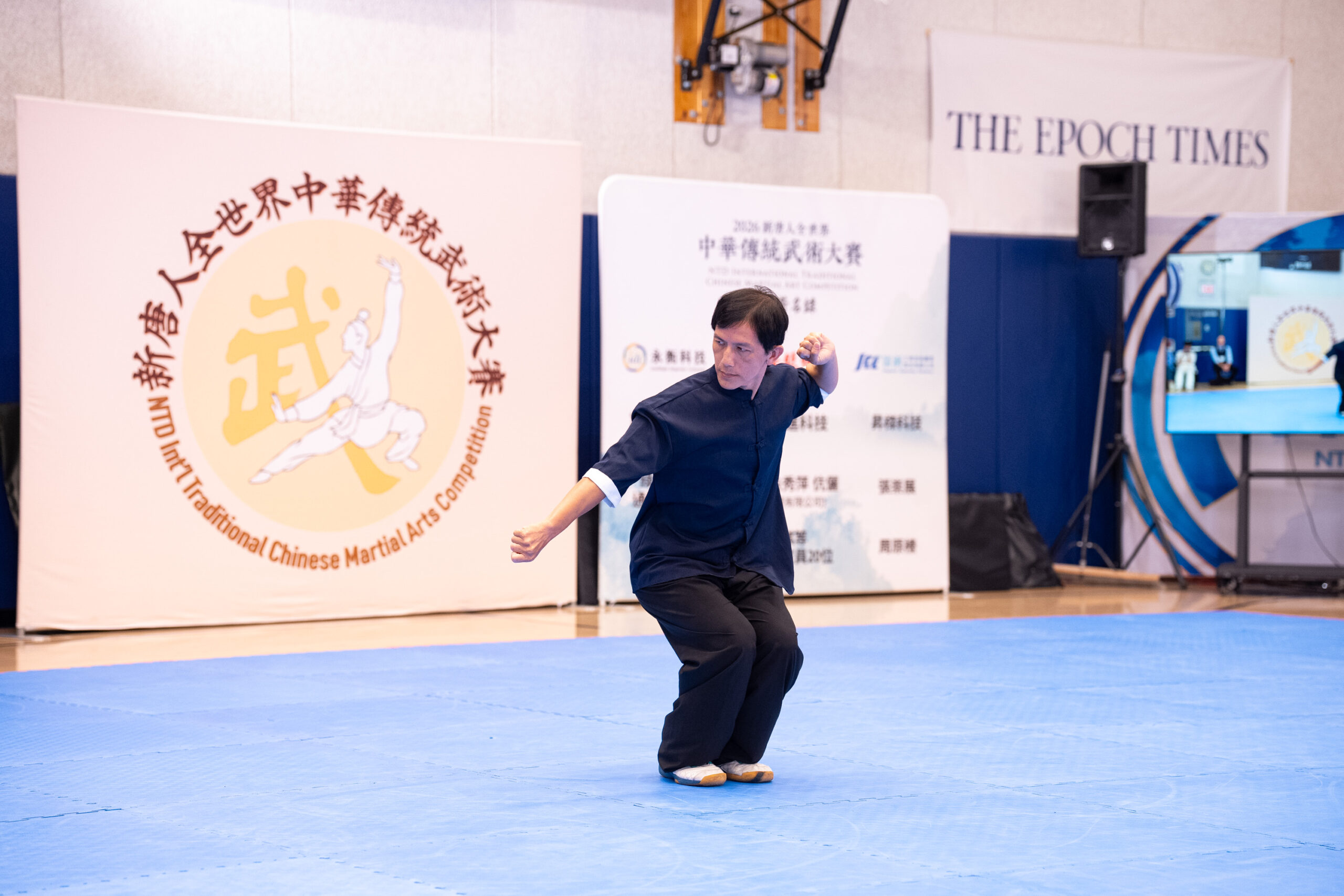
For the first time participating in the NTD World Chinese Traditional Martial Arts Competition, Xu Tangzhi, a high school physics teacher from Miaoli, Taiwan, brought his decades of martial arts experience to New York. To him, martial arts initially was just because the Baguazhang in a comic was “cool”, but along the way, martial arts has become a part of his life, gradually realizing that traditional martial arts embodies not only martial skills, but also mentality, ethics, and cultural heritage.
Xu Tangzhi became interested in Baguazhang due to a Japanese comic called “Ken” during high school. When he was studying at Changhua Normal University, where the school’s martial arts club had a connection with Taiwan’s martial arts community, he formally started learning Baguazhang, and has been practicing ever since.
“At first, I thought martial arts were cool to watch.” He said. However, what really kept him going for decades was not just the techniques themselves. “Our club is like a family.” He said, even though senior brothers graduated over a decade or two ago, they still come back to communicate, exchange ideas, and even teach juniors.
Training during university was very strict and tough, and precisely because of the shared experience of rigorous training, a deep bond formed among the senior brothers. For him, this relationship itself is also a part of traditional martial arts culture.
“When we had training camp in college, we would train for ten hours a day, with very little sleep.” He recalled, “In fact, that was not just sharpening our skills, but also our mentality.”
After years of martial arts practice, one of Xu Tangzhi’s biggest realizations is that “doing martial arts is actually comfortable”, because “movements are expanded, and your ability to control your body becomes higher, which makes your mood calmer.” He said, “I enjoy this feeling.”
He explained that during practice, you gradually learn to be aware of your own body, feel the tension and relaxation of muscles and fascia, and understand the transmission of body strength. For him, this is not just physical exercise but also internal adjustment.
This type of training makes it easier for him to maintain calm in the face of discomfort in life. “For example, you might get injured, get sick, or feel hot or cold, or encounter a noisy environment, and other uncomfortable situations where we can calm ourselves.”
“We will become more aware of our inner selves, so we can better overcome these environmental challenges.” He believes that this is the difference between traditional martial arts training and solely pursuing combat effectiveness.
Regarding the emphasis on “martial virtue” at the NTD traditional martial arts competition, Xu Tangzhi believes that martial virtue is not an additional requirement outside of competition, but an integral part of prolonged practice in traditional martial arts. “I think martial virtue comes from those knights-errant and their silent understandings and agreements among themselves.”
Firstly, one must “respect teachers and value morals”. In his view, traditional martial arts differ from military martial arts that aim for quick lethality. Traditional martial arts require long-term self-cultivation and in martial arts groups, respecting teachers, cherishing the master’s teachings, and the group’s spirit come first.
Secondly, it’s about “governing with noble virtues”. “One should not use their dominance to compel others.” He said. In ancient times, martial practitioners traveled the world, even with great martial skills, they should not resort to violence lightly; many conflicts could be resolved through reasoning, communication, and coordination.
Thirdly, is to be “humble and courteous”. “Knowing your own limitations allows you to learn and continuously improve yourself.” He said, if a person thinks they are already excellent, it is difficult for them to progress. “Being polite can reduce a lot of conflicts.” In his view, this is the practical embodiment of martial virtue in daily life.
After years of practicing martial arts, Xu Tangzhi has his observations on the differences between traditional martial arts and modern competitive martial arts.
He believes that for beginners, it may be hard to distinguish between the two. However, with increasing martial arts experience, one can see the differences from the source of power in movements, and the way the body is used.
“The momentum of traditional martial arts lies in its dynamism.” He said, traditional martial arts emphasize generating power from the feet, passing through the legs, waist, and then to the hands, making the body’s strength and movements a harmonious whole.
Using the training of Baguazhang as an example, traditional martial arts focus on stance training and stability during movement, not just simply fixing your feet on the ground, but controlling the tension and relaxation of different parts of the body while moving, transferring the momentum generated in the lower body to the upper body.
In comparison, modern martial arts emphasize fast-paced movements, technical difficulty, and visual effects at the performance. “They also fight impressively, but that is a different expression, not the way of traditional martial arts.”
In this year’s NTD Martial Arts Competition, Xu Tangzhi, participating for the first time in the US, not only made it to the finals but also won a bronze medal with a set of Baguazhang on August 15.
He admitted that initially he had mixed feelings, not knowing the strength of other competitors, and unsure if he would make it to the finals. However, once on the competition stage, he relaxed and began to enjoy the competition itself. For him, the competition was also an opportunity to understand different traditional martial arts styles and interact with fellow enthusiasts.
In the competition, he saw martial artists of different ages and countries. “It truly lives up to being a global competition.” He said, particularly witnessing the performances of many young athletes made him realize that traditional martial arts still hold strong vitality.
He believes that martial arts offer more than physical fitness, such as emotional stability, the ability to face setbacks, and awareness of the body and mind. Practicing martial arts requires constantly observing one’s body and facing emotions, instead of repressing them; this process helps individuals gradually understand and adjust themselves.
“Martial arts can provide a lot to individuals.” He said, therefore it should not be given up by children just for the sake of educational or practical considerations. “I think it is a pity to do so.”
He particularly observed that the martial arts culture in Taiwan is weakening compared to some other countries. “I am more concerned about Taiwan.” In his view, Taiwan places more emphasis on education, and many parents may not see martial arts as a promising path, but martial arts have long-term benefits for a person’s willpower, mentality, and health.
Participating in the competition in the US, he especially noticed traditional martial arts styles displayed by some competitors. “I think they embody a more traditional martial arts style, with the body’s tension being transmitted to the weapon effectively.”
The competition further emphasized to him that traditional martial arts need a platform to be recognized. “Traditional martial arts are not just for self-defense, but also for mental, physical exercise.” He said, such cultural heritage deserves to be preserved and promoted.
What worries him is that the number of people truly learning traditional martial arts is decreasing. “Many people even mistake modern martial arts for traditional martial arts.” He said, modern martial arts is also a form of exercise with its own characteristics, but if the two are conflated, true traditional martial arts may lose its space.
“If there were no NTD platform, I think traditional martial arts might gradually decline, which is truly worrisome.”
He used his alma mater, Changhua Normal University, as an example. In the past, the martial arts club had hundreds of members, but by his time, there were only about eight left. Currently, the entire club in the university has only two to three students. “It’s becoming increasingly difficult to recruit students.” He said.
Therefore, as he nears retirement, he is starting to rethink another mission of his lifelong martial arts practice – passing down what he learned from his predecessors.
“If those before me passed it on to me, I feel a bit remiss if I don’t pass it on.” He used to keep his martial arts practice very low-key and was hesitant to let his students know about it, only selecting a few students for one-on-one teaching. Now, he hopes to have more time post-retirement to teach martial arts and introduce more people to authentic traditional martial arts.
For him, perhaps this is also one of the most important meanings of coming to New York for the competition: to allow more people to see traditional martial arts and ensure that this tradition, which carries physical skills, mental training, and cultural spirit, continues to be learned, practiced, and passed down.