
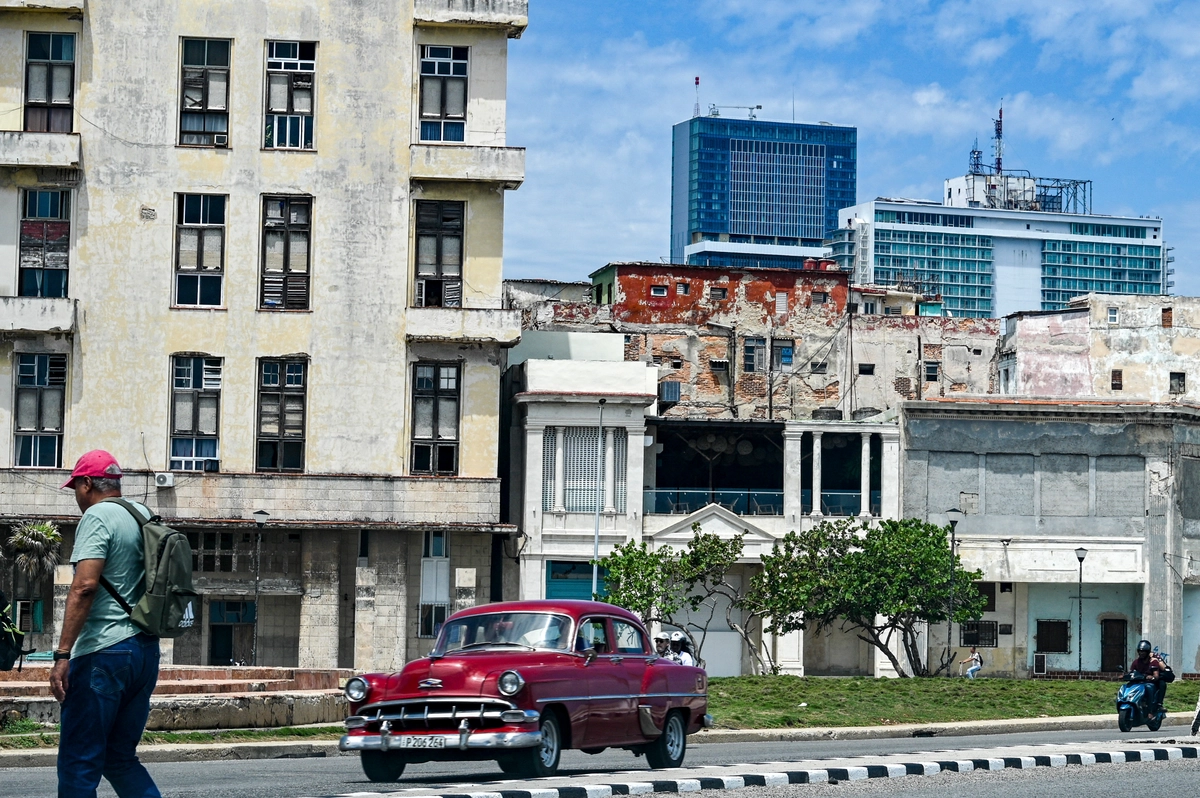
The United States government continues to exert pressure on Cuba. The US State Department announced on Thursday (July 23) that it has imposed new sanctions on 9 Cuban state-owned or government-supported entities and two officials. The targeted entities include Cuba’s energy industry, companies assisting in circumventing US sanctions, as well as institutions and officials allegedly involved in forced labor related to overseas medical missions.
Secretary of State Marco Rubio stated during the announcement of the sanctions that the Cuban communist regime poses a “profound and multi-dimensional threat” to US national security and stability in the Western Hemisphere. Prior to this, the US had already imposed multiple rounds of sanctions on Cuban President Miguel Díaz-Canel, the Cuban military, and the maritime trade sector.
The latest sanctions cover several state-owned enterprises in the Cuban energy industry, including the Cuban state oil company CUPET’s research center CEINPET, as well as Empresa De Energia S.A. and Einarbo S.A. responsible for natural gas product imports.
Additionally, the US has added Terminal de Contenedores de Mariel S.A. (TC Mariel), Coral Maritima S.A., Orbit S.A., and CEIBA Investments Limited to the list of sanctioned companies. The State Department accuses these four companies of aiding the Cuban military enterprise group Grupo de Administración Empresarial S.A. (GAESA) in managing and operating its assets to maintain its business networks.
GAESA, controlled by the Cuban military, is one of Cuba’s largest business conglomerates and has long been subject to US sanctions. In May of this year, the US further expanded sanctions on its affiliated companies based on a new executive order.
The State Department stated that TC Mariel was previously in charge of operating the Port of Mariel container terminal in Cuba and transferred the assets to Coral Maritima S.A. in June this year. CEIBA Investments Limited, headquartered in the UK Crown Dependency of Guernsey, mainly engages in real estate investments in Cuba. The US claims that its Panamanian subsidiary recently acquired equity in an investment project previously held by GAESA. As for Orbit S.A., the US alleges it is “highly likely” controlled by GAESA and primarily operates as a money transfer processing company.
The sanctions also target Cuban official overseas medical dispatch institutions, including Comercializadora de Servicios Médicos Cubanos S.A., the state-owned overseas medical dispatch institution in Cuba, and the Central Unit for Medical Collaboration (UCCM) responsible for recruiting Cuban medical personnel for international medical projects.
Jose Angel Portal Miranda, Minister of Public Health of Cuba, and Gretza Sánchez Padrón, director of UCCM, are among those sanctioned. For decades, Cuba has been sending medical personnel overseas as a crucial tool in its diplomatic policy, with some medical projects receiving international recognition. However, in recent years, this system has faced increasing scrutiny.
The US State Department accuses the Cuban government of coercing medical personnel to participate in international medical projects and withholding 50% to 95% of their salaries. The US believes that international medical projects have become one of the Cuban government’s most significant sources of foreign exchange income.
Shortly before the announcement of these sanctions, the US State Department issued a report titled “Cuba: The Capital of 21st Century Communism,” portraying Cuba as a crucial hub for the expansion of communism in the Western Hemisphere. The report accuses the Havana government of promoting a “subversion movement” aimed at weakening US interests through infiltration, espionage activities targeting the US government, and disruptive actions.
There are, however, opposing viewpoints within the US, with some Democratic lawmakers such as Representative Mark Pocan questioning the escalation of pressure on Cuba. Pocan argues that Cuba does not pose an urgent national security threat to the US and criticizes recent sanctions and restrictions on oil supplies for exacerbating power outages and humanitarian crises in Cuba, further impacting the local economy.