
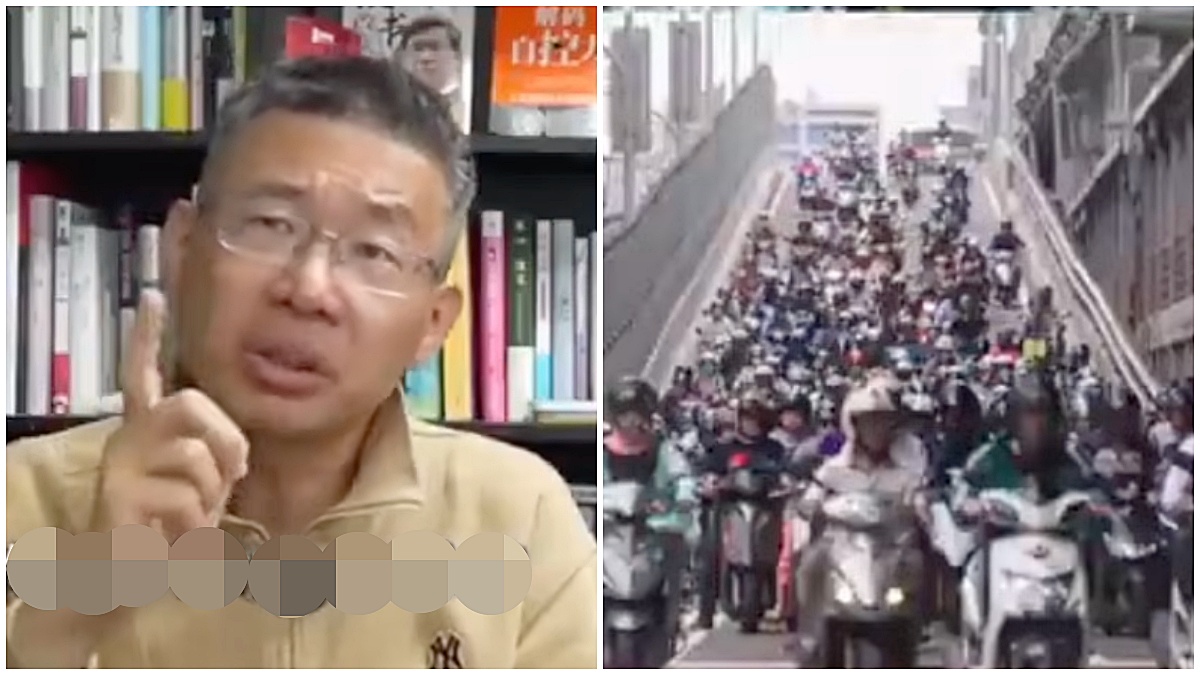
Upon arrival in Taiwan, one can discover a different side of China, according to former Tsinghua University professor Zheng Yuhuang. With a tradition of thousands of years, Chinese culture is deeply rooted, and Taiwan shares the same cultural heritage as the mainland, offering many aspects worth learning from.
Recently, a video review by Zheng Yuhuang on Taiwanese society has sparked intense discussions on overseas social media platforms. As a scholar who has led Tsinghua MBA students in exchanges to Taiwan, Zheng Yuhuang has conducted a profound analysis of the significant differences in social governance and cultural environment between the two sides.
First and foremost, the level of urban management and quality of the people are high in Taiwan. While the streets of Taipei are filled with motorcycles, they are orderly and quiet, with no chaos or reckless behavior. The traffic control system, where motorcycles have equal rights as cars, is admirable, contrasting sharply with the strict bans on electric bikes and motorcycles implemented in many cities in mainland China.
Secondly, Taiwan adopts an open and people-friendly approach to public services. Zheng Yuhuang observed that many government institutions in Taiwan have open doors to the public without stringent security checks, truly embodying trust and dignity towards ordinary citizens.
Thirdly, the inheritance of traditional culture and the value of respecting teachers and morals are highly preserved in Taiwan. Zheng Yuhuang lamented that the essence of “respecting teachers and morals” in Chinese traditional culture is well retained in Taiwan, where students voluntarily bow when encountering professors, showing a mutual respect and equality among individuals.
In contrast, mainland Chinese universities have witnessed incidents where students report teachers for their classroom remarks, gradually eroding the fundamental respect for teachers and morals. Additionally, Zheng Yuhuang candidly compared public welfare policies.
He pointed out that in terms of encouraging childbirth, Taiwan provides significantly higher direct subsidies compared to the mainland, truly implementing welfare benefits. In Taiwan, for the third child aged 0 to 18, there is a monthly subsidy of 5000 New Taiwan Dollars (approximately 1000 Chinese Yuan), while in mainland China, the subsidy for the third child is provided until the age of 3, with 300 Yuan per month.
The experience and sentiments of Zheng Yuhuang towards Taiwan are not isolated instances. Recently, a Chinese lawyer and blogger traveled to Taiwan and was deeply impressed by what he saw and heard there.
The blogger shared a video on an overseas platform, where he recounted his observations at a Taipei MRT station. He noticed that passengers on escalators stood orderly on the right, leaving the left path clear for those in a hurry. Contrary to his initial belief of this behavior being a local phenomenon, this orderly conduct was consistent across multiple MRT stations as he traversed various lines in Taipei.
The blogger was particularly struck by the surroundings near Taipei 101 Tower in the Xinyi District, the most expensive and bustling area of Taiwan, where there was a clear stream flowing adjacent to the tower. The water was so clear that he could see fish swimming at the bottom, demonstrating a pristine environment devoid of any litter.
During lunch at a bento shop, the blogger was once again amazed by the behavior of the office workers and students, who not only cleaned up after themselves but also wiped down their tables for the next diners, showing a high level of civic responsibility and respect for others.
The blogger expressed his profound reflection upon returning from the trip, realizing that true disparity does not lie in the height of buildings or the width of roads but rather in the inherent level of civilization, adherence to rules, consideration and respect for strangers, and the attitude of peacefully coexisting with the environment.
He emphasized that these values cannot be bought with money and take generations of family education and nurturing from the society to cultivate. This experience left him deeply impressed and in awe.
Zheng Yuhuang also mentioned that Taiwan showcases a fusion of traditional Chinese culture with modern civilized society, presenting a possibility worth exploring and contemplating for every compatriot.