
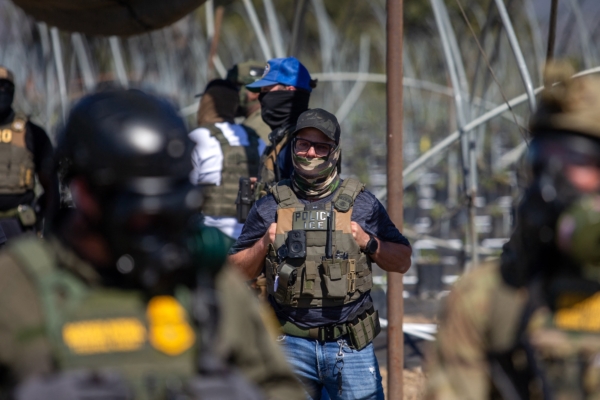
The United States Federal Appeals Court ruled on Wednesday, October 14, that a California law requiring federal law enforcement officers to disclose their identities is unconstitutional. The court issued a preliminary injunction against the law.
In a 21-page decision, a panel of judges from the Ninth Circuit Court of Appeals stated that California’s “No Vigilantes Act,” which mandates federal law enforcement officers on duty in California to show identification, improperly restricts the actions of federal law enforcement officers.
The judges wrote, “Since Congress did not authorize the enactment of such laws, the law is subject to the ‘intergovernmental immunity principle.'” According to legal precedents, the “intergovernmental immunity principle” prohibits state laws from regulating or discriminating against the federal government.
As of the time of publication, the California Attorney General and the U.S. Department of Justice had not responded to requests for comments from the media.
The Ninth Circuit Court of Appeals was considering a request for a preliminary injunction against California’s “No Vigilantes Act.” The law was originally scheduled to take effect in January, but California officials agreed to halt its enforcement during the court’s review of related legal challenges.
The issuance of a preliminary injunction must meet several conditions, including the likelihood of success for the party applying for it in the case.
The panel of judges from the Ninth Circuit Court of Appeals stated that California’s law violated the supremacy clause of the U.S. Constitution and indicated that the federal government would “undoubtedly prevail” in this legal action.
The panel, consisting of Judges Mark Bennett, Daniel Collins, and Jacqueline Nguyen, unanimously instructed the federal district judge handling the case to issue a preliminary injunction against the provisions of the law concerning federal law enforcement officers.
In February of this year, Judge Christina Snyder of the Central District of California Federal District Court halted another law that prohibited law enforcement officers from wearing masks, the “No Secret Police Act,” but rejected the federal government’s request for a preliminary injunction against the “No Vigilantes Act.”
Snyder believed that the “No Secret Police Act” applied different standards to federal and state law enforcement officers, while the “No Vigilantes Act” did not violate the supremacy clause of the Constitution. Additionally, since the law applied the same provisions to federal and state law enforcement officers, it did not constitute discrimination against the federal government.
In the spring, before the appellate decision was made, Bennett, Collins, and Nguyen approved the issuance of the injunction, determining that the federal government was likely to prevail in the litigation.
In the latest ruling, the three judges stated that the district judge’s determination that the law was not unconstitutional was incorrect.
The panel pointed out, “Even if the state government regulates its own operations in the same way, the supremacy clause prohibits the state government from directly regulating the operations of the federal government.”
The judges further stated, “In summary, if a state law directly regulates the conduct of the U.S. federal government without authorization from Congress, it is invalid, regardless of how essential the controlled activities are to the functions or operations of the federal government or the extent to which state law interferes with these functions or operations. “