
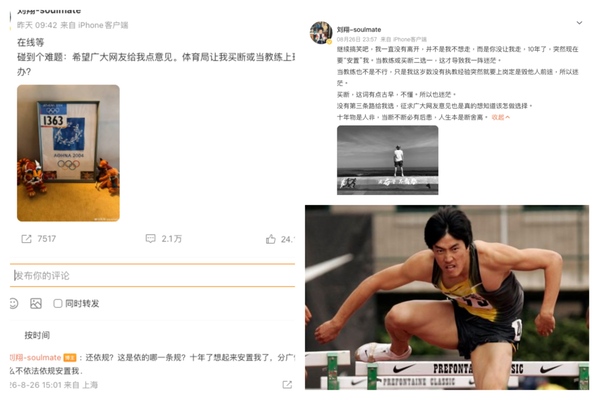
On the afternoon of August 26, Olympic champion Liu Xiang suddenly sought help online, stating that the Shanghai Sports Bureau gave him an ultimatum: either buy out his contract or work as a coach. In response, the Shanghai Sports Bureau stated that this decision was made to ensure his proper placement. Liu Xiang retorted, “After ten years, you remember to place me, but when it came to sharing the advertising revenue, why didn’t you place me according to the law and regulations?” This sparked widespread public attention towards the issue of “sharing advertising revenue”.
In the afternoon of August 26, 43-year-old Liu Xiang posted a plea for help on his personal Weibo account, “Encountered a difficult situation: hoping netizens can give me some advice. The Sports Bureau is giving me the option to either buy out or work as a coach, what should I do?” The post was accompanied by a picture of his race bib numbered 1363 from when he won gold at the 2004 Athens Olympics.
Subsequently, the Shanghai Sports Bureau responded that based on the relevant regulations regarding the retirement placement of athletes issued by the National Sports Administration and the Shanghai Municipality, they had communicated with Liu Xiang on the afternoon of the 26th, planning to properly place him mainly through organized placements or self-employment in accordance with the regulations.
Later that evening, Liu Xiang criticized the Shanghai Sports Bureau in the comments section of his plea post, “According to regulations? Which regulation is that? After ten years, now suddenly remember to place me, while when it came to sharing advertising revenue, why didn’t you place me according to the law and regulations?”
Late at night, Liu Xiang once again posted on his personal Weibo account, blaming the Shanghai Sports Bureau, “Continue the farce, I have never left, it’s not that I don’t want to leave, but you didn’t let me leave. After ten years, suddenly now you want to ‘place’ me. To work as a coach or buy out, this has left me in confusion.
“To work as a coach is not impossible, but at my age, with no coaching experience suddenly being put in that position, it’s definitely detrimental to someone else’s future, thus the confusion.
“Buy out, this term seems outdated, I don’t understand it. So I’m also confused.
“No third option for me to choose, seeking opinions from netizens as I genuinely want to know how to make a choice.
“Ten years, things have changed, indecision will surely lead to trouble, life itself is about detachment.”
In response to this, the network self-media account “Hong Kong Lao Lei,” which focuses on finance, cryptocurrency, and social hot topics, analyzed on the X social platform stating that what Liu Xiang wants is the system’s identity, social security, medical insurance, special benefits, positioning, while the Shanghai Sports Bureau is primarily focused on completing the top leadership’s directive to clean up free riders, of course, there are reasons for Liu Xiang’s declining value. “Liu Xiang’s main concerns are: belonging identity, historical positioning. The main concern for the Shanghai Sports Bureau is: political completion.”
Aged 43, Liu Xiang made history at the 2004 Athens Olympics in the men’s 110m hurdles final, breaking the Olympic record with a time of 12.91 seconds, winning the gold and becoming the first male Olympic champion in Chinese track and field. In the 2008 Beijing Olympics, Liu Xiang withdrew from the men’s 110m hurdles due to a recurring injury to his right Achilles tendon before the heats. At the 2012 London Olympics, he tripped over the first hurdle in the heats and ended up hopping on one leg to the finish line.
In 2015, Liu Xiang retired and has been in a special placement status of “named but not in office” for a long time, holding the position of Deputy Secretary of the Youth League Committee of the Shanghai Sports Bureau, not a civil servant.
The dispute between Liu Xiang and the Shanghai Sports Bureau has sparked widespread public attention regarding the sharing of advertising fees between the two parties.
Li Xuan, the director of the domestic section of the Chinese Football News, analyzed in a blog post in 2022 that athlete placement rules were already in place back in 2002, and with Liu Xiang retiring for over 11 years without being placed, it seems a bit strange, doesn’t it?
“I see in Liu Xiang’s comments under his own Weibo post, he also expressed doubt about receiving such a placement notice after 10 years of retirement, with a key mention of ‘sharing advertising fees’. So the question arises, has the Shanghai Sports Bureau been delaying Liu Xiang’s retirement athlete placement because it can participate in sharing Liu Xiang’s advertising fees? If this is true, then the situation becomes complicated.
“This raises another question, is it because a portion of his advertising fee quota has been shared with the Shanghai Sports Bureau, that Liu Xiang believes it’s only natural for him to have a position and not have to work?”
The self-media account “Tijie Fengyun” wrote in a blog post stating that after 11 years of retirement, the Sports Bureau suddenly remembered to “place” Liu Xiang? Either buy out or work as a coach. A good example of “according to regulations,” but when it came to sharing advertising revenue, why didn’t they follow the law and regulations?
“Tijie Fengyun” expressed, “During his peak, Liu Xiang’s commercial endorsements, he took 50% personally, the sending unit took 20%, this money clearly went into the system’s pocket. 11 years of being in a hanging position, not working, without real power, the social security paid by the Sports Bureau, in exchange for the ‘residual value’ of Liu Xiang’s name hanging on the wall.
“Now, with tightened regulations, they remember to place him? Remember to follow the rules? Rules are like bricks, bring them out when needed, hide them when not.
“… This isn’t just Liu Xiang’s dilemma. This is a microcosm of China’s sports culture of ‘use and discard’ – sharing the glory and tangible benefits during your peak, but when retired, it’s all about shifting the blame. When you enjoyed the glory and actual money he brought in, why didn’t you ask if he wanted to be a coach?
“Liu Xiang doesn’t need this salary, he’s long been financially independent. But what he wants is fairness. 11 years of being in a hanging position is not a gift, it’s a deal. The transaction is completed, now saying ‘either buy out or work’? Fine, then buy out. But before buying out, let’s settle the accounts – over these 11 years, who took advantage of whom?”
According to a report by China Central Television News in July 2007, Wang Dawei, then deputy director of the Athletics Management Center of the National Sports Administration, introduced the principle of Liu Xiang’s advertising income distribution: “We now refer to the distribution policy of the National Sports Administration, athletes get 50%, coaches get 15%, local sports bureaus that train athletes get 20%, the Chinese Athletic Association keeps 15%.”
According to public reports, Liu Xiang’s commercial value peaked around 2007.
In 2007, based on Forbes China Celebrity List statistics, Liu Xiang’s commercial income was around 163 million yuan. Following the relevant policy on advertising revenue distribution by the National Sports Administration at the time, calculated at 160 million yuan, Liu Xiang could personally receive around 80 million yuan before tax, and the Shanghai Sports Bureau could get around 32 million yuan.
One of Liu Xiang’s major sources of commercial income after retirement was a lifelong ambassador contract signed with Nike. According to media reports, this contract guaranteed around 2 million USD per year, approximately 14 million yuan, with additional sales commissions.