
Lynn Dong, who was laid off by a Fortune Global 500 company’s Shanghai branch in February this year, has been searching for a job ever since.
She has interviewed with 11 companies for a total of 22 times, but has not received any job offers.
Many multinational companies in Shanghai are cutting costs. Dong has applied for three positions at three foreign companies, all of which had reached the final stages, even completing salary negotiations. However, these positions suddenly vanished as these companies either underwent restructuring or paused their hiring.
“The job market this year is really bizarre,” revealed the 38-year-old marketing professional to Epoch Times. She used a pseudonym to avoid retaliation from the Chinese authorities.
However, she cannot “lie flat,” as she has two children: one in elementary school and one in kindergarten. “Lying flat” is a Chinese slang term referring to a societal trend where people refuse to strive to improve their own circumstances.
Dong’s experience reflects the broader pressure that the slowdown of the Chinese economy is putting on businesses. Analysts point out that while investing in advanced technology may alleviate Beijing’s economic woes, the current focus on expenditure exacerbates the imbalance in the Chinese economy.
China’s economy grew by 4.3% in the second quarter, the lowest level in three years. Although Beijing does not officially release monthly domestic GDP growth rates, it is evident that China’s overall economic situation is weak.
Economic data for the first seven months of this year indicate that China is facing pressure from tightening monetary conditions.
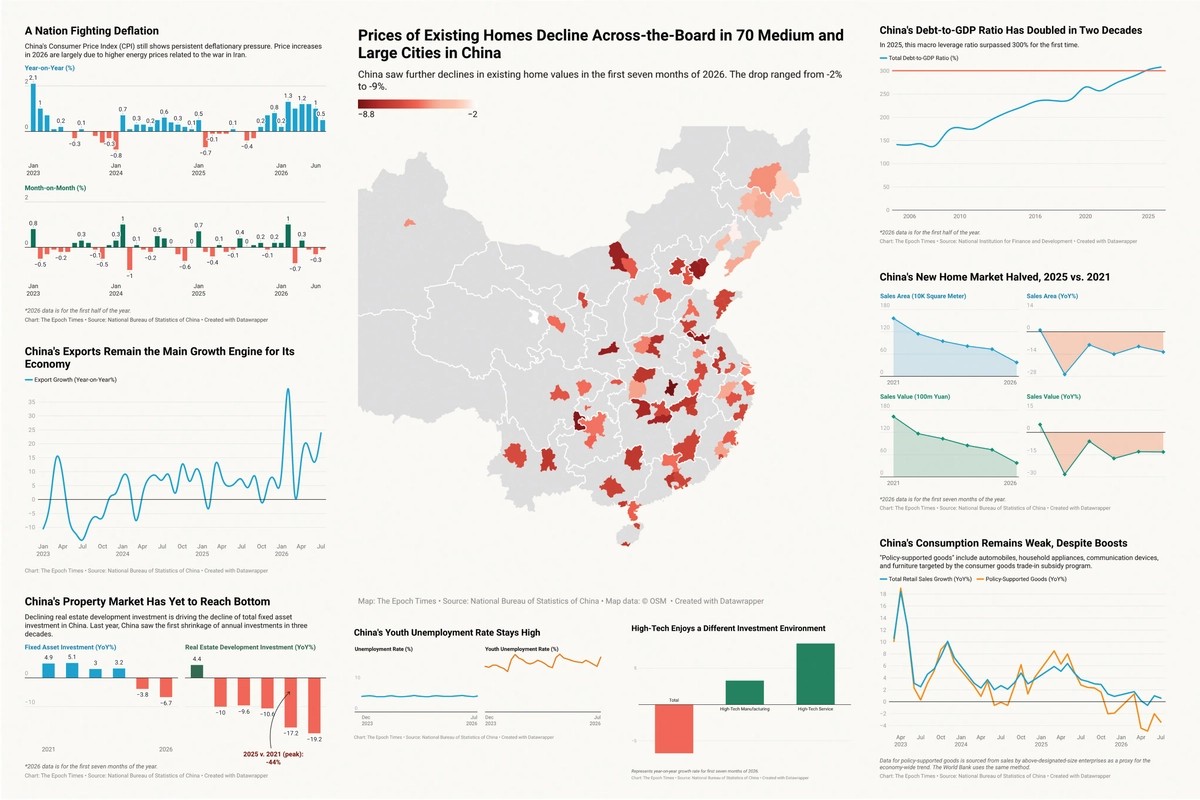
From January to July, the Consumer Price Index (CPI) in China saw a slight increase compared to the same period last year, averaging a 0.9% rise. However, the World Bank based in Washington D.C. highlighted that this increase is not due to strong domestic demand but rather a result of the rise in energy prices caused by the conflict in Iran.
Despite government initiatives such as the “replace old with new” program to stimulate upgrades in cars and high-end household goods, consumer spending remains weak.
An important aspect of China’s economic situation is the plummeting real estate market, which has yet to hit rock bottom.
Since reaching its peak in 2021, China’s real estate investment has dropped by 44%, with new home sales areas and sales values halving.
Seventy large and medium-sized cities monitored in Beijing have seen a comprehensive downturn in the secondary housing market, with declines ranging from 2% to 9%.
As of June 2026, China’s real estate market has not stabilized.
In 2025, the size of China’s new home market has halved compared to the peak in 2021.
From January to July 2026, house prices in existing homes have dropped across 70 large and medium-sized cities in China.
As of June 2026, consumer spending remains weak in China.
As of June 2026, the youth unemployment rate in China remains high.
As of June 2026, exports continue to be a major driver of economic growth in China.
Despite an overall decline in investment in China, there has been an increase in investments in advanced technology sectors. However, these investments have yet to translate into more job opportunities or consumer spending.
At the same time, Chinese leader Xi Jinping has been sending clear signals regarding where he wants capital to flow.
On July 17, at the World Artificial Intelligence Conference held in Shanghai, Xi Jinping heavily promoted China’s low-cost artificial intelligence and expressed China’s commitment to providing AI services to other regions around the world.
“Xi Jinping has invested all of China’s resources in artificial intelligence. He is using all of China’s resources as a wager. If he succeeds, China can rival the U.S., and Beijing can sit on the same level as Washington,” said Mike Sun, a long-time U.S. investment consultant in China, to Epoch Times.
“If he fails, China’s economy will plunge into a more severe decline over the next few decades.”
From January to May 2026, total investment in China decreased, but investment in high-tech industries increased.
Meanwhile, China’s lending space is further narrowing. Data from the National Institution for Finance and Development, an official think tank in Beijing, shows that China’s debt-to-GDP ratio surpassed 300% for the first time last year.
China has long relied on expanding investment to drive economic development, such as the housing reforms in the 1990s and infrastructure investments following the 2008 global financial crisis. However, the cost has been a heavy debt burden.
“This traditional approach is no longer viable,” independent commentator Cai Shengkun told Epoch Times.
He added, “Even the investment engine is cooling down,” pointing out that fixed-asset investment in China decreased by 6.7% year-on-year in the first seven months of this year. Last year marked the first annual decline in investment in nearly 30 years.
As of June 2026, China’s debt-to-GDP ratio has doubled over the past twenty years.
To boost market liquidity, the People’s Bank of China plans to inject 14 trillion yuan (over 2 trillion U.S. dollars) into the domestic economy by January 15, 2027. Both Mike Sun and Cai Shengkun believe that if this 14 trillion yuan cannot stimulate economic growth to the target range of 4.5% to 5%, the central bank may provide more funds to support economic growth.
Although Beijing is adept at increasing supply, this might not necessarily stimulate demand. China’s consumer price index fell by 0.1% month-on-month in July.
In a report in July, the World Bank pointed out that Beijing’s current fiscal expenditures have exacerbated existing supply-demand imbalances. The authors of the report added that continued investment in priority areas is aimed at short-term growth but sacrifices the opportunity to narrow the gap in supply-demand imbalances.
Therefore, the World Bank predicts that China’s economy will grow by 4.4% this year, slightly lower than the growth target set by the Chinese government.
Epoch Times reporter Gu Xiaohua also contributed to this report.
Original article: “9 Charts Show How China’s Economy Is Weakening” published in English Epoch Times.