
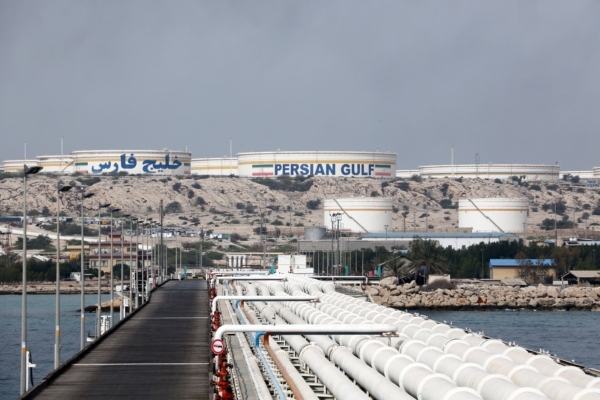
Recently, the United States government announced an expansion of secondary sanctions against Iran, warning that countries, banks, and businesses continuing to engage in related commercial activities with Iran could become targets of sanctions. China is one of Iran’s major buyers of oil. U.S. Treasury Secretary Beznit stated that no country can remain unaffected by U.S. sanctions. Internally, the Chinese Communist Party is evaluating the potential impact of the new round of sanctions on China’s financial, energy, and foreign trade systems.
The U.S. Treasury Department announced on August 24 the initiation of the “economic exiles action,” extending the economic strikes against Iran by broadening the secondary sanction risks to include digital assets, gold, technology, aviation, and shipping sectors. The Treasury Department of the United States stated that countries will be given a certain period to handle Iran-related commercial activities identified by the U.S., and failure to take action may result in sanctions.
According to Reuters, China has been one of the largest buyers of Iranian oil for years. The United States had previously sanctioned some independent oil refineries in China and ships transporting Iranian oil, but so far has not imposed sanctions on large Chinese banks involved in related transactions. Beznit mentioned that banks involved in converting Iranian oil into funds could potentially become targets of sanctions.
Mr. Ma, an individual connected to the Chinese Ministry of Commerce, informed Epoch Times that compared to previous U.S. sanctions targeting enterprises and vessels, the current concern within China is the potential expansion of sanctions into the financial settlement sector. He stated, “The concern here in the CCP is that the U.S. is expanding sanctions into financial settlement, which would affect financial system operations. There are hundreds of Chinese-funded bank branches overseas, and if these banks are included in the secondary sanctions scope, they will not be able to conduct business. The CCP is now evaluating which sectors such sanctions would impact.”
Mr. Ma also disclosed that a few months ago, the Chinese Ministry of Commerce and Foreign Trade had begun assessing how long the U.S.-China trade war might last and to what extent U.S. sanctions might eventually advance. He remarked, “The Ministry of Commerce is busier than the Ministry of Foreign Affairs lately, needing to provide data for upper-level officials to review. Now everything is decided by senior management, and they are concerned about how far the U.S. will impose sanctions. If it only targets shipping companies or intermediaries, adjustments can be made. However, if it affects banks, the issue becomes serious and involves domestic import and export enterprises. We cannot afford to lose U.S. dollar settlement and access to the U.S. market for the Iranian market.”
In April of this year, the U.S. Treasury Department warned financial institutions about the sanctions risks related to engaging in independent “land refining” transactions with China. The U.S. Treasury estimated that China purchases about 90% of Iran’s exported oil, with the majority going to independent oil refining companies.
Liu Tuo (pseudonym), a Beijing insider engaged in foreign trade business, expressed that Chinese companies are worried about the subsequent sanctions list published by the U.S. Treasury Department and the risk control measures taken by banks. Senior CCP officials are more concerned about U.S. sanctions directly impacting the financial system. He commented, “Interference is certain. If subjected to destructive blows, the consequences for those engaged in foreign trade in China would be disastrous. If not state-owned enterprises, banks will halt your transactions if they believe your trade risks may trigger U.S. sanctions. They will either stop your transactions or face sanctions themselves. Many companies now dare not directly do business with Iranian companies, but banks suspect if you may be doing business with Iran, they fear sanctions. Recently, banks have been cautioning enterprises not to ’cause trouble.’ The U.S. is pointing guns at us, so be careful, pause first and then consider.”
Public data indicates that the U.S. has already consecutively sanctioned Chinese enterprises involved in Iranian oil trade, independent oil refineries in Shandong, and related transportation networks for several months. Beznit further stated that any entity aiding Iran in evading sanctions or assisting in turning oil revenues into cash could face the risk of being cut off from the U.S. financial system.
Currently, the CCP has not publicly released specific countermeasures. Mainland economic scholar Zhao Qing (pseudonym) noted that the CCP must maintain its energy and strategic ties with Iran while ensuring that major financial institutions do not bear the risk of being excluded from the U.S. financial system.
Zhao Qing stated that the CCP’s financial system now relies on administrative orders, with banks carrying significant non-performing assets of tens of billions of Chinese Yuan. If the U.S. delivers a fatal blow by targeting banks in secondary sanctions, the consequences will be severe. He remarked, “I believe the CCP has realized this, and the U.S. knows that the real strength lies in allowing third-country enterprises to choose themselves, whether they want the Iranian market or the U.S. market. The Ministry of Commerce within the CCP is evaluating internally the impact of secondary financial sanctions on the Chinese side, not preparing to fight against the U.S. I think the CCP is calculating whether their pockets can withstand the blow.”
The U.S. has yet to take immediate action against major Chinese banks. Beznit stated that the U.S. would give relevant parties a certain period for rectification and emphasized the desire not to disrupt the global financial system. However, he also warned that the U.S. would soon advance relevant measures.