
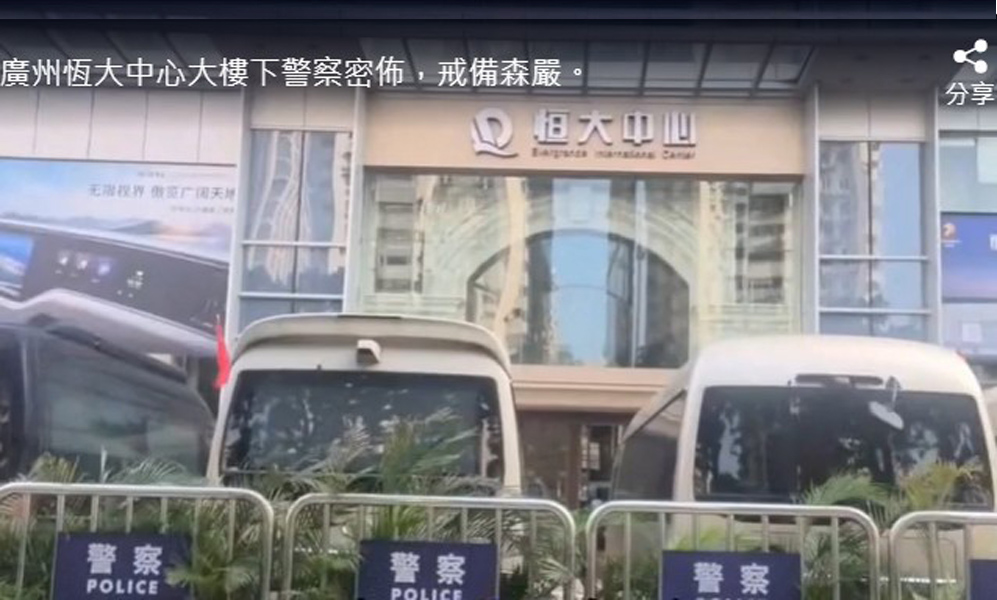
On August 20, the Intermediate People’s Court of Shenzhen, Guangdong Province, China, announced the verdict of the first trial for Xu Jiaying, the founder of Evergrande Group. Xu was sentenced to life imprisonment for crimes including fraudulent fundraising, embezzlement of duties, and bribery by organizations. His personal assets were confiscated, and illegal gains were recovered. Analysts pointed out that the rise and fall of Xu Jiaying is not simply a case of individual criminal activities but a product of the operation of China’s land policies and authoritarian system.
The court’s announcement stated that Evergrande Group and Xu Jiaying were found guilty of illegal deposit-taking, fundraising fraud, and corporate bribery. Xu Jiaying was sentenced to life imprisonment and lifetime deprivation of political rights. Evergrande Group and Evergrande Real Estate were fined a total of 15.82 billion Chinese yuan. In the same case, Xu Jiaying’s two sons, Xu Tenghe and Xu Zhijian, along with 56 others, were also sentenced.
Political commentator Chen Pokong, in an interview with a media outlet, analyzed that top billionaires like Xu Jiaying are essentially “tools for the Party, exchanging human capital for wealth,” and once the system changes, they become sacrifices to maintain political stability.
Looking back at the rise and fall of Evergrande, its fate has always been deeply tied to the logic of the Chinese Communist Party’s system. The “three highs” model of high leverage, high debt, and high turnover at Evergrande is essentially a product of the collusive growth between officials and businesses under China’s land finance system and state-owned bank lending system.
However, when the system faced systemic financial risks, authorities suddenly introduced new regulations in 2020 to control developers’ debt with the “three red lines,” leading to a hard landing for credit. In mid-2021, Evergrande’s funding chain collapsed, with massive defaults on commercial papers, and by the end of the year, it failed to pay $260 million in overseas debt interest, leading to an official default.
Subsequently, Evergrande filed for bankruptcy protection in the U.S. in 2023, was liquidated by a Hong Kong court in early 2024, and officially delisted in August 2025, with debts exceeding $300 billion (approximately 2.44 trillion yuan), making it the heaviest indebted property developer globally.
A commentary channel host remarked that Xu Jiaying became the scapegoat for the entire real estate policy of the CCP, noting that he was convicted for “high leverage and fundraising” when these activities were once considered encouragements during the rapid development phase of the real estate sector.
Analyzing the structural background of Evergrande’s rise from an institutional perspective, the host stated, “Real estate is the closest and most collusive sector with the CCP’s power among private industries in China, and Xu Jiaying is the most typical representative.”
The host explained that Xu Jiaying did not create real estate policies himself but merely “maximized the use of these policies.” From local government land sales and state-owned bank loans to the presale system of “payment before construction,” every aspect of Evergrande’s business model was controlled by the government, making Xu Jiaying a “white glove” of CCP policies.
The host believed that Evergrande’s infinite expansion model was essentially a “Ponzi scheme,” depending on constantly finding new buyers to sustain its operations. However, as the rigid housing demand eventually disappears, a collapse becomes the inevitable result of the institutional nature.
The host cited the legislative trajectory to illustrate the background of Evergrande’s rise: constitutional amendments in 1988 allowed land use rights to be transferred legally, interim regulations issued in 1990 made compensated land transfers legal nationwide, and after the tax system reform in 1994, local governments became highly reliant on land transfer fees.
Special mention was made of a sentence “urban land belongs to the state” quietly inserted in the 1982 new CCP Constitution, seen as the true institutional root that has led the Chinese real estate industry from super prosperity to bubble burst, a scenario that would not happen in countries with protected private land rights.
Referring to his own book written 20 years ago, where he stated that China’s rich list is a prisoner list, and quoting a famous line from “Dream of the Red Chamber,” the host described Xu Jiaying as “a microcosm of a thousand and one stories in the communist Chinese era,” moving from wealth accumulation through government-business collusion to imprisonment and loss of wealth, mirroring the social norms of a totalitarian regime.
The host emphasized that the collusion between officials and businesses was indeed the “original sin” of these individuals, but this sin “originated from the system,” attributing their wealth creation to the requirements of the authoritarian system that forced them to adopt such methods for prosperity. He highlighted that this case once again exposed that China is a society governed by “man,” not “law,” from Deng Xiaoping’s era of overlooking violations to Xi Jinping’s era of tightening control measures.
He cautioned that today, no one – from elderly politicians and Political Bureau Standing Committee members to entrepreneurs and senior military officials – feels secure in the system they themselves established, as it ultimately devours them. Elaborating on the specifics of the case seems meaningless as “all entrepreneurs behave in the same way… it’s just a matter of whether you get caught or not.”
He stated that Xu Jiaying once swore allegiance to communism under the Party flag but now faces lifelong imprisonment, a common fate for many Chinese billionaires, CCP officials, and even high-ranking military officers who once made similar pledges, eventually serving out their lives under a system of “on-demand allocation.”
Regarding whether the fines imposed on Evergrande will compensate the victims of unfinished projects, the host was not optimistic, suggesting that the victims might not receive any compensation or only limited compensation, as the CCP authorities seize funds to enrich the state and party treasury without intending to help the people.
He pointed out that many victims have tried to sue Evergrande or Xu Jiaying, but their cases were not accepted by the authorities, leaving most citizens with losses amounting to a “vanished dream.”
He believed that objectively, the victims represent a source of social instability, and when faced with public resentment, the CCP’s primary focus is not to solve the problems but to eliminate those who bring them up.
Regarding the notion that the top billionaires “work for the Party, exchanging human capital for wealth,” Chen Pokong considered this to be an inevitable pattern. Besides Xu Jiaying, he mentioned the case of Mou Qizhong, the top billionaire in 1989, who supported stability above all else at the time but was later sentenced to life imprisonment after the Tiananmen Square crackdown. Although he has been released since, he is now considered “semi-disabled,” depicting these entrepreneurs as “business-savvy but politically naive.”
When asked if this case indicates the decline of Xi Jinping’s regime, Chen Pokong bluntly stated that communist China was already heading towards collapse, and Xi Jinping’s regime is also on a similar path to decline, ending with a poetic quote: “All deaths have a long-lasting echo.”
Analysts believe that while Xu Jiaying’s case marks the end of the Evergrande scandal, without changes in the land finance and authoritarian systems that led to Evergrande’s rise and fall, similar cases are likely to repeat themselves in the future.