
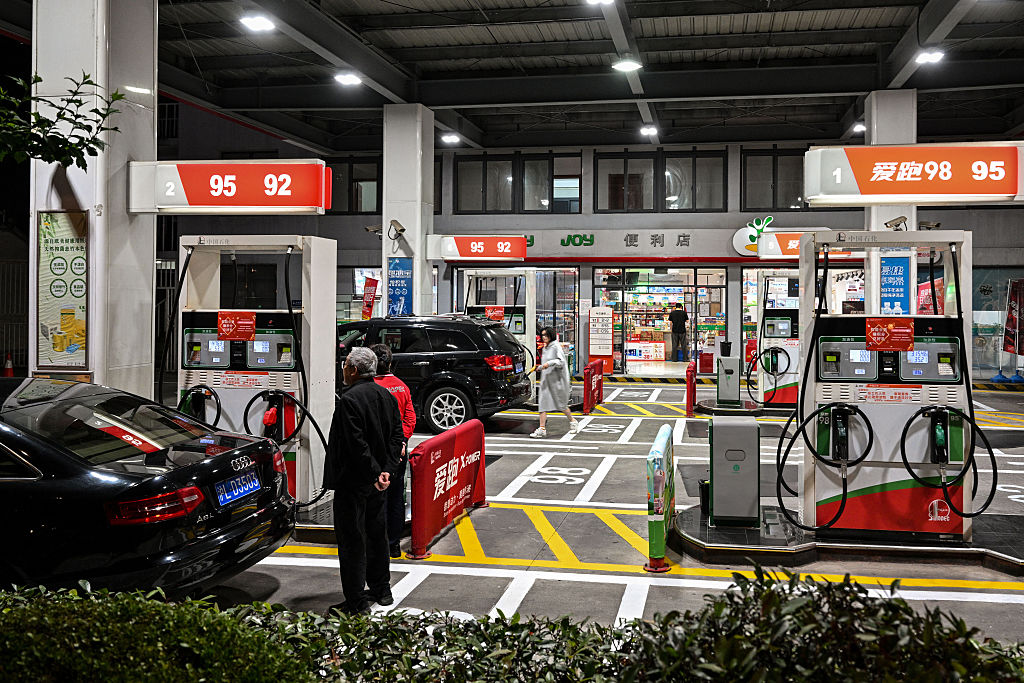
On July 31, at 24:00, the price of refined oil in mainland China saw its tenth increase of the year, with gasoline and diesel rising by 685 yuan and 655 yuan per ton, respectively. Based on the national average, filling a 50-liter tank with 92-octane gasoline will cost about 27 yuan more.
According to a report by “First Finance and Economics,” the National Development and Reform Commission of the Communist Party of China announced an increase in the retail price limit of refined oil in mainland China starting from 24:00 on July 31.
On average nationwide, 92-octane gasoline has increased by 0.54 yuan per liter, 95-octane gasoline by 0.57 yuan, and 0-grade diesel by 0.56 yuan.
Calculated based on a 50-liter tank, filling a regular private car with a tank of 92-octane gasoline will cost about 27 yuan more. For vehicles consuming 7 to 8 liters of fuel per 100 kilometers, the fuel cost for driving 100 kilometers will increase by about 4 yuan.
According to calculations by Longzhong Information, a major commodity and related industry data service provider in mainland China, the fuel cost for a large logistics truck carrying 50 tons will increase by approximately 22.4 yuan per 100 kilometers.
This marks the 15th round of oil price adjustments in mainland China this year and the tenth increase of the year. As of this round, the price adjustment pattern for the year is ten increases, four decreases, and one unchanged.
In response to this, some netizens expressed that the continuous rise in oil prices not only affects drivers but also has a clear chain reaction. The cost of logistics, express delivery, and fresh transport will increase, and ultimately, these costs will be passed on to ordinary consumers.
Another netizen pointed out that compared to regular car owners, the impact on freight drivers is even greater. The fuel tank capacity of heavy-duty trucks typically reaches three to four hundred liters, and after this price increase, filling up once may cost over 200 yuan more, further squeezing profit margins.
The price adjustment period for this round was from 24:00 on July 17 to 24:00 on July 31. “First Finance and Economics” reported that international oil prices fluctuated during this period, with the average cycle price still higher than the previous cycle.
Li Yan, an oil analyst at Longzhong Information, stated that escalating tensions between the United States and Iran and Houthi attacks on Saudi oil tankers have heightened market concerns about disruptions in crude oil supply, leading to the increase in international oil prices. Subsequently, as expectations for US-Iran negotiations improved, oil prices briefly retreated.
According to a report by “China New Economy,” Ping An Securities believes that geopolitical conflicts and the peak season for fuel consumption may support short-term international oil prices staying above $80 per barrel.
Liu Bingjuan, an oil analyst at Longzhong Information, mentioned that the risk of disruptions in crude oil supply continues to rise, prolonging market concerns. However, refineries in several Asian countries are operating at low levels, indicating a slow improvement in global crude oil demand.
The next round of oil price adjustments in mainland China will start at 24:00 on August 14. Li Yan predicts that with easing concerns over geopolitical risks in the market, there is a higher probability of a price decrease in the next round.