
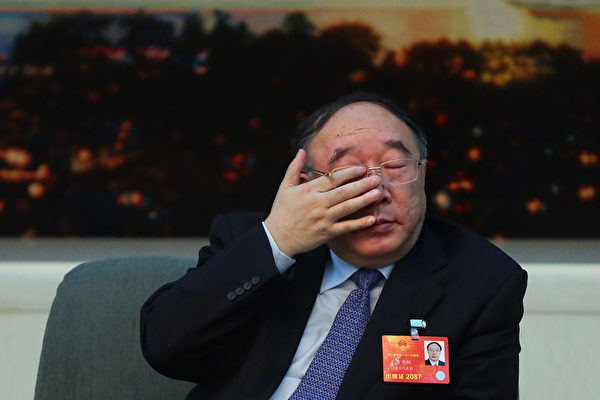
On the evening of October 13, 2026, at 6:00 pm Beijing time, the official website of the Central Commission for Discipline Inspection of the Chinese Communist Party announced that Huang Qifan, former Deputy Secretary of the Chongqing Municipal Committee and former Mayor of the city, is suspected of serious violations of discipline and law and is under investigation.
Huang Qifan, born in May 1952 in Zhuji, Shaoxing City, Zhejiang Province, was a prominent member of the Shanghai gang under Jiang Zemin. He worked in Shanghai from 1968 to 2001, holding positions such as Director of the Shanghai Economic Information Center, Deputy Director of the Pudong New Area Management Committee, and Deputy Secretary-General of the Shanghai Municipal Committee.
In October 2001, Huang Qifan was transferred to Deputy Mayor of Chongqing City, promoted to Executive Deputy Mayor in May 2002, and became the Mayor of Chongqing in January 2010, serving until he stepped down in December 2016. He worked under six Chongqing Municipal Party Secretaries, including He Guoqiang, Huang Zhendong, Wang Yang, Bo Xilai, Zhang Dejiang, and Sun Zhengcai, with Bo Xilai and Sun Zhengcai having been ousted. Huang Qifan was once known in the public as the “veteran of the six dynasties” and a “political survivor.”
As the sensitive period before the Fifth Plenary Session of the Chinese Communist Party approached, why was Huang Qifan, a 74-year-old retired official, investigated? The specific reasons have not been officially disclosed. Based on online revelations and trends in political cleaning, the possible behind-the-scenes of Huang Qifan’s downfall is analyzed.
Over three months ago, political commentator Jiang Wangzheng revealed on June 22, 2026, that former Deputy Secretary of the Chongqing Municipal Committee and Mayor Huang Qifan was questioned. On October 12, Jiang Wangzheng again disclosed that Huang Qifan was questioned for the second time and interrogated.
After Huang Qifan was officially announced to be under investigation, on October 13, Jiang Wangzheng revealed that Huang Qifan was taken away by the special task force of the Central Commission for Discipline Inspection on October 10. Huang Qifan’s mistress and other specific associated individuals were also detained by the Discipline Inspection Commission of Shapingba District in Chongqing. Huang Qifan’s son, Huang Ranfei, being treated for cancer in Hong Kong, was controlled by the Discipline Inspection Commission staff of the Liaison Office of the Central People’s Government in Hong Kong and the Macao Special Administrative Region. Huang Ranfei was under double protection from the Hong Kong Independent Commission Against Corruption (ICAC) due to his involvement in illegal operation of “rat trading.”
On October 12, Jiang Wangzheng released a revelation that Huang Qifan was believed to have been cleared in the Wei Xiaodong case, but this time it involved the daughter of Li Zhanshu.
According to the revelations, Huang Qifan’s son, Huang Ranfei, working in finance in Shenzhen, had direct contacts with Li Qianxin, the daughter of Li Zhanshu. The cooperation between Li Qianxin, her subordinates, Huang Ranfei, in the listing of enterprises on the Shenzhen Stock Exchange Growth Enterprise Market and Hong Kong IPOs involved frequent occurrences of “rat trading,” commission warehouses, kickbacks, and officials holding shares.
Li Zhanshu, considered a close aide of the Chinese Communist Party leader Xi Jinping, held positions such as a member of the Political Bureau of the Central Committee of the Chinese Communist Party after the 19th National Congress, and Chairman of the Standing Committee of the National People’s Congress after the 19th National Congress.
In recent years, the officialdoms under the purview of Li Zhanshu in Heilongjiang Province and Guizhou Province have been continuously cleansed, and many of his old associates have fallen from grace. Two months ago, on July 31, 2026, Guo Wenqing, former General Manager of China Minmetals Corporation, was suddenly put under investigation after two years of retirement. Guo Wenqing had intersections with Li Zhanshu in his earlier years and had served as his secretary.
On October 12, 2026, it was revealed that one of the white gloves of the former Chairman of the China Securities Regulatory Commission, Yi Huiman, had frequent contact with Huang Qifan and his son Huang Ranfei.
Huang Qifan had a good relationship with Fang Xinghai, the former Vice Chairman of the China Securities Regulatory Commission, and referred to Fang Xinghai as “uncle.” The Fang Xinghai case had entered the review stage, involving many contents related to Huang Ranfei and Li Qianxin. There was a mention of Huang Ranfei’s name in an intermediary agreement in Hong Kong, involving a state-owned enterprise in Chongqing holding shares in a listed company.
Fang Xinghai, former Deputy Chairman of the China Securities Regulatory Commission, was investigated on July 24, 2026. Yi Huiman, former Chairman of the China Securities Regulatory Commission, was taken down from her position as Deputy Director of the Economic Committee of the National Committee of the Chinese People’s Political Consultative Conference on September 6, 2025.
Fang Xinghai had served as Yi Huiman’s deputy for five years and both were natives of Wenzhou, with connections to Huang Qifan, also a native of Zhejiang.
Just before Huang Qifan was officially announced to be under investigation, on October 13, the Hong Kong newspaper Ming Pao reported that a development forum organized by the Hangzhou branch of the Ningbo Bank scheduled for October 26 in Hangzhou had abruptly canceled due to “unforeseen reasons,” which coincided with Huang Qifan being removed from office as Mayor of Chongqing. Huang Qifan had served as the Vice Chairman of the China International Economic Exchange Center, an official think tank, after stepping down from his mayoral duties in Chongqing. The center was established in 2008, the year after the global financial crisis, and was viewed as a “Super Think Tank of China.”
In May 2025, the second Chairman of the center, Bi Jingquan, was removed from office and sentenced to 14 years in prison in September 2026, with charges related to bribery during his tenure in the center.
In January 2026, the business management unit of the center had been transferred from the National Development and Reform Commission to the Chinese Academy of Social Sciences for restructuring. According to a report by Caijing in February 2026, there were controversies surrounding the center’s fundraising through undertaking local government projects and providing consulting services. Some retired high-ranking officials who had worked at the center had returned the funds they received irregularly, with some facing significant amounts.
On the eve of Huang Qifan’s announced removal, the Hong Kong newspaper Sing Tao Daily reported on October 13 that a chat message revealed that on October 12, a scholar stated that the “old mayor” (referring to Huang Qifan), who had retired from the National People’s Congress for more than 8 years, was supposed to give a lecture at Tsinghua University but was taken away two days earlier, prompting the scholar to step in. This “old mayor” had worked as a consultant at the Internet Industry Research Institute of Tsinghua University after retirement.
According to the official website of Tsinghua University, in January 2019, Huang Qifan began serving as the Chairman of the Industry Transformation Advisory Committee of the Internet Industry Research Institute at Tsinghua University; thereafter, he attended various expert seminars and academic conferences at Tsinghua University and the institute.
Tsinghua University’s Internet Industry Research Institute was established in December 2016, under the supervision of the School of Economics and Management at Tsinghua University. The Industrial Transformation Advisory Committee of the Internet Industry Research Institute is a consultative body dedicated to advising on China’s industrial development and transformation, founded on January 4, 2019.
It is noteworthy that both Chinese Communist Party leader Xi Jinping and former Premier Zhu Rongji are alumni of Tsinghua University. Zhu Rongji became the first Dean of the School of Economics and Management at Tsinghua University in 1984 and during his tenure as the Premier of the State Council, promoted the establishment of the Advisory Committee of the School of Economics and Management at Tsinghua University. Wang Qishan, a former member of the Politburo Standing Committee and an associate of Zhu Rongji, took over as the Honorary Chairman of the Advisory Committee in October 2024 after Zhu Rongji.
Huang Qifan and former Chairman of the China Securities Regulatory Commission, Fang Xinghai, had a good relationship and were close in private. Huang Qifan’s son referred to Fang Xinghai as “uncle.” The Fang Xinghai case has entered the review stage, involving many contents related to Huang Ranfei and Li Qianxin. In Hong Kong, there is an intermediary agreement with Huang Ranfei’s name on it, involving a listed company in which a state-owned enterprise in Chongqing holds shares.
Fang Xinghai, former Deputy Chairman of the China Securities Regulatory Commission, in July 24, 2026, was under investigation. One of the white gloves of Yi Huiman, former Chairman of the China Securities Regulatory Commission, had frequent contact with Huang Qifan and Huang Ranfei, father, and son.
After he was removed from office, Huang Qifan was appointed as a visiting professor at Fudan University in September 2018 and joined the School of Economics at Fudan University. Fudan University is the alma mater of Jiang Mianheng, the son of Jiang Zemin, and Wang Huning, a member of the Political Bureau Standing Committee. Huang Qifan’s removal took place amidst the turbulence in the political and business circles of Shanghai.
From early June to the present, Shanghai has experienced a series of personnel shake-ups in its senior positions; Deputy Mayor Chen Yujian was removed from office, Executive Deputy Mayor Wu Wei and Deputy Mayor Jie Dong were reassigned; Gong Zheng resigned, and Zhu Zhongming stepped in as the acting Mayor of Shanghai; Secretary-General of the Shanghai Municipal Committee Hua Yuan and Secretary of the Songjiang District Committee Wang Huajie were appointed as Deputy Mayors of Shanghai. During the same period, there were numerous adjustments to the officials in the Shanghai municipal and district-level bureaus. Furthermore, since June 2026, over 20 officials and executives of state-owned enterprises have been investigated in Shanghai, including Huang Chunyi, Deputy District Head of Jinshan District, Chen Jiang, former Deputy Director of the People’s Congress of Baoshan District, Yang Yongning, former Director of the Shanghai Bureau of the National Food and Material Reserves, Wang Wei, Senior Customer Manager of China Bank International Securities Limited, Deng Mingbo, Deputy General Manager of China Petrochemical Oil Sales Co., Ltd. Shanghai Branch, Li Kang, General Manager of the Market Development Department of the Private Banking Department of the Bank of Industrial and Commercial Bank of China, and Li Ying, former Deputy General Manager and Chief Accountant of the Shanghai Petroleum Branch of China Petrochemical Oil Sales Co., Ltd. These events have highlighted Huang Qifan’s long-term involvement in the dark underworld of corruption in Chongqing and Shanghai involving state-owned enterprises. As a Zhejiang native, Huang Qifan had close associations with the Zhejiang clique of Xi Jinping, the Qinghua clique, and the Wenzhou clique. Online revelations also suggested that Huang Qifan’s son had business dealings with the daughter of Li Zhanshu, a handpicked ally of Xi Jinping. With the power crisis rumors surrounding Xi Jinping in recent years, various factions of Xi loyalists such as the Shandong clique, Fujian clique, and the Qinghua clique have faced purges; the unusual movements in the Organization Department have seen non-Xi-aligned officials, particularly those previously associated with the State Council under Wen Jiabao and Li Keqiang, being reassigned to key positions in Fujian and Jiangsu provinces, including Ben Xuexiang, a former senior official of the discipline inspection commission entrusted with investigating Shanghai clique members Chen Liangyu and Zhou Yongkang’s case.
As the sensitive period before the 21st National Congress of the Chinese Communist Party approached, the downfall of the once seemingly untouchable figure, Huang Qifan, reflects the intensifying factional struggles at the top levels of the Chinese Communist Party, possibly heralding a new political storm in the Chinese political landscape. The questions of which faction within the Chinese Communist Party will lead the investigation into Huang Qifan, which other high-ranking officials will be implicated, and how it will impact the personnel arrangements at the upcoming 21st National Congress of the Chinese Communist Party all deserve further attention.