
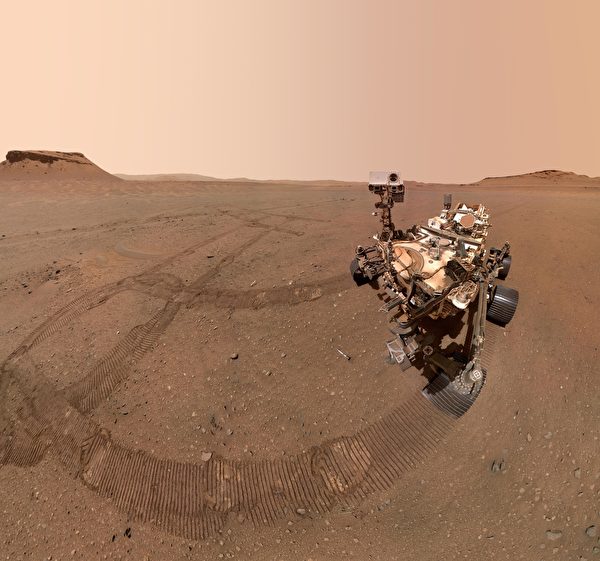
Despite humanity has not yet set foot on Mars, robotic rovers are continuing to expand the footprint of human exploration in the universe. The U.S. National Aeronautics and Space Administration (NASA) announced on Monday, October 12, that its six-wheeled Perseverance rover has set a historic record for the longest distance traveled on a celestial body outside of Earth.
As of Sunday, October 11 (day 2,006 of the mission), Perseverance reached 28.10 miles (45.22 kilometers) after covering a crucial distance of 299.6 feet (91.31 meters) on that day, surpassing the previous record holder Opportunity rover’s 28.06 miles (45.16 kilometers) set between 2004 and 2018.
Perseverance landed on Mars on February 18, 2021, and completed the distance in about four years and eight months, much faster than the nearly 15 years it took the Opportunity rover to achieve a similar feat. This record not only surpasses Mars milestones but also exceeds the driving distance of all lunar rovers in history, including the Soviet Lunokhod 2 (24.2 miles) and the Apollo 17 lunar rover (22.2 miles).
Perseverance’s efficient propulsion is attributed to its powerful AutoNav autonomous navigation system. Unlike earlier Mars rovers, Perseverance is equipped with a Vision Compute Element co-processor that captures stereoscopic images of the terrain ahead, creates 3D obstacle maps, and autonomously plans the safest route while driving.
The team considers this “walk-and-think” ability a crucial advancement – while earlier Mars rovers had to stop and “think” after each segment, Perseverance can process 600,000 data points with each glance and propel at nearly full speed, achieving a record of covering 412 meters in a single day.
According to NASA statistics, over 90% of Perseverance’s driving distance is autonomously completed by AutoNav. In contrast, the original Opportunity and Spirit rovers had only about 5% autonomous driving. Mark Maimone, deputy lead of the Perseverance rover’s robotic operations team, mentioned that since gaining autonomous decision-making capabilities, the rover’s driving performance has improved significantly. Additionally, with continuous software upgrades, Perseverance can now correct its position while comparing satellite orbit maps, reducing unnecessary steering and significantly lowering mechanical wheel wear.
At the time of breaking the record, Perseverance was passing through an area of Jezero Crater known as “Lac de Charmes,” heading towards a location called “Idubi.” This region preserves some of the oldest terrains in the solar system, as similar features on Earth have long been eroded due to natural processes.
In addition to the driving distance milestone, Perseverance’s scientific achievements have been abundant. Steven Lee, project manager for the NASA Perseverance and Curiosity rovers, highlighted the rover’s significant discovery of potential “biosignatures” in a rock formation called “Cheyava Falls,” hinting at possible traces left by ancient microbial life.
However, the scientific team emphasizes that these indicators of life traces are preliminary and await confirmation through future Mars sample return missions, which will bring samples back to Earth for laboratory analysis.
Currently, Perseverance’s hardware and power systems are in excellent condition, with scientists estimating its potential to cover over 100 kilometers. NASA has approved extending its mission until the end of 2028, during which it will continue to explore south along the crater’s rim towards “Rainbow Falls,” delving into research on ancient crust and geothermal systems formed about 4 billion years ago by impact events.